
The invention discloses an AI thermal imaging all-weather intelligent monitoring method
An intelligent monitoring and thermal imaging technology, applied in the field of thermal imaging, can solve the problems of lack of intelligent algorithm deployment and high false alarm probability, etc., and achieve the effect of excellent loss function, lower false positive rate, and improve accuracy
- Summary
- Abstract
- Description
- Claims
- Application Information
AI Technical Summary
Problems solved by technology
Method used
Image

Examples
Embodiment 1
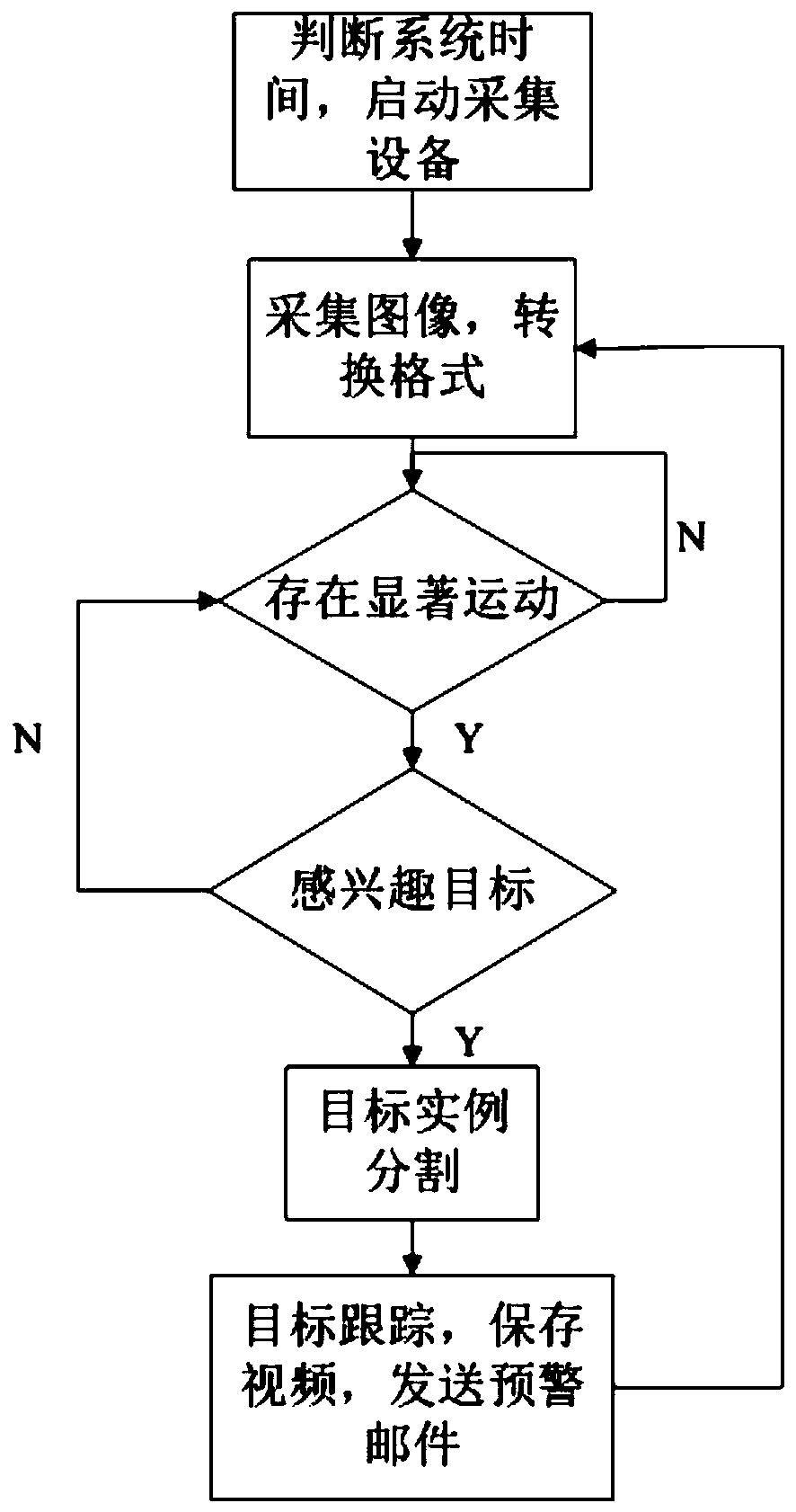
[0059] In the AI thermal imaging all-weather intelligent monitoring method provided by a preferred embodiment of the present invention, the motion detection algorithm in S3 is a PBAS motion detection algorithm, and its workflow is as follows:
[0060] S31: Collect the pixels and gradient magnitudes of the previous N frames as the background model, and compare the newly arrived pixels with the background model. The comparison method is as follows:
[0061]
[0062] In the formula, I(xi) is the input, Bk(xi) represents the pixels in the background model, R(xi) represents the pixel threshold, min represents the minimum number of matches, and F(xi)=1 represents the foreground;
[0063] The judgment threshold R(xi) is calculated by the following formula:
[0064]
[0065] In the formula, Dk(xi) is the average value of the N minimum values of the input pixel.
[0066] After the moving target is detected, in order to eliminate noise and light and shadow interference, confi...
Embodiment 2
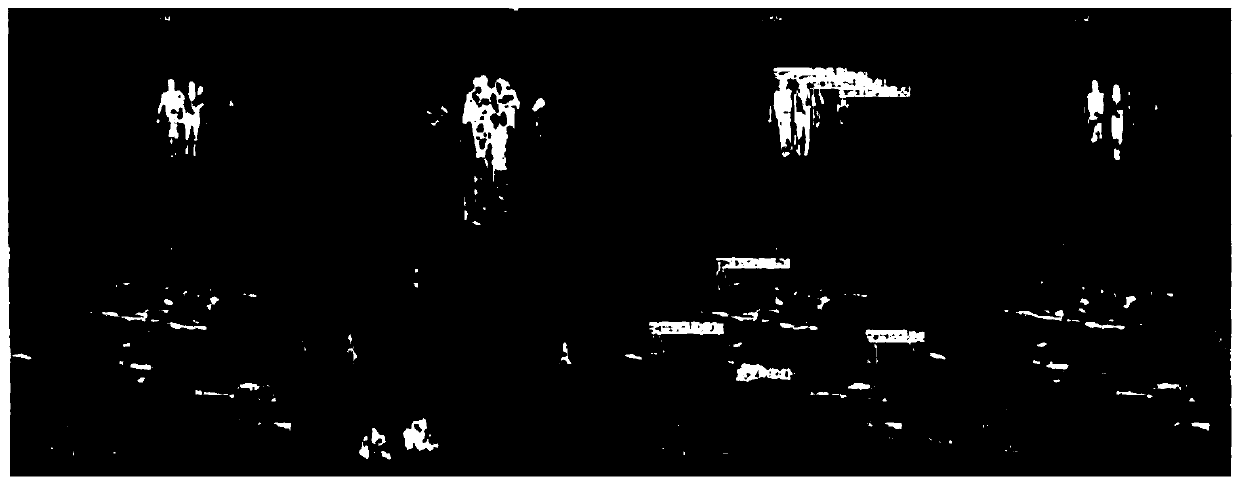
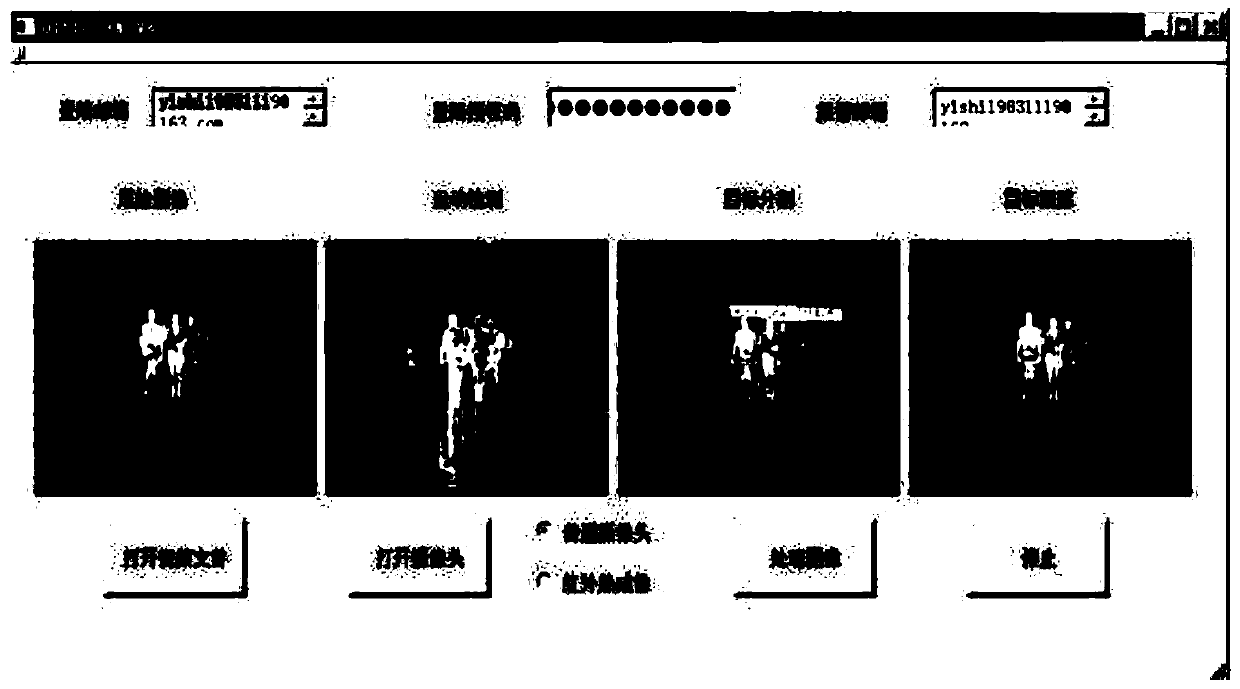
[0069] In this embodiment, on the basis of Embodiment 1, the target of interest is segmented in S4 using the MASK-RCNN segmentation framework based on deep learning technology in artificial intelligence, and its workflow is: S41: Select the following for video images with significant motion Targets of interest are segmented: pedestrians, cars, trucks, motorcycles, bicycles and boats, and the segmentation threshold is set to 0.6; S42: Use the non-maximum suppression algorithm (NMS) to eliminate redundant segmentation windows and find the best target segmentation position.
Embodiment 3
[0071] In this embodiment, on the basis of Embodiment 2, the single or multi-target tracking workflow in S5 is:
[0072] S51. Determine the number of currently segmented targets of interest, and start the tracking mode as a single target or multiple targets. The reason why the target tracking link is performed is that the target segmentation speed is slow, and it is difficult to ensure the real-time performance of the system. Therefore, save the early warning video and switch to target tracking mode;
[0073] S52. Use the high-performance target tracking algorithm CSR-DCF, which is a tracking algorithm based on correlation filtering, which is improved by using the "spatial confidence" method; its main idea is to use the image segmentation method to generate better adaptability. Mask, the spatial confidence map is obtained by solving the posterior probability; the posterior probability of the target is solved, as shown in the following formula:
[0074]
[0075] In the form...
PUM
 Login to View More
 Abstract
Description
Claims
Application Information
 Login to View More