
A single letter positioning method with a global convergence
An underwater vehicle, convergence technology, applied in satellite radio beacon positioning systems, instruments, navigation and other directions, can solve problems such as initial position error and large position error of underwater vehicle
- Summary
- Abstract
- Description
- Claims
- Application Information
AI Technical Summary
Problems solved by technology
Method used
Image

Examples
Embodiment 1
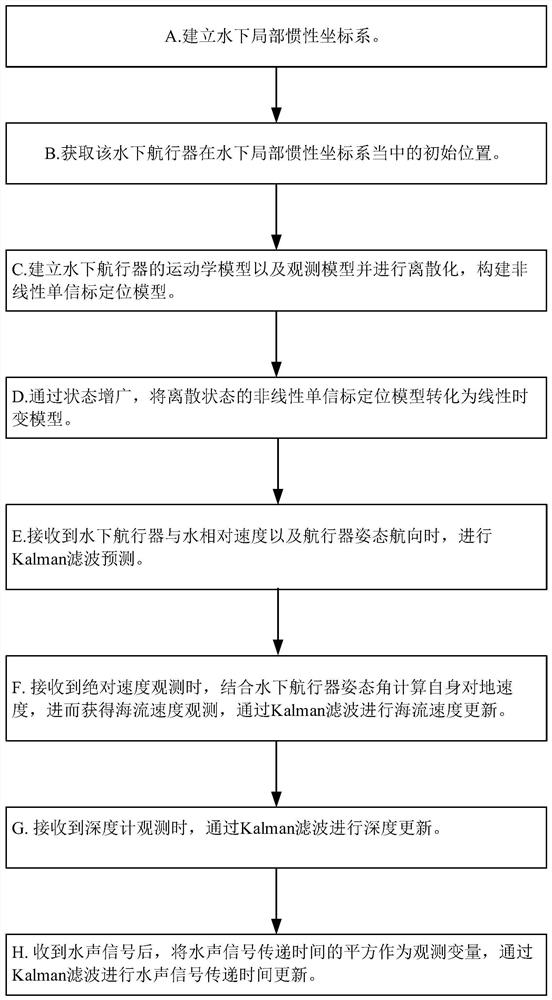
[0161] Embodiment 1, see attached figure 1 , a single-beacon positioning method for underwater vehicles with global convergence. The underwater vehicle is equipped with hydrophones, Doppler velocimeters, depth gauges, attitude and heading reference systems, and GPS; broadcasting an underwater acoustic signal; the method comprising the steps of:
[0162] A. Take any point in the positioning area as the origin, and set the east, north, and sky directions as x, y, and z axes respectively to establish an underwater local inertial coordinate system.
[0163] B. Obtain the initial position of the underwater vehicle in the underwater local inertial coordinate system through the equipped GPS.
[0164] C. Establish and discretize the kinematics model and observation model of the underwater vehicle, and construct a nonlinear single-beacon positioning model.
[0165] The establishment method of the kinematic model is as follows:
[0166] Define the position vector as:
[0167] p=[x y...
Embodiment 2
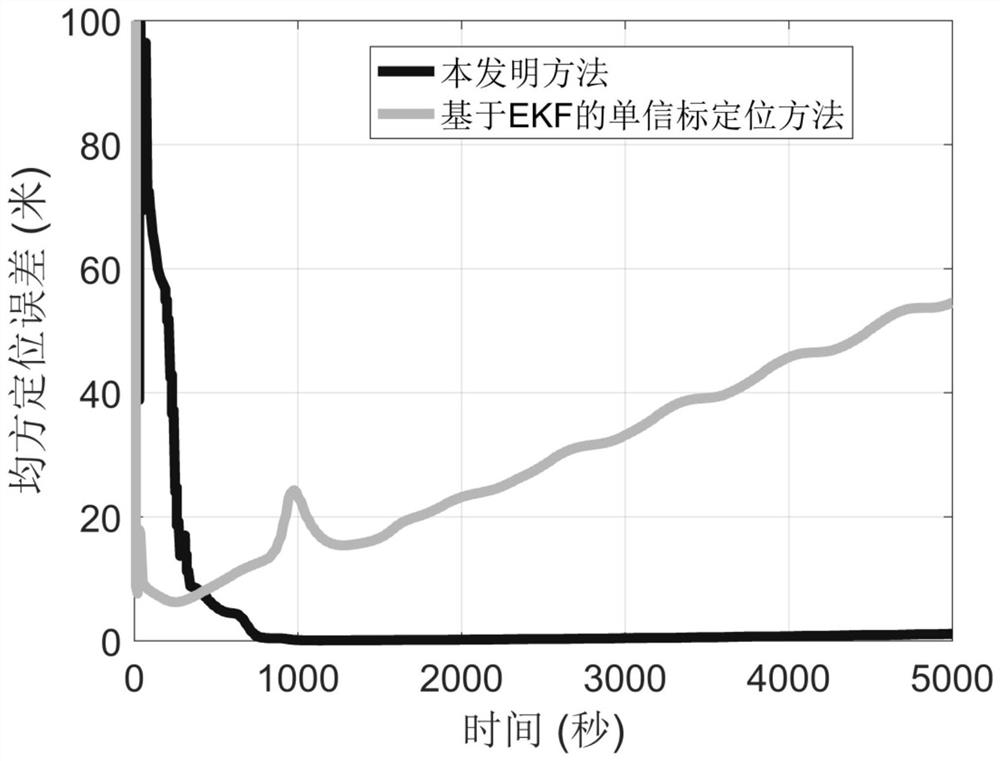
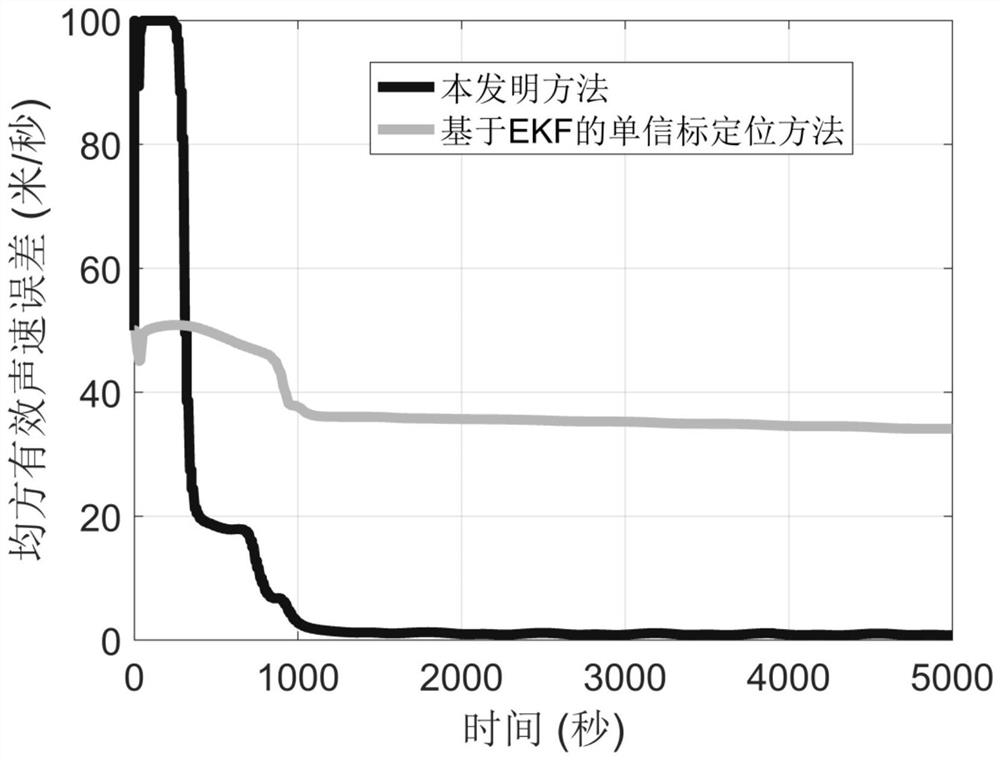
[0310] Embodiment 2, the method described in Embodiment 1 is verified by simulation data.
[0311]As a comparison, this embodiment also shows the positioning results of the traditional underwater single-beacon positioning method based on the extended Kalman filter (EKF) for position calculation. The overall simulation time is 5000 seconds, and the simulated effective speed of sound is constant at 1500 m / s during the whole movement process. The simulated ocean current speeds in three directions are -0.1 m / s, 0.2 m / s and 0.1 m / s respectively. The simulated underwater acoustic signal transmission period is 10 seconds, that is, the underwater acoustic signal transmission time update period is 10 seconds. The sampling period of the simulated Doppler speedometer, attitude and heading reference system and depth gauge is 0.1 second (equivalent to 10Hz sampling frequency), that is, the system discrete period, ocean current velocity update period and aircraft depth update period are all...
PUM
 Login to View More
 Abstract
Description
Claims
Application Information
 Login to View More