
Generation and monitoring device of turbidity flow derived from slope collapse
A monitoring device and technology of turbidity flow, which is applied in the field of sediment hydrodynamic model test, can solve the problems of damage to measuring instruments by derivative turbidity flow, failure to consider the entrainment of sediment erosion by derivative turbidity flow, and the difference in results, etc. Low, good integrity, and ingenious device structure
- Summary
- Abstract
- Description
- Claims
- Application Information
AI Technical Summary
Problems solved by technology
Method used
Image

Examples
Embodiment Construction
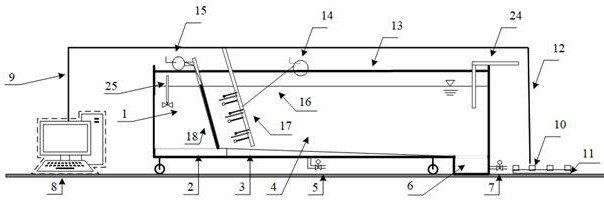
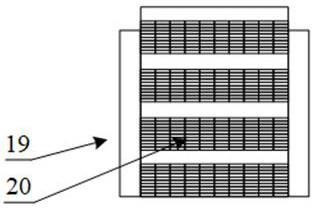
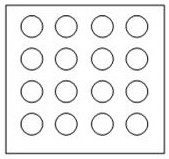
[0027] Such as figure 1 As described above, the present invention is divided into a breakdown landslide water tank 4 and a buffer grit chamber 6, and the bottom of the breakdown landslide water tank 4 is placed with a simulated bed horizontal section 2 and an inclined section 3 . The drain valve 5 is set in the collapsed landslide tank. Sand piles 1 with uniform fine-grained diameters are stacked in the collapsed landslide tank, and the stacking of the sand piles requires the assistance of a vibrating compactor 25 and an adjustable bottom slope 18 . Place measuring rod 17 in the described breakdown landslide water tank. The measuring rod is equipped with UPV (ultrasonic velocity profiler 21), CCM (conductivity concentration meter 23) and siphon tube 22, and the combination of the three obtains high-frequency derived turbidity flow velocity and concentration profile data, see Figure 4 . The side wall of the buffer grit chamber is provided with a drainage valve 7, and the up...
PUM
 Login to View More
 Abstract
Description
Claims
Application Information
 Login to View More