Multi-target detection method based on convolutional neural network
A convolutional neural network and detection method technology, applied in neural learning methods, biological neural network models, neural architectures, etc., can solve problems such as insufficient detection accuracy of small targets, and achieve improved accuracy, improved algorithm accuracy, and good fusion features. Effect
- Summary
- Abstract
- Description
- Claims
- Application Information
AI Technical Summary
Problems solved by technology
Method used
Image



Examples
Embodiment 1
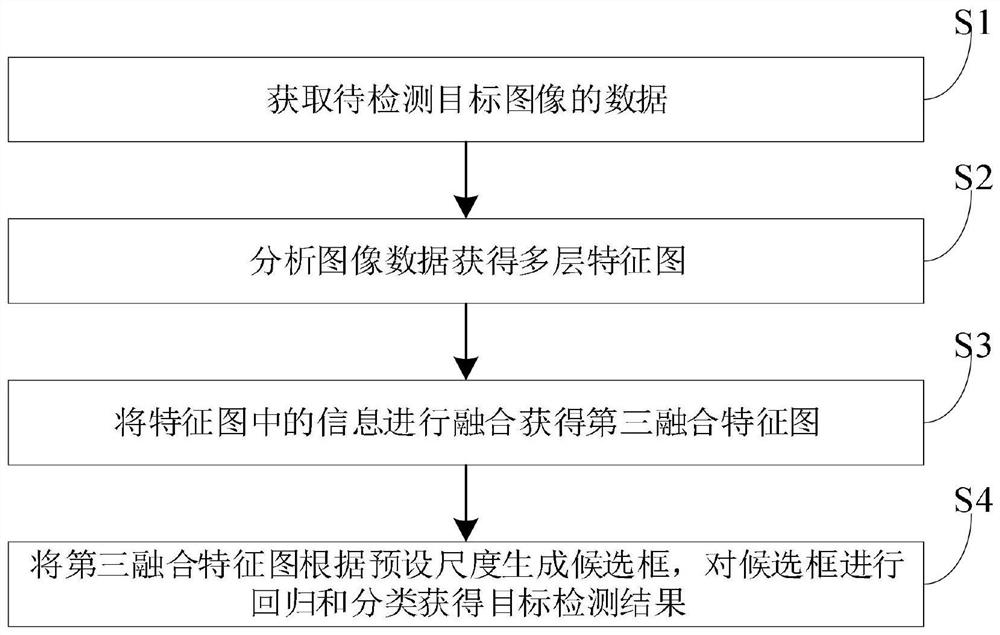
[0026] Refer to attached figure 1 , a kind of multi-target detection method based on convolutional neural network that the present invention proposes, comprises the following steps:
[0027] Step S1: Acquiring image data of the target to be detected;
[0028] In the embodiment of the present invention, the multi-target detection method is applied to the industrial camera interface image acquisition platform, and the industrial camera is used to collect image data to realize multi-target detection, which makes the application range and environment more extensive.
[0029] Step S2: Extract image data to obtain multi-layer feature maps.
[0030] In the embodiment of the present invention, the yolov5 detection framework is selected as the improved benchmark model. After the industrial camera acquires the image data, the image data is spliced by random zooming, random cutting, random arrangement, etc., to enrich the detection data set.
[0031] Using the backbone network in the...
Embodiment 2
[0037] Based on step S3 of Embodiment 1, the embodiment of the present invention provides a gated spatial pyramid cavity convolutional network, the structure of which is as follows figure 2 As shown, it includes: input layer 101, gating mechanism 102, first convolution 103, second convolution 104, third convolution 105, fourth convolution 106, connection unit 107, fifth convolution 108 and output layer 109.
[0038] The input layer 101 inputs the feature maps into the gating mechanism 102, the first convolution 103, the second convolution 104, the third convolution 105 and the fourth convolution 106, respectively. The outputs of the four convolutions are respectively multiplied by the output of the gating mechanism 102 , and then the multiplication results are connected through the connection unit 107 . The purpose of the fifth convolution 108 is to adjust the number of output channels, so that the output result of the connection unit 107 outputs the first fusion feature map...
Embodiment 3
[0041] Based on step S3 of embodiment 1, after obtaining the second fusion feature map, the present invention introduces an attention mechanism; refer to Figure 4 , the attention mechanism network includes: a second global pooling layer 301 , a seventh convolution 302 , a second activation function 303 , an eighth convolution 304 and a third activation function 305 . The input data undergoes global average pooling through the second global pooling layer 301, and then performs channel compression through the seventh convolution 302, activates with the second activation function 303, restores the number of channels through the eighth convolution 304, and finally uses the third activation Function 305 generates final channel weights and outputs the result. In this embodiment, the seventh convolution 302 and the eighth convolution 304 are pointwise convolutions with a size of 1×1, the second activation function uses the Hardswish function, and the third activation function uses t...
PUM
 Login to View More
 Abstract
Description
Claims
Application Information
 Login to View More
 - R&D
- Intellectual Property
- Life Sciences
- Materials
- Tech Scout
- Unparalleled Data Quality
- Higher Quality Content
- 60% Fewer Hallucinations
Browse by: Latest US Patents, China's latest patents, Technical Efficacy Thesaurus, Application Domain, Technology Topic, Popular Technical Reports.
© 2025 PatSnap. All rights reserved.Legal|Privacy policy|Modern Slavery Act Transparency Statement|Sitemap|About US| Contact US: help@patsnap.com