Check patentability & draft patents in minutes with Patsnap Eureka AI!

Weld joint appearance prediction method based on improved adaptive fuzzy neural network

A fuzzy neural network, adaptive fuzzy technology, applied in biological neural network models, neural architectures, computational models, etc.

Active Publication Date: 2021-08-03
BEIHANG UNIV
View PDF6 Cites 4 Cited by
  • Summary
  • Abstract
  • Description
  • Claims
  • Application Information

AI Technical Summary

Problems solved by technology

[0005] In order to solve the fitting problem between welding parameters and weld appearance dimensions, the present invention provides a robot welding weld seam shape prediction method based on improved self-adaptive fuzzy neural network

Method used

the structure of the environmentally friendly knitted fabric provided by the present invention; figure 2 Flow chart of the yarn wrapping machine for environmentally friendly knitted fabrics and storage devices; image 3 Is the parameter map of the yarn covering machine
View more

Image

Smart Image Click on the blue labels to locate them in the text.
Viewing Examples
Smart Image
  • Weld joint appearance prediction method based on improved adaptive fuzzy neural network
  • Weld joint appearance prediction method based on improved adaptive fuzzy neural network
  • Weld joint appearance prediction method based on improved adaptive fuzzy neural network

Examples

Experimental program
Comparison scheme
Effect test

Embodiment 1

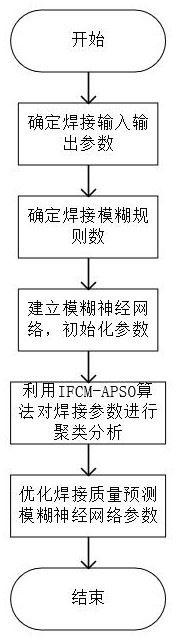
[0072] The first embodiment of the present invention relates to a shape prediction method based on an improved self-adaptive fuzzy neural network, the process of which is as follows figure 2 As shown, the specific steps are as follows:

[0073] Step 1: Initialize the fuzzy neural network for weld shape prediction, and determine the welding fuzzy rules;

[0074] Step 2: Determining the input welding parameter variables of the fuzzy neural network and the output of the fuzzy neural network;

[0075] Step 3: Calculate the welding parameter membership degree of each welding parameter variable according to the welding fuzzy rules determined in step 1;

[0076] Step 4: Use the fusion algorithm based on Intuitive Fuzzy C-Means Clustering (IFCM) and Adaptive Inertia Weighted Particle Swarm Optimization (APSO) to optimize and calculate the unknown parameters in the membership degree of welding parameters, and obtain the welding parameter membership degree of each welding parameter va...

Embodiment 2

[0081] Further, the second embodiment of the present invention relates to a weld shape prediction method based on an improved adaptive fuzzy neural network, which specifically includes the following steps:

[0082] Step 1: Initialize the fuzzy neural network for weld shape prediction, and determine the welding fuzzy rules;

[0083] Use if-then definition rules to describe the weld shape prediction fuzzy neural network. Specifically, the weld shape prediction fuzzy neural network in step 1 can be defined by the following "if-then" rules:

[0084]

[0085] in, is the first Welding Fuzzy Rules, , is the number of welding fuzzy rules; is the welding parameter variable First a fuzzy subset; is the input welding parameter variable, and ; is the number of input welding parameter variables, is the first The output of fuzzy rules, where is the weight coefficient.

[0086] Step 2: Determining the input welding parameter variables of the fuzzy neural network ...

Embodiment 3

[0144] The accuracy and applicability of a fuzzy neural network largely depends on the available training data set, the larger the data set, the wider the input range it covers and the better the resulting network. In order to compare the predictive performance of the patented algorithm, the present invention conducted a welding test on a 3mm thick titanium alloy steel plate, and generated 250 data sets by changing the process parameters. 200 of them are randomly selected for the training of the fuzzy neural network, and the remaining 50 are used for testing the fitting degree of the network; two independent fuzzy neural network models are established, which are respectively used for the prediction of welding width and welding height data. Such as Figure 4Shown are the shape parameters of a typical T-weld.

[0145] According to the input and output dimensions of the training samples, the fuzzy neural network determines the number of input nodes to be 4 and the number of outp...

the structure of the environmentally friendly knitted fabric provided by the present invention; figure 2 Flow chart of the yarn wrapping machine for environmentally friendly knitted fabrics and storage devices; image 3 Is the parameter map of the yarn covering machine
Login to View More

PUM

No PUM Login to View More

Abstract

The embodiment of the invention provides a weld joint appearance prediction method based on an improved adaptive fuzzy neural network. The method comprises the steps: initializing a weld joint appearance prediction fuzzy neural network, and determining a welding fuzzy rule; determining a welding parameter variable input by the fuzzy neural network and a fuzzy neural network output quantity; calculating a welding parameter membership degree of each welding parameter variable; optimizing and calculating unknown parameters in a welding parameter membership function by using a fusion algorithm based on an intuitionistic fuzzy C-means clustering (IFCM) and an adaptive inertial weight particle swarm optimization (APSO) algorithm to obtain the welding parameter membership degree of each welding parameter variable; performing fuzzy calculation according to the welding parameter membership degree of each input variable; and predicting output values of the weld width and the weld height. According to the prediction method provided by the invention, the labor cost is reduced, the accuracy of welding result prediction is effectively improved, and the problem that a traditional fuzzy neural network easily falls into a local minimum point in a training process is solved.

Description

technical field [0001] The invention relates to the field of robot welding, in particular to a method for predicting the shape of a weld seam based on an improved self-adaptive fuzzy neural network, and to a method for predicting the shape of a robot welding seam. Background technique [0002] The quality of welding directly affects the machining accuracy and service life of welded parts. In the welding process, there are many factors affecting the welding quality. The welding quality inspection of titanium alloy mainly includes the compactness, physical properties, mechanical properties, welding defects and appearance dimensions of the welded joint. The abnormal fluctuation of welding parameters, the vibration of the mechanical arm, the selection of welding parameters by welding workers and the operation specifications of welding equipment will all affect the final welding quality. In the existing processing plants, the welder usually sets the welding parameters and uses t...

Claims

the structure of the environmentally friendly knitted fabric provided by the present invention; figure 2 Flow chart of the yarn wrapping machine for environmentally friendly knitted fabrics and storage devices; image 3 Is the parameter map of the yarn covering machine
Login to View More

Application Information

Patent Timeline
no application Login to View More
Patent Type & Authority Applications(China)
IPC IPC(8): B23K37/00B23K37/02B25J9/16G06K9/62G06N3/00G06N3/04
CPCB23K37/00B23K37/0252G06N3/006G06N3/04B25J9/161B25J9/1664B25J9/1679G06F18/23213G06F18/214G06F18/241
Inventor 陶永兰江波高赫温宇方任帆江山
Owner BEIHANG UNIV
Features
  • R&D
  • Intellectual Property
  • Life Sciences
  • Materials
  • Tech Scout
Why Patsnap Eureka
  • Unparalleled Data Quality
  • Higher Quality Content
  • 60% Fewer Hallucinations
Social media
Patsnap Eureka Blog
Learn More