
Multipoint harmonic responsibility division method
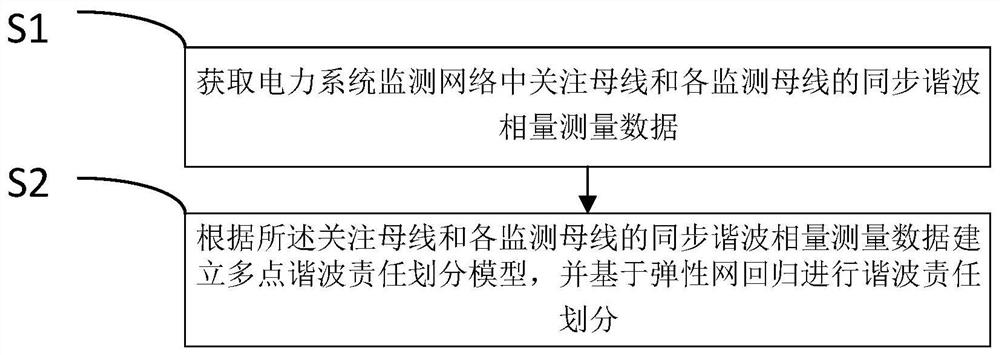
A harmonic and responsibility technology, applied in the field of multi-point harmonic responsibility division, can solve problems such as inability to divide harmonic responsibility, and achieve accurate estimation, good accuracy, robustness, adaptability and robustness.
- Summary
- Abstract
- Description
- Claims
- Application Information
AI Technical Summary
Problems solved by technology
Method used
Image

Examples
Embodiment 1
[0081] Verified by IEEE30 node system, such as image 3 shown. In the study, buses 2, 5, 7, 8 and 21 are considered as non-linear loads, which are modeled with a current source model. The harmonic spectrum is shown in Table 1. This simulation case focuses on the analysis of the 5th harmonic problem. The harmonic current amplitude and phase of the harmonic source are adjusted according to the fundamental current vector.
[0082] Table 1
[0083]
[0084]
[0085] In the simulation case, the responsibility of the harmonic measurement current to buses 3, 7, and 21 is analyzed. In order to consider the fluctuation of the actual power system, it is assumed that the network load fluctuates randomly within the range of ±10% of the fundamental power. A total of 1000 simulated data were generated for each case, and a measurement error of ±0.5% was randomly added to each set of simulated data.
[0086] Since in the actual monitoring system, the load type contained in the moni...
) example 1
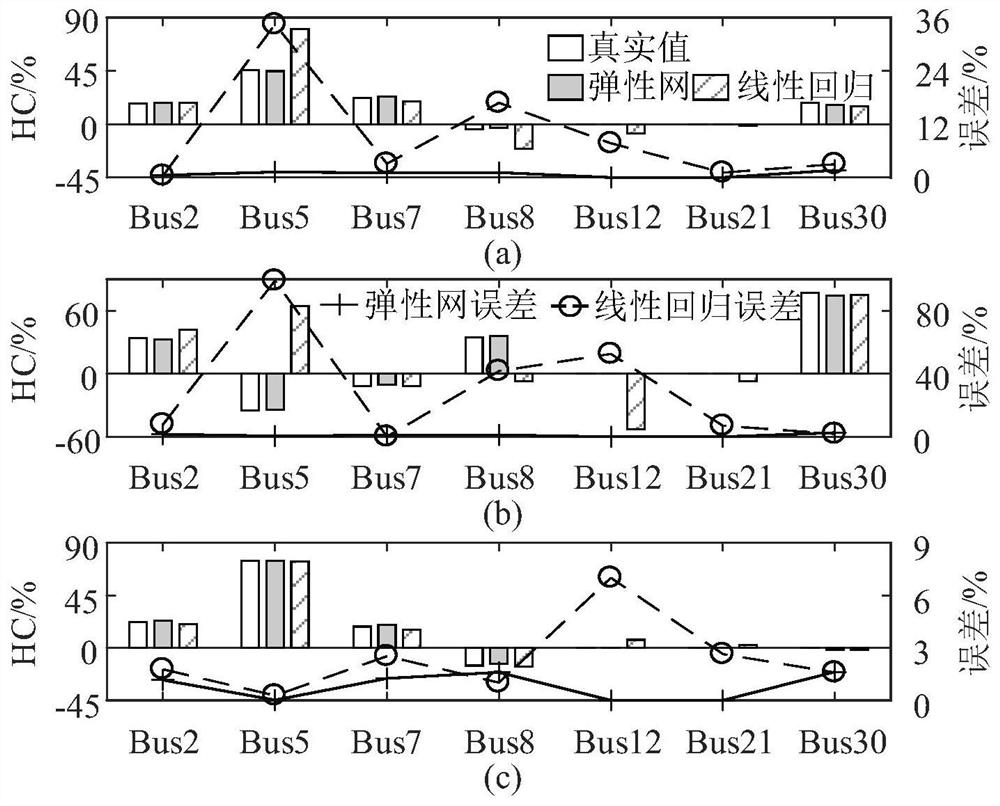
[0087] 1) Case 1: The monitoring buses are 2, 5, 7, 8, 15, 19 and 21, including all harmonic sources and some linear load buses of the system;
[0088] 2) Case 2: Harmonic sources 12 and 30 are added, and the monitoring bus is the same as Case 1;
) example 3
[0089] 3) Case 3: The monitored bus contains all the harmonic sources in Case 2, and harmonic sources 2 and 7 are significantly correlated.
[0090] In these simulation cases, the proposed method is compared with the multiple linear regression method, where the actual responsibility of each harmonic source is calculated using the actual harmonic impedance of the harmonic source relative to the bus C of interest.
[0091] 1) Case 1: The harmonic currents of all monitored buses and the harmonic voltages of bus C are used to estimate the harmonic liability. In this case there are no background harmonics, a preliminary analysis of the measured data is performed first:
[0092] a. Before adding the measurement error to the simulated data, X has 7 columns, but its rank is 5. That is, the measured harmonic currents are completely multicollinear. After adding the measurement error, X becomes full rank.
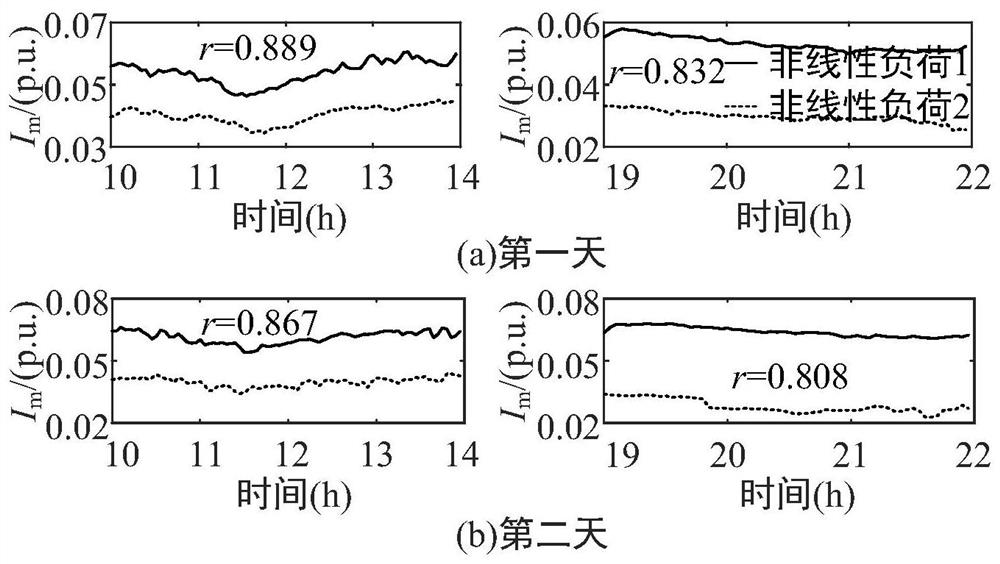
[0093] b. The Pearson correlation coefficient of the measured data is shown in...
PUM
 Login to View More
 Abstract
Description
Claims
Application Information
 Login to View More