
Lidar system for wind measurement
A technology of lidar, wind power, applied in the field of measurement process
- Summary
- Abstract
- Description
- Claims
- Application Information
AI Technical Summary
Problems solved by technology
Method used
Image

Examples
Embodiment Construction
[0053] For the sake of clarity, the dimensions of elements shown in these figures do not correspond to real sizes or real size ratios. Furthermore, some of these elements are shown only symbolically, and the same references indicated in different figures designate the same or elements with the same function.
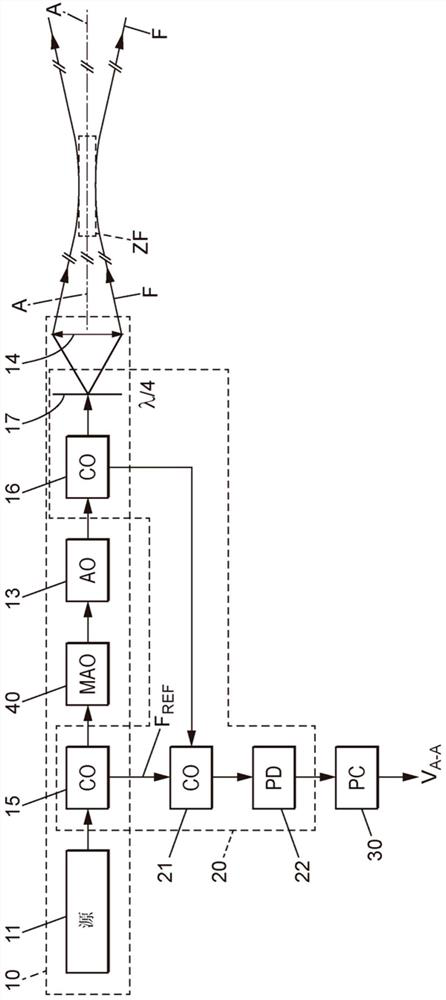
[0054] figure 1 The lidar system according to the invention shown in may consist of a continuous emission lidar system. It includes a laser emission source 10 , a heterodyne detection system 20 and a Doppler calculation module 30 .
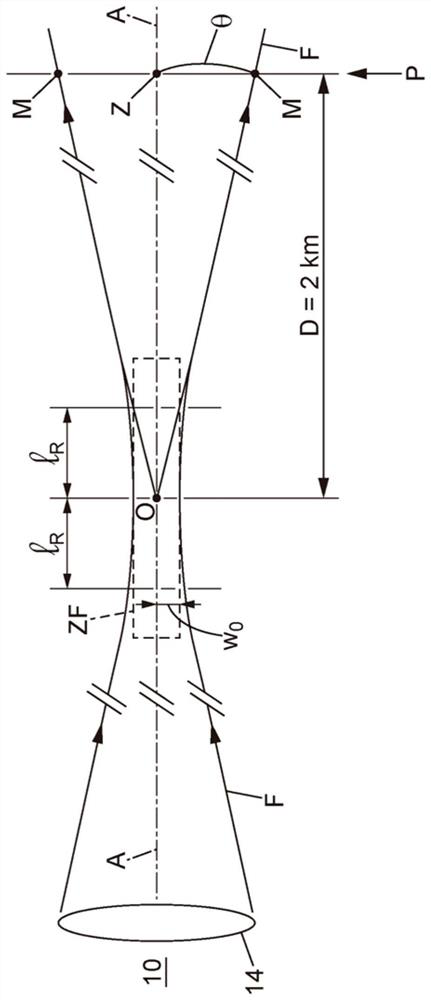
[0055] The laser emitting source 10 may include an initial laser source 11 (labeled source), an optical amplifier 13 (labeled AO), and an optical outlet 14 . The laser emission source 10 is therefore designed to generate a laser beam F with a converging beam structure in the spatial region behind the optical outlet 14 . In this way, the transverse cross-section of the beam F with the optical axis A-A decreases between the optical exit 14 ...
PUM
 Login to View More
 Abstract
Description
Claims
Application Information
 Login to View More