The current high-rise fire extinguishing is mainly carried out by firefighters erecting fire ladders, but ordinary fire ladders can only reach tens of meters, limited by the working height and
work space, it is difficult to effectively control and extinguish complex high-rise fires, and A fire ladder
truck often costs several million yuan
[0003] Countries around the world have developed a variety of UAV fire extinguishing solutions to extinguish high-rise fires. One of them is to carry fire extinguishing materials by UAVs for high-rise fire extinguishing. Due to the limitation of UAV load and
battery capacity, it cannot carry enough at one time. The fire extinguishing materials are used to extinguish the fire, the fire extinguishing range is very limited, and the working time is limited. The
drone has to take off and land many times to carry new fire extinguishing materials to extinguish the fire. Not only is time wasted, but the extinguished fire may also rekindle during this period
[0004] The other is that a single UAV pulls the hose to extinguish the fire. It also has the problem of limited working time and repeated take-off and landing. There is also the problem that the size of the dragged hose is too small due to the limited load of the UAV, resulting in poor fire extinguishing effect. There is a problem that the
high gravity of the water belt leads to a low
flying height, and when the
drone pulls the water belt across a complex space, the hose is bent and knotted by obstacles, resulting in the interruption of the fire extinguishing agent delivery and the hose cannot continue to drag
verb: move
[0005] There are many defects in the existing UAV fire extinguishing invention, for example: in the
patent application number CN209956230U, the central position of the hose and the UAV is fixed, so that the UAV can only move in the vertical direction and cannot move on the horizontal plane. Moving, the water belt cannot be turned into a curve to cross obstacles to extinguish fire; each drone sprays water, resulting in a large demand for water and a
large size of the hose, resulting in the need for a large number of drones; when a local fire occurs When there is a danger of
deflagration, the drone in the middle cannot be evacuated in time because it is fixed with the water belt, so it is easy to burn. When a drone in the middle fails, it cannot be separated from the hose, which becomes a burden
[0006] In the patent with the application number CN106983978A, the UAV is parked on the roof of the fire
truck, which is easily damaged by the sun and rain, and the
parking area is limited and cannot carry many UAVs; the UAV on the spraying platform is fixed with the spray gun, causing the spray gun to only spray in a directional manner , or the spray gun can only be rotated in a
small range by adjusting the posture of the drone, and the
recoil of the spray gun in a fixed direction is easy to make the spraying platform tilt and unstable, and it is difficult to control. It is also equipped with an auxiliary pumping device, which undoubtedly increases the load. Its pipeline can move freely in the auxiliary platform. When the pipeline is tilted, the pipeline will slide under the action of gravity, which makes it difficult for the auxiliary platform to carry the pipeline; and as the working distance changes, it is necessary to repeatedly install or disassemble the pipeline close to the reel. Auxiliary platform UAVs lead to failure to extend or retract the pipeline in time, and consume a lot of time and easily damage the connection mechanism; each UAV is controlled by a
remote control, which not only requires a large number of
remote control personnel, but also requires a lot of
remote control personnel. It is difficult to remotely control the drones to keep a distance; the drones do not have self-spray protection and are easily burned by the fire
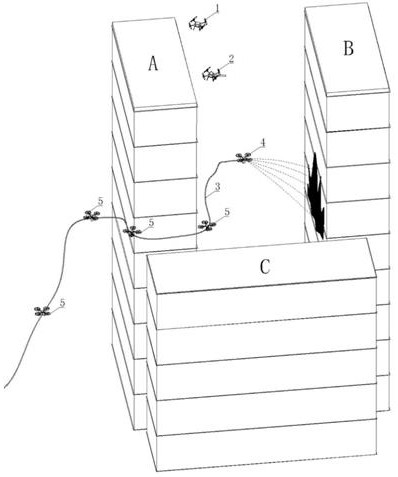
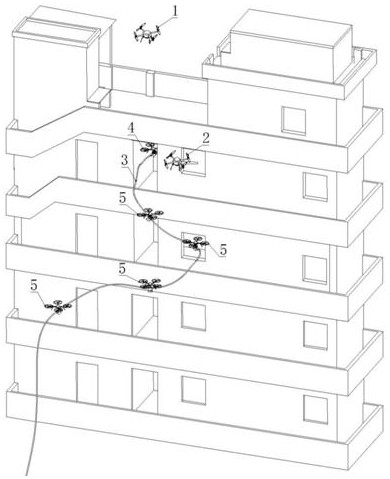
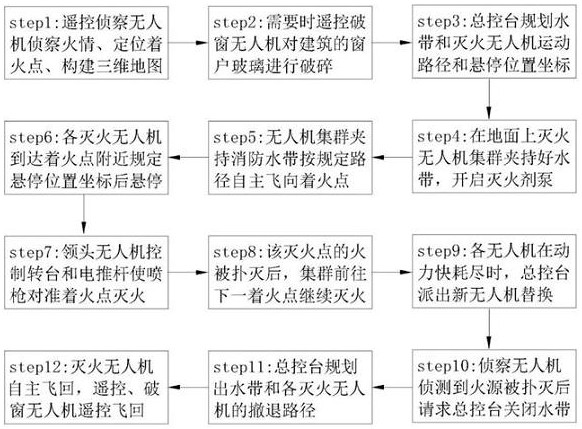
[0007] Fire extinguishing in high-rise buildings is still a worldwide problem. There are many problems in the existing concept of UAV fire extinguishing, which makes it difficult to apply it to actual fire rescue. Therefore, in order to solve this problem, a UAV cluster cooperative relay fire extinguishing
system in a complex space is designed. is very necessary


 Login to View More
  Login to View More