

Probe unit of microscope with atomic force and manufacturing method
A technology of atomic force microscope and manufacturing method, which is applied in the direction of measuring device, scanning probe technology, scanning probe microscopy, etc., can solve the problem of low orientation of carbon nanotubes, achieve uniform hole diameter, easy control of depth, and improve The effect of precision
- Summary
- Abstract
- Description
- Claims
- Application Information
AI Technical Summary
Problems solved by technology
Method used
Image

Examples
Embodiment Construction
[0018] The present invention will be further described in detail below in conjunction with the accompanying drawings.
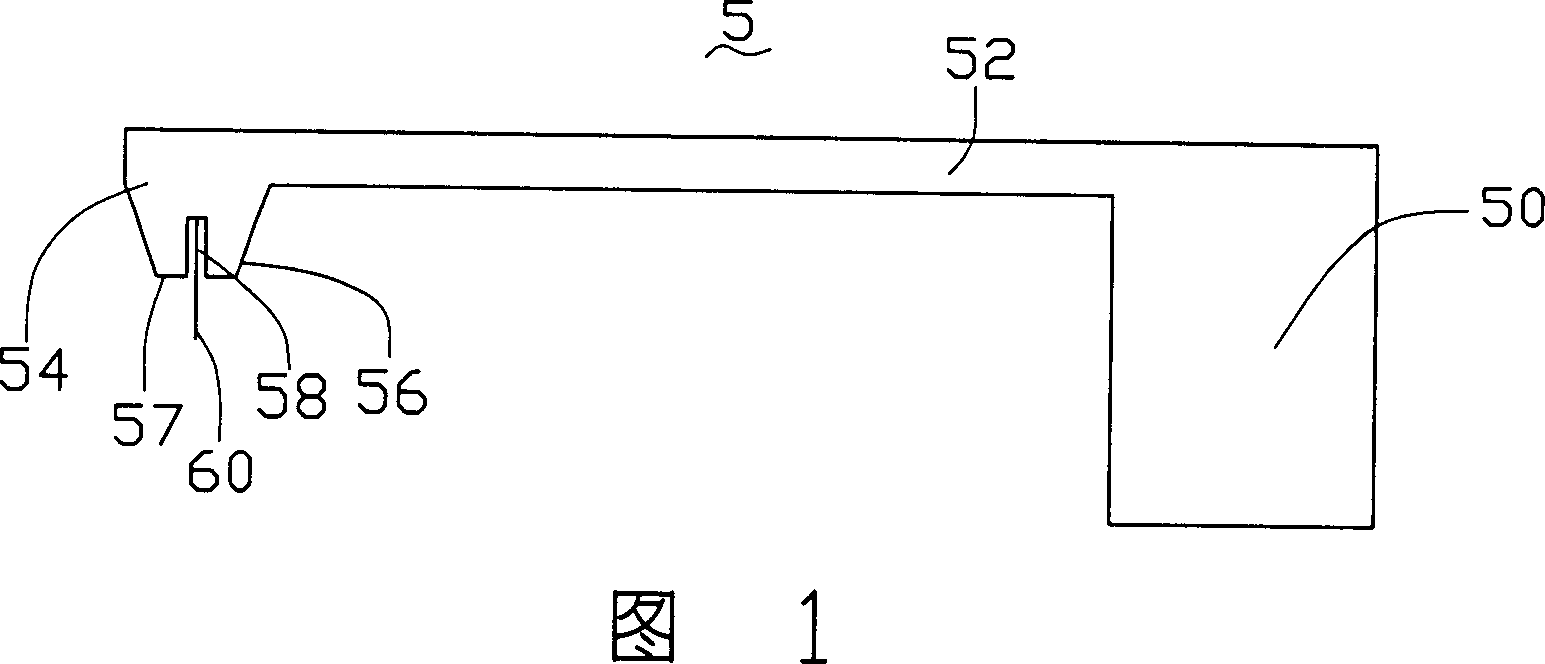
[0019] Please refer to Fig. 1, the AFM probe device 5 provided by the present invention includes: a probe base 50; a cantilever 52 fixed on the probe base 50 has an end 54; of carbon nanotubes 60 . Wherein, the top 56 of the cantilever end 54 forms a plane 57 , and the plane 57 has a hole 58 . Carbon nanotubes 60 grow out of the hole 58 and are substantially perpendicular to the plane 57 .
[0020] In this embodiment, the diameter of the hole 58 is preferably 20-100 nanometers. Cantilever 52 may be made of silicon nitride.
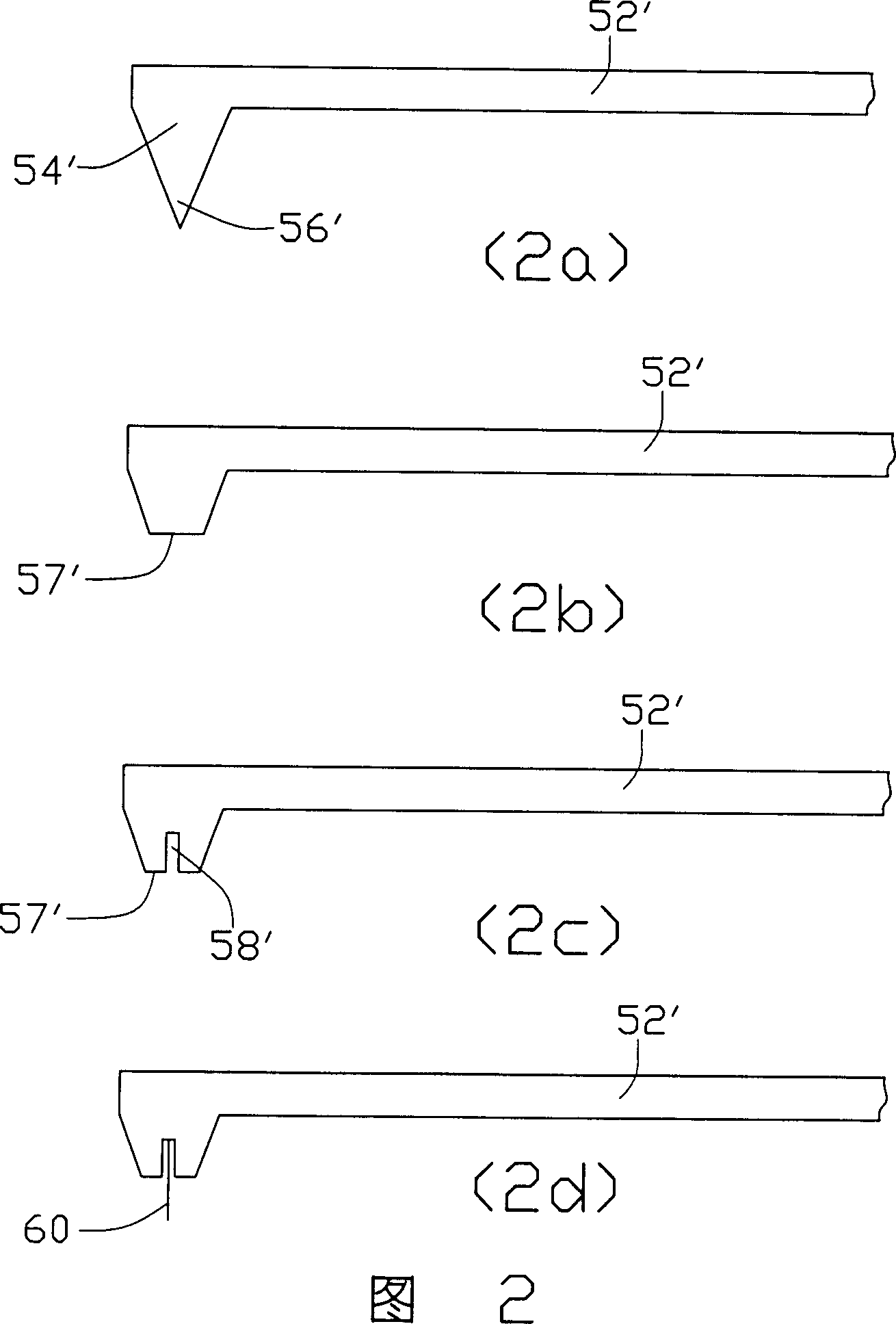
[0021] Please refer to FIG. 2, the manufacturing method 7 of the above-mentioned AFM probe device 5 provided by the present invention includes steps:
[0022] (2a) providing an AFM-usable cantilever 52' having a tipped end 54' having a pointed top 56';
[0023] (2b) A plane 57' can be formed on the top 56' of the end by cutting and...
PUM
| Property | Measurement | Unit |
|---|---|---|
| pore size | aaaaa | aaaaa |
Abstract
Description
Claims
Application Information
 Login to View More