Automated luminaire location identification and group assignment using light based communication for commissioning a lighting control system
a technology of automatic luminaire location identification and group assignment, which is applied in the direction of electroluminescent light sources, electrical light circuit arrangements, electrical apparatus, etc., can solve the problems of large time and labor expenditure on luminaire/networked device identification, loss/damage of physical media such as installation drawings (with ids attached), and achieve cost-effective effects of reducing manual efforts
- Summary
- Abstract
- Description
- Claims
- Application Information
AI Technical Summary
Benefits of technology
Problems solved by technology
Method used
Image



Examples
embodiment 500
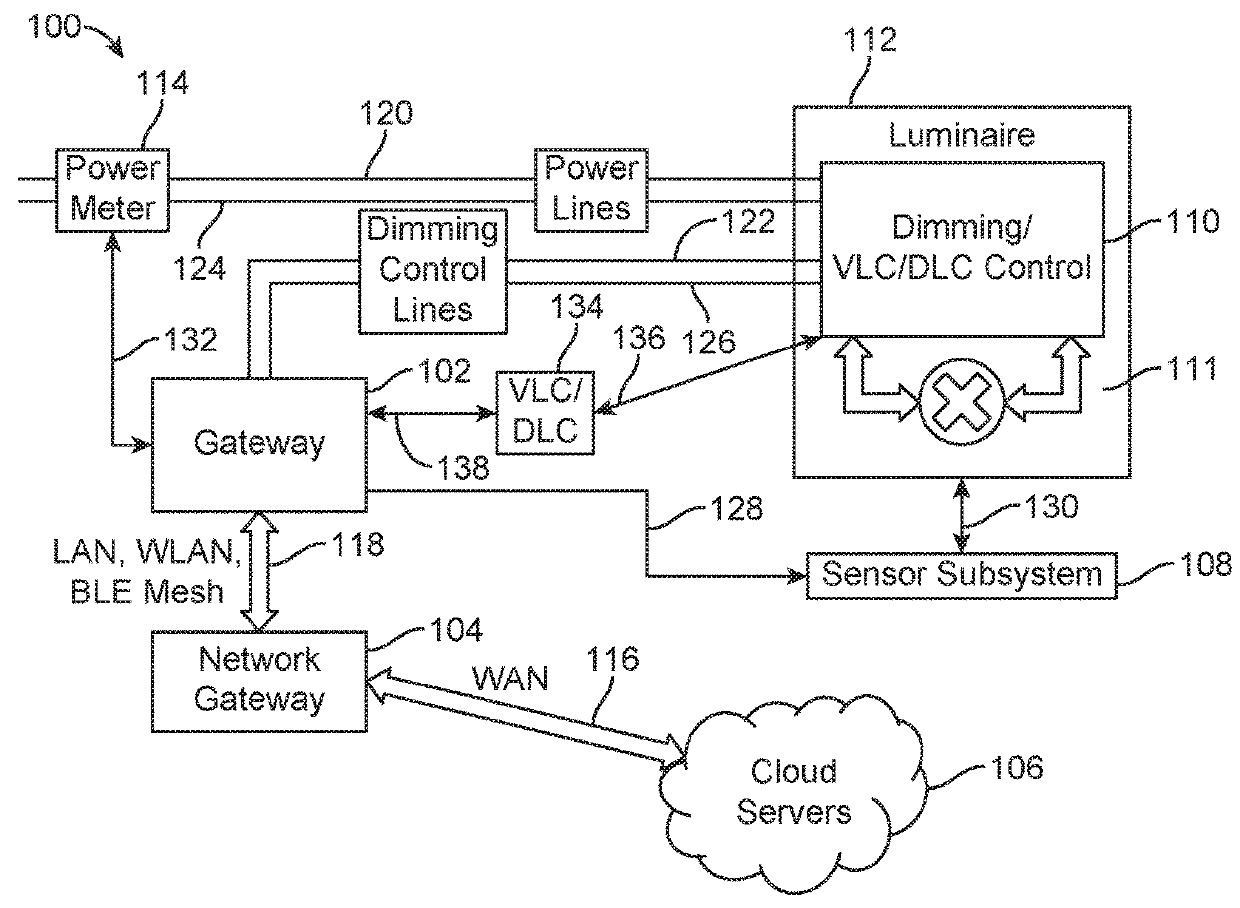
[0071]FIG. 5 illustrates an embodiment 500 of the power meter 114, which may be used in the system 100. Any known ‘power meter device consistent with this disclosure may be used. According to an aspect, the power meter 114 may be wirelessly or physically connected with and / or have physical connectivity within the USLG 102 (see, for example, FIG. 1). In one embodiment, the list of information that is communicated by the power meter 114 via the UART includes: RMS Voltage, Voltage THD, RMS current, Current THD, Active Power, Reactive power, Apparent power, Power factor, and Frequency. Various mixed signal microcontrollers 204, such as those sold by Texas Instruments under the Manufacturer's Code “MSP43012041” may be used by the system 100 and are able to communicate with the power meter 114.
[0072]In general, aspects of the present disclosure describe a method for automatic luminaire location identification and group assignment using light based communication / visual light communication ...
embodiment 700
[0076]FIG. 7 illustrates an embodiment 700 of a protocol list data structure 710 for the gateway 102. The data structure 710 may be designed such that it is easy to traverse the protocol options and pick the correct protocol during the discovery process. The protocol list includes N protocols, were N can be any number. In an embodiment, each protocol (X 702, Y 704, Z 706 . . . W 708) contains directives to the gateway 102 to setup the specific protocol interface (e.g., power level, specific line connections, and other required information as dictated by the protocol standard interface). Further, each protocol may contain a set of directives / actions numbered 1-N. The discovery process may use these directives to take actions like sending a message or changing the voltage level over the dimming control lines. According to an aspect, each action in the list is associated with a list of sensor measurement ranges, one per sensor and per power meter. These measurement ranges may be compar...
embodiment 800
[0077]FIG. 8 illustrates an embodiment 800 of the protocol discovery process 802. According to an aspect, at step 804, the protocol is determined from a list of protocols, as seen, for instance, in FIG. 7. At step 806, the process may include retrieving / taking / assuming a protocol from the list of protocols, and mark it as the “current protocol”. The current protocol may include a dimming control protocol. At step 808, the system may check if the entire list of protocols is finished. If the list is completed ‘Yes’, then the next step of operation goes to step 810, which may indicate that there has been a failure to identify a protocol. In an embodiment, when a current protocol that has passed all of the verifications correctly is found, proper identification of the protocol and / or the identification process will be successfully achieved. If the list is not finished, ‘No’, then the next step of operation may go to step 812. According to an aspect, at step 812, the system activates the...
PUM
 Login to View More
 Abstract
Description
Claims
Application Information
 Login to View More
 - R&D
- Intellectual Property
- Life Sciences
- Materials
- Tech Scout
- Unparalleled Data Quality
- Higher Quality Content
- 60% Fewer Hallucinations
Browse by: Latest US Patents, China's latest patents, Technical Efficacy Thesaurus, Application Domain, Technology Topic, Popular Technical Reports.
© 2025 PatSnap. All rights reserved.Legal|Privacy policy|Modern Slavery Act Transparency Statement|Sitemap|About US| Contact US: help@patsnap.com