
Medicament and apparatus for treating chronic kidney disease
a technology of kidney disease and medication, applied in the direction of antibody medical ingredients, instruments, drug compositions, etc., can solve the problems of increasing the frequency of advanced atherosclerotic lesion due to arterial calcification and concomitant decrease of gtr
- Summary
- Abstract
- Description
- Claims
- Application Information
AI Technical Summary
Benefits of technology
Problems solved by technology
Method used
Image

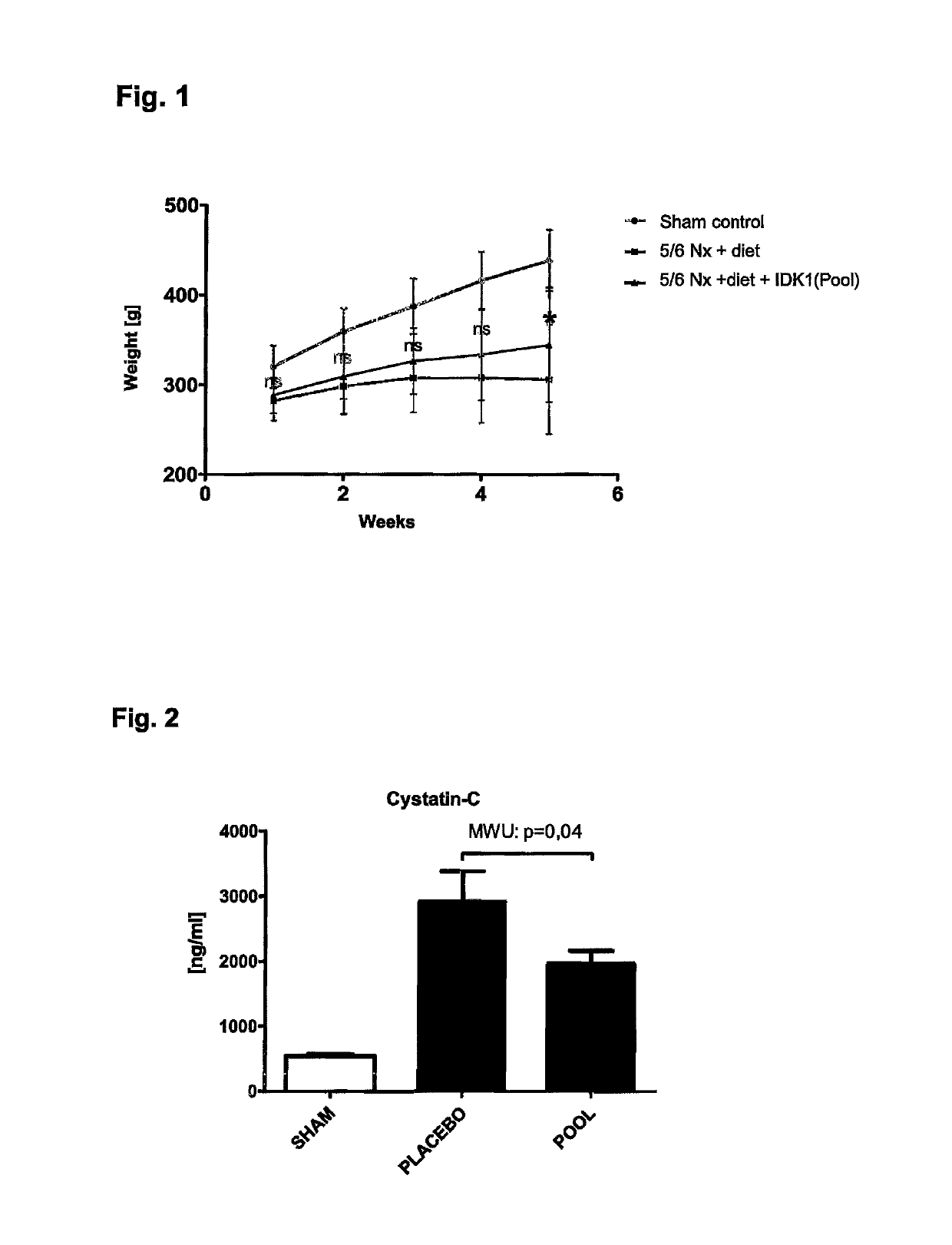
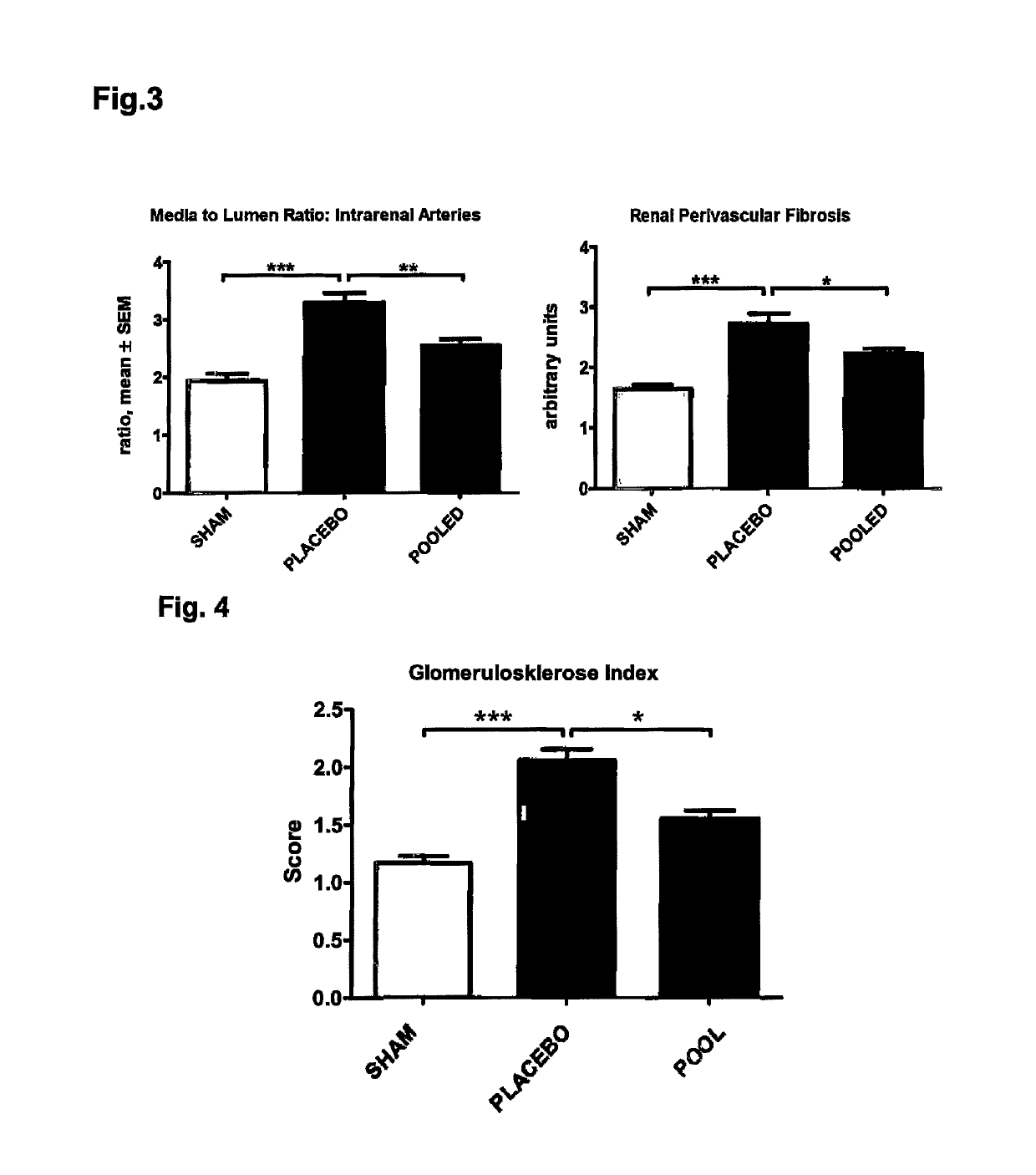
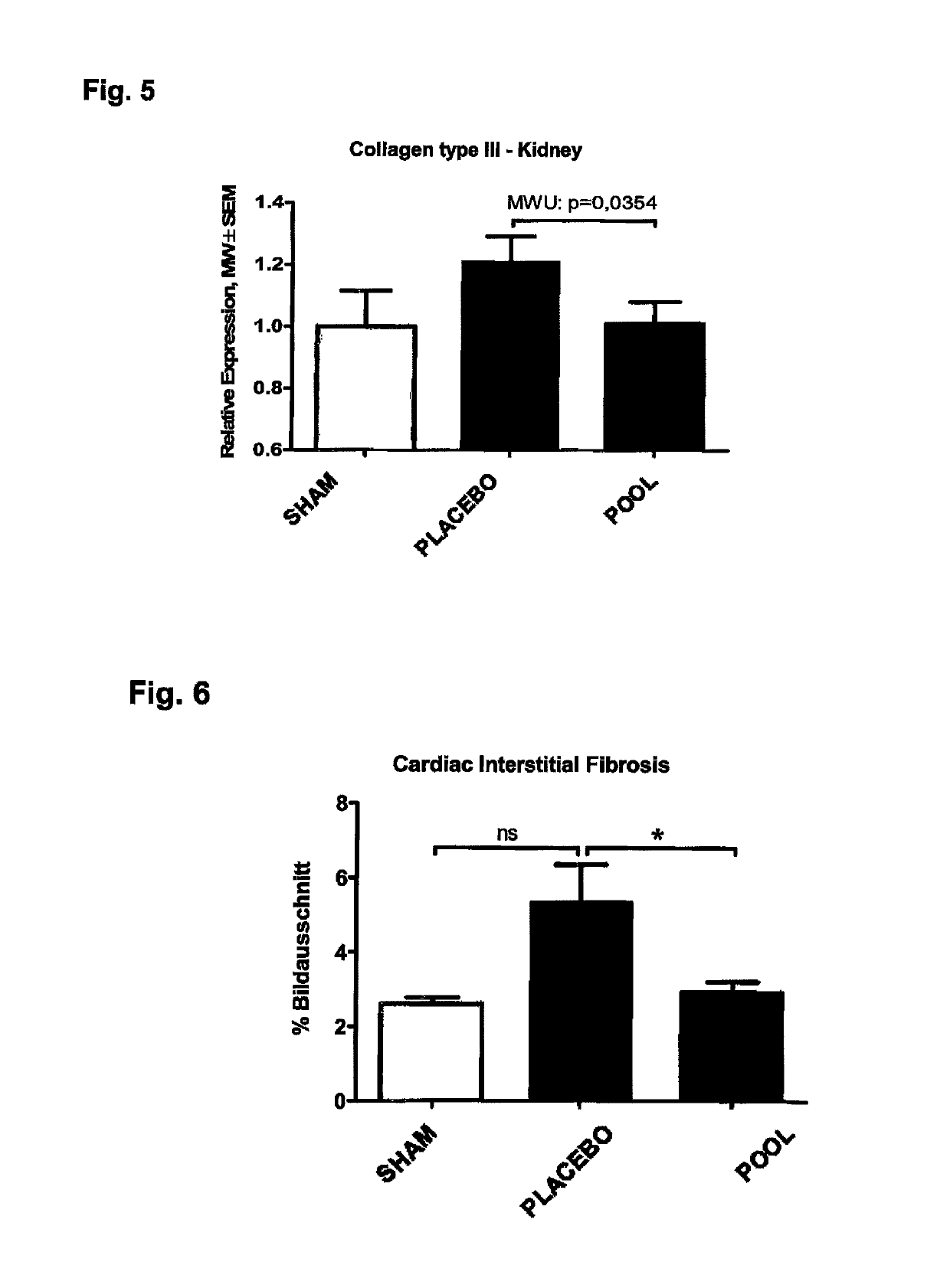
Examples
example 1
Inducing Vascular and Tissue Calcification in Rats
[0028]Among the available experimental models, the 5 / 6 nephrectomy (5 / 6 Nx) of rats is most used for studies of progressive renal disease. This is because the features of this experimental procedure are common to CKD observed in humans [Kren S et al, The course of the remnant kidney model in mice. Kidney int. 1999; 56:333-337]. The 5 / 6 nephrectomy has also been established to test new therapies and has been proven to be clinically relevant [Fujihara C K et al, Losartan-hydrochlorothiazide association promotes lasting blood pressure normalization and completely arrests long-term renal injury in the 5 / 6 ablation model. Am J Physiol Renal Physiol. 2007; 292:F1810-1818; Terzi F et al, Sodium restriction decreases AP-1 activation after nephron reduction in the rat: role in the progression of renal lesions. Exp Nephrol. 2000; 8:104-114; Waanders F et al, Effect of renin-angiotensin-aldosterone system inhibition, dietary sodium restriction,...
example 2
f the Anti-BSP mAb Therapy in Rats
[0032]Visual Inspection of Aorta and Remnant Kidney
[0033]The organs were taken at end and visually inspected. The aortas from healthy (sham) animals showed no signs of aortic calcification, no atherosclerotic intima lesions and no ‘artheriosclerotic’ intima / media lesions. The aortas from 5 / 6 Nx kidney remnant rats, which had received a phosphorus calcium diet and calcitriol, showed massive aortic calcifications and dilated aorta brackets. The thoracic and abdominal regions of the aortas of the Nx rats further showed dilated calcified brackets. Whereas healthy (sham) animals showed no symptoms for a kidney disease, the remnant kidneys of the 5 / 6 Nx rats were edematous enlarged and whitely colored as typical for uremic calcification.
[0034]Body Weight
[0035]The body weight of healthy (sham) and 5 / 6 Nx rats were significantly different after five weeks. The body weights of the healthy animals increased gradually during the five weeks period whereas the b...
example 3
s Binding to BSP in Plasma
[0049]BSP is bound in plasma by complement factor H with high affinity. There have been produced antibodies against peptide partial structures of BSP (Fisher, L. W. et al., Acta Orthop Scand Suppl., 1995, 266, 61-655), against recombinant BSP (Stubbs J T 3rd et al. J. Bone Miner. Res. 1997 12(8), 1210-22), and against BSP isolated from bones, which antibodies failed to bind any BSP in plasma or serum. As the larger factor H molecule of 150 kDa seems to mask the smaller BSP of ca. 65 kDa (Fedarko N S et al., J. Biol. Chem., 200, 275, 16666-16672; WO 00 / 062065) we screened for an antibody which cross-reacts with BSP (rat or human) in serum or plasma, or a BSP fragment thereof, and this even in the presence of factor H or endogenous BSP receptors.
[0050]For this purpose we used conserved peptide epitopes from the human BSP sequence, more precisely, from human BSP II disclosed at UniProtKB / SWISS-PROT:P21815 (SIAL_HUMAN) and its natural variants at positions 195,...
PUM
| Property | Measurement | Unit |
|---|---|---|
| pH | aaaaa | aaaaa |
| concentration | aaaaa | aaaaa |
| pH | aaaaa | aaaaa |
Abstract
Description
Claims
Application Information
 Login to View More