

Apparatus for heating polymeric powders by means of radiation in powder coating methods
a technology of polymeric powder and radiation, which is applied in the direction of polyamide coating, powdery paint, coating, etc., can solve the problems of affecting the quality of the coating, so as to achieve rapid change in radiation intensity and temperature
Active Publication Date: 2019-07-16
EVONIK OPERATIONS GMBH
View PDF20 Cites 1 Cited by
- Summary
- Abstract
- Description
- Claims
- Application Information
AI Technical Summary
Benefits of technology
The patent is about a new device that can warm polymer powder particles without the problems of previous methods. The device should have a specific range of wavelengths and should change the intensity of radiation quickly to change the temperature quickly.
Problems solved by technology
Heating by convection sometimes takes a relatively long time, and so the charging of the particles declines and adhesion decreases.
There is a distinct decrease in the quality of the coating in this case.
One problem, however, is that many uncoloured polymers have only very poor absorbance of electromagnetic radiation in the visible and near infrared (IR-A) wavelength range (0.78-1.4 μm), or the absorbance is highly dependent on the colouring of the polymer particles.
In the case of the uncoloured polymer particles, owing to the poor absorbance, a significant portion of the radiative energy is not utilized.
A further drawback of the current prior art is the possible contact of powder particles with hot surfaces and the associated elevated risk of dust explosions.
Radiative heaters such as ceramic radiation sources fulfil this requirement, but are very sluggish with regard to temperature regulation.
Method used
the structure of the environmentally friendly knitted fabric provided by the present invention; figure 2 Flow chart of the yarn wrapping machine for environmentally friendly knitted fabrics and storage devices; image 3 Is the parameter map of the yarn covering machine
View moreImage
Smart Image Click on the blue labels to locate them in the text.
Smart ImageViewing Examples

Examples
Experimental program
Comparison scheme
Effect test
example 1
adiation Source without Screen (Noninventive)
[0034]A halogen radiation source comprising a halogen lamp as radiation source, a housing and a guard plate had its maximum radiative power in the wavelength range of 0.78-2.5 μm.
example 2
adiation Source (Noninventive)
[0035]A ceramic radiation source had its maximum radiative power in the IR-C wavelength range (3-1000 μm).
example 3
adiation Source with Screen (Inventive)
[0036]The halogen radiation source from Example 1 had a screen made from oxidized steel sheet with a thickness of 0.5 mm and with an absorbance of more than 0.88 in the wavelength range of 0.78-2.5 μm.
the structure of the environmentally friendly knitted fabric provided by the present invention; figure 2 Flow chart of the yarn wrapping machine for environmentally friendly knitted fabrics and storage devices; image 3 Is the parameter map of the yarn covering machine
Login to View More PUM
| Property | Measurement | Unit |
|---|---|---|
| thickness | aaaaa | aaaaa |
| diameter | aaaaa | aaaaa |
| diameter | aaaaa | aaaaa |
Login to View More
Abstract
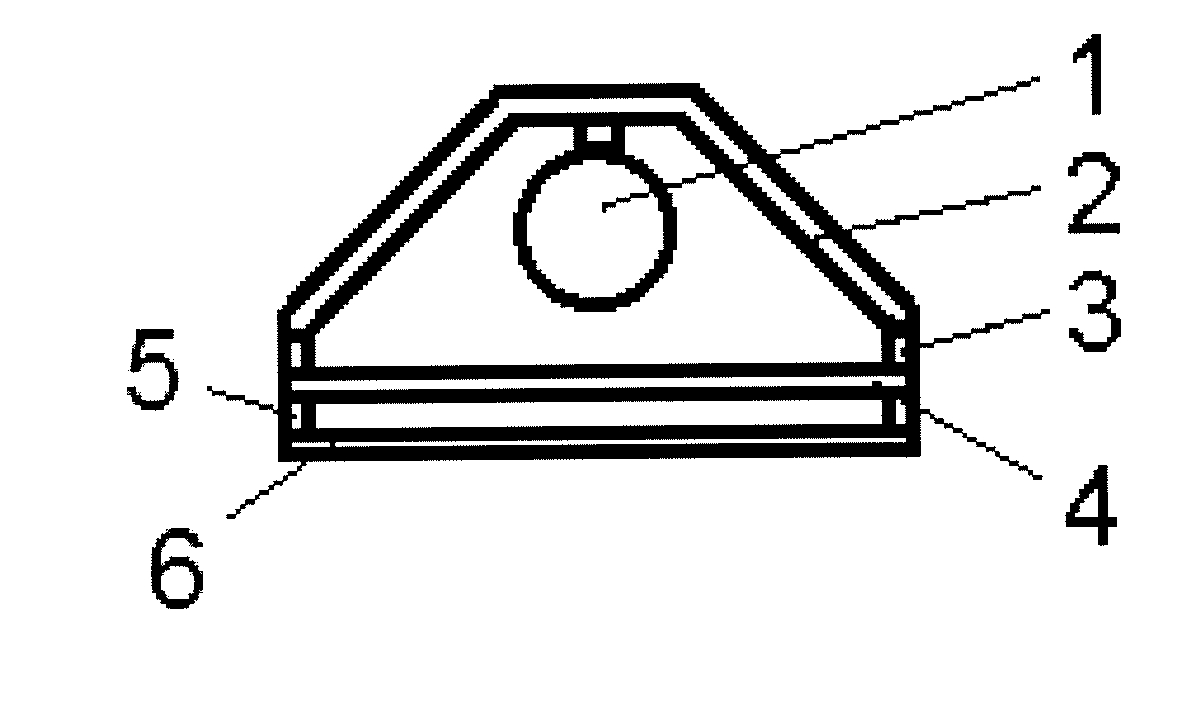
An apparatus for heating powder particles, contains a radiation source (1), a housing (2) and a screen (4). The radiation source (1) has its maximum radiative power in the wavelength range of 0.78-2.5 μm. The screen (4) has an absorbance of at least 0.8 in the wavelength range of 0.78-2.5 μm.
Description
BACKGROUND OF THE INVENTIONField of the Invention[0001]The present invention relates to an apparatus for heating polymeric powders by means of radiation in powder coating methods, to a method of heating the powders and to the use of the apparatus.Description of the Related Art[0002]The powder particles used for powder coating generally consist of dry, grainy particles having a diameter between 1 and 140 μm. In chemical terms, these are usually based on epoxy resins or polyester resins. In addition, hybrid systems containing both epoxy resins and polyester resins as binder are in wide use. Powder particles based on thermoplastic polymers are likewise frequently used.[0003]The state of the art is electrostatic application of the powder particles. In electrostatic powder coating, the first step is to generate a cloud of electrically charged powder. The particles of like charge are transported to the workpiece surface. They are precipitated at the surface, adhere there electrostatically...
Claims
the structure of the environmentally friendly knitted fabric provided by the present invention; figure 2 Flow chart of the yarn wrapping machine for environmentally friendly knitted fabrics and storage devices; image 3 Is the parameter map of the yarn covering machine
Login to View More Application Information
Patent Timeline
 Login to View More
 Patent Type & Authority Patents(United States)
IPC IPC(8): H01B3/00H05B3/00C09D177/02B05D1/06C09D5/03B05D3/02B29C35/08
CPCH05B3/0057B05D1/06B05D3/0263C09D5/03H05B3/009C09D177/02B29C2035/0822B05D2202/10B05D2401/32B05D2505/00B05C19/04B05C19/06
Inventor GREBE, MAIKDIEKMANN, WOLFGANGBAPTISTA, ANDREAS
Owner EVONIK OPERATIONS GMBH