
Method and apparatus for wireless communications
a wireless communication and wireless technology, applied in electrical equipment, transmission, sonic/ultrasonic/infrasonic transmission, etc., can solve the problems of large majority of existing underwater networking devices suffering, and the inability to advance video streaming applications with current technology
- Summary
- Abstract
- Description
- Claims
- Application Information
AI Technical Summary
Benefits of technology
Problems solved by technology
Method used
Image

Examples
Embodiment Construction
[0044]A description of example embodiments follows.
[0045]Embodiments of the present disclosure include underwater wireless technology capable of short-range (i.e., up to 500 m), high-rate, wireless connectivity for unmanned vehicles, scuba divers, and other equipment in areas with underwater infrastructure (e.g., oil rigs) and / or base stations that act as gateway between radio frequency (RF) and acoustic domains. Accordingly, some embodiments are based on orthogonal frequency-division multiplexing (OFDM) schemes (discussed in detail below) and implement resource allocation schemes that assign dynamically time-frequency blocks to devices based on distance, channel, traffic, and other factors.
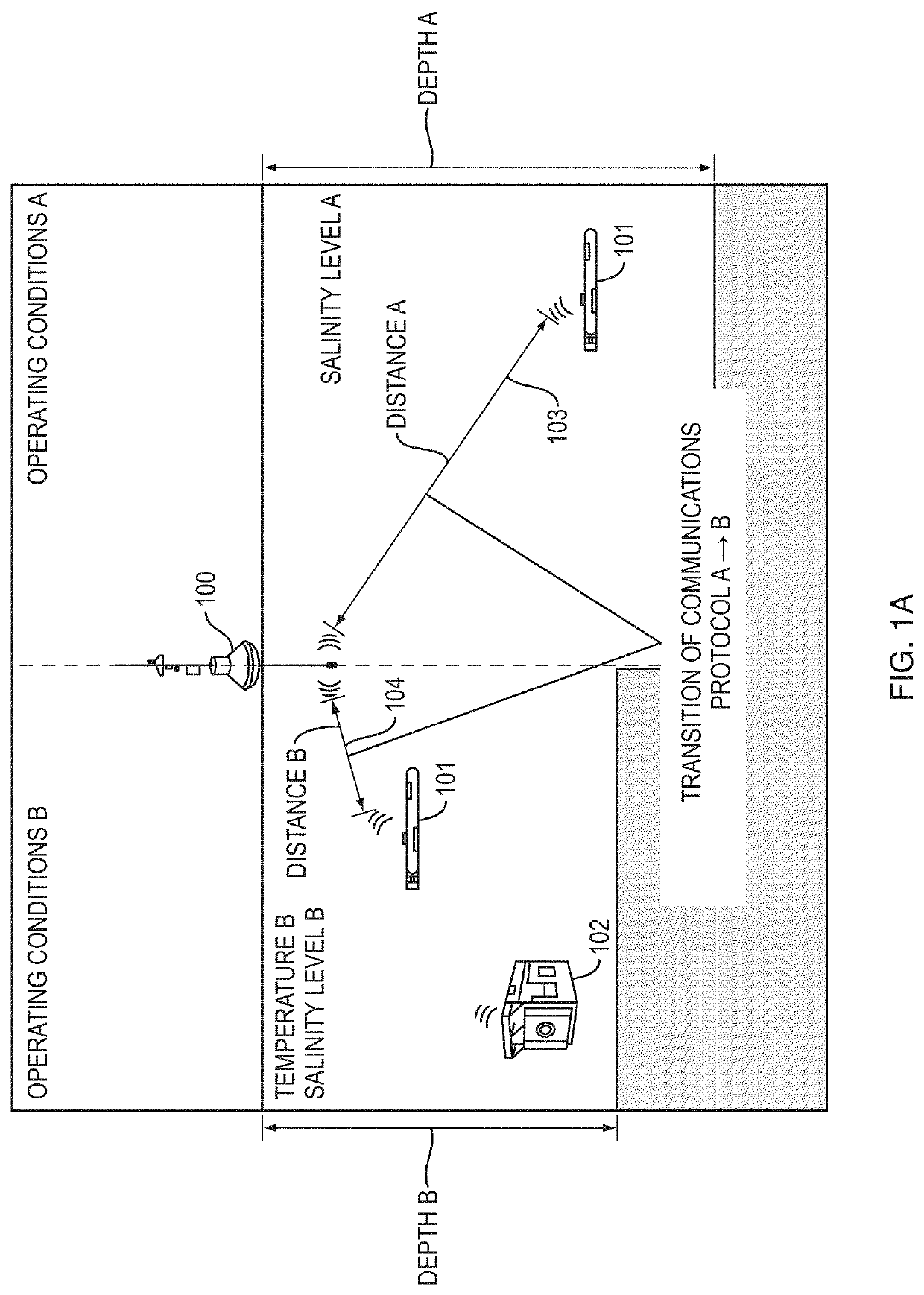
[0046]FIG. 1A illustrates an example of an underwater acoustic wireless communications platform 100 changing communications protocols based on operating conditions. Underwater acoustic communications may be affected by operating conditions, such as distance, depth, temperature, salinity, noise an...
PUM
 Login to View More
 Abstract
Description
Claims
Application Information
 Login to View More