
Methods and devices for harvesting and processing connective tissue precursor cells from autologous fat
a technology of autologous fat and precursor cells, which is applied in the field of methods and devices for harvesting and processing connective tissue precursor cells from autologous fat, can solve the problems of not forming every cell type that exists in an adult animal, starting to become restricted, and conflicting use of the term, etc., to achieve rapid and convenient preparation, convenient and efficient handling, and increase the health and viability of cells
- Summary
- Abstract
- Description
- Claims
- Application Information
AI Technical Summary
Benefits of technology
Problems solved by technology
Method used
Image

Examples
example 1
n of Fatty Tissue Via Liposuction
[0328]The patient will be sterilely prepped and draped. A skin wheal, typically on one side of the abdomen or in a thigh or buttocks area, will be raised, initially using a small and thin needle, such as a 27 gauge (27G) needle, which can deliver a saline solution containing an anesthetic such as xylocaine if desired, or which can be used after a topical anesthetic (such as a benzocaine ointment) has been applied to the skin in that area. After the initial wheal is raised using a very small needle, a larger needle (such as a 3″ 25G needle) can be used, with a fanning-style injection technique, to inject 5 cc of 1% xylocaine through the subcutaneous fat. Once this has been done, an even larger needle, such as an 18G needle, can be used if desired. When the final sharp-tipped needle is being withdrawn from the anesthetized wheal, its sharp beveled tip is used to make a somewhat enlarged nick in the skin, to accommodate an injector cannula.
[0329]A salin...
example 2
trifugation Step
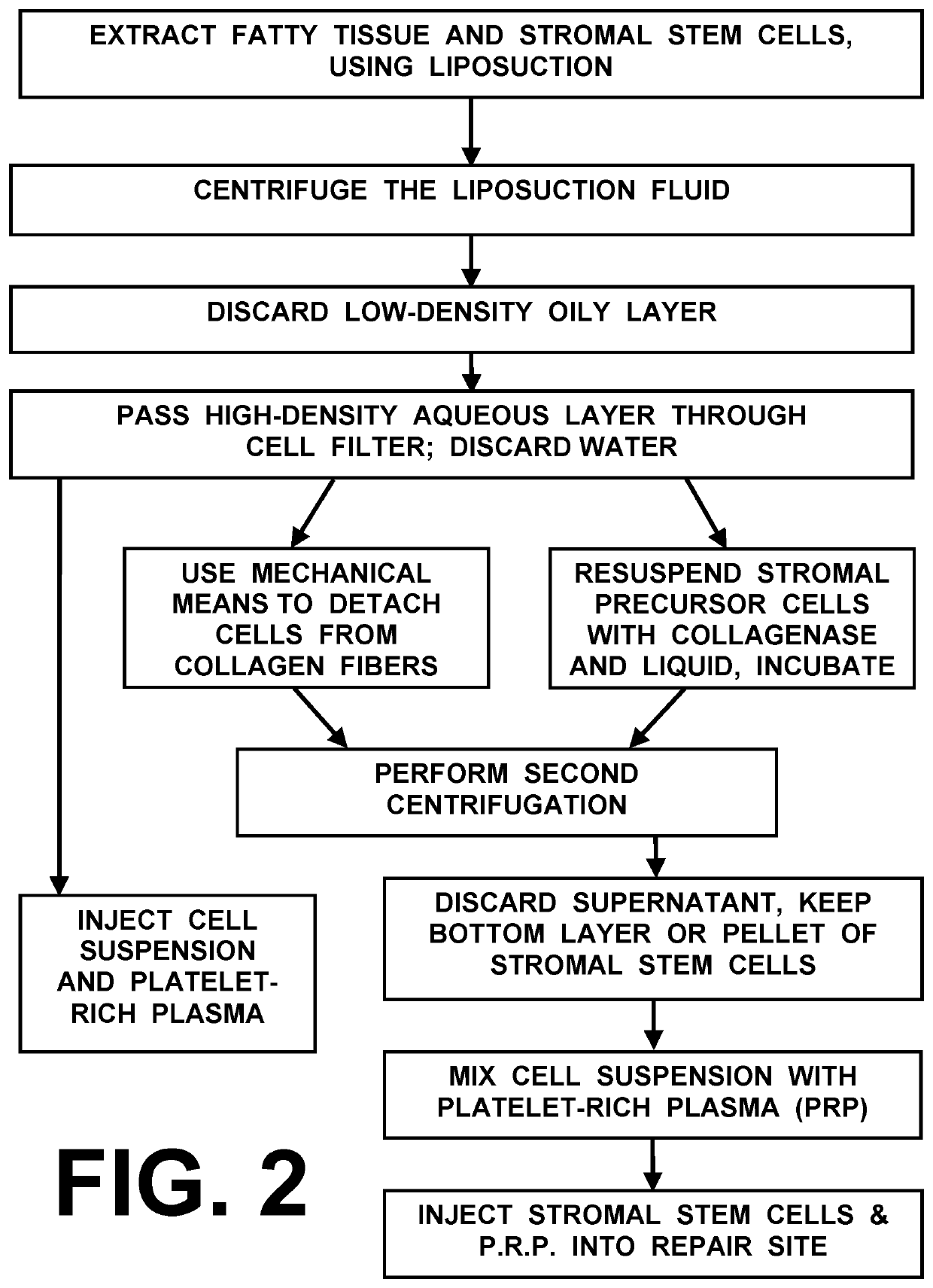
[0335]When a desired number of 20 cc syringes have been filled with a fluidized liposuction extract, they are placed into two holding cartridges which are designed for use in the type of centrifuge machine the surgeon is using. As described above, a preferred approach involves screwing a small “blind” cap onto the threaded luerlock tip of each syringe, before the syringe is placed in a centrifuge cartridge.
[0336]The syringe plungers, which were used to establish suction during the liposuction process, are disengaged from the syringe barrels, before the loaded syringes are centrifuged, by unscrewing the tips of the plungers from accommodating threads in plunger tip or stopper components, made from rubber or a flexible polymer. Each rubber or polymer stopper will remain in position, within a syringe barrel, during centrifugation, and will act as a watertight cap on the liquid in the syringe, which will help maintain sterility of the contents inside the syringe.
[0337]Af...
example 3
se Treatment and Second Centrifugation
[0344]The layer of “spun fat” from the first centrifugation step will contain a substantial amount of extra-cellular debris, including glycogen particles, and strands of collagen, the fibrous protein which creates the extra-cellular matrix that holds cells together in any type of soft tissue.
[0345]As described above, one method for breaking apart and removing the remnants of the extra-cellular collagen matrix (which otherwise can cause viable stem cells in the spun fat layer to clump together in undesirable ways) involves treating the “spun fat” from the first centrifugation step (supplemented by cells that were filtered out of the watery layer that was formed during the first centrifugation), with an aqueous salt solution, and with collagenase, an enzyme that will digest and break apart collagen fibers.
[0346]As mentioned above, this type of cell-concentrating treatment, using an enzyme, is no longer preferred, since a better and faster mechanic...
PUM
| Property | Measurement | Unit |
|---|---|---|
| temperatures | aaaaa | aaaaa |
| diameter | aaaaa | aaaaa |
| volume | aaaaa | aaaaa |
Abstract
Description
Claims
Application Information
 Login to View More