Device and method for manufacture of carbonaceous material

a carbonaceous material and manufacturing method technology, applied in the manufacture of nanostructures, chemical/physical/physical-chemical processes, energy-based chemical/physical/physical processes, etc., can solve the problems of difficult to obtain high-purity single-walled carbon nanotubes substantially free from catalysts, difficult to remove metal catalysts, etc., to achieve efficient convergent organic gas, reduce the effect of impurities

a carbonaceous material and manufacturing method technology, applied in the manufacture of nanostructures, chemical/physical/physical-chemical processes, energy-based chemical/physical/physical processes, etc., can solve the problems of difficult to obtain high-purity single-walled carbon nanotubes substantially free from catalysts, difficult to remove metal catalysts, etc., to achieve efficient convergent organic gas, reduce the effect of impurities

US20040062992A1Inactive Publication Date: 2004-04-01SONY CORP

Image

Smart Image Click on the blue labels to locate them in the text.
Viewing Examples
Smart Image
  • Device and method for manufacture of carbonaceous material
  • Device and method for manufacture of carbonaceous material
  • Device and method for manufacture of carbonaceous material

Examples

Experimental program
Comparison scheme
Effect test

Embodiment Construction

was prepared under the same conditions as those used to prepare Invention 1 except that the carbonaceous materials accumulating on the capturer 23 were recovered without the heating process. Comparative Example 2 was prepared under the same conditions as those used to prepare Invention 1 except that the anode was a composite rod made of metal powder and carbon to have the composition of Co=1.2%, Ni=1.2% and C=97.6% and that the carbonaceous materials accumulating on the capturer 23 were recovered without the heating process.

[0083] Since Inventions 1 through 4 are different from Inventions 5, 6 and Comparative Example 2 in composition of the anode of the carbonaceous material manufacturing apparatus, Inventions 1 through 4 are compared with Comparative Example 1 whereas Inventions 5 and 6 are compared with Comparative Example 2. Carbonaceous materials obtained in Inventions 1 to 6 and Comparative Examples 1, 2 were evaluated with a thermogravimetric device. For this thermogravimetric...

the structure of the environmentally friendly knitted fabric provided by the present invention; figure 2 Flow chart of the yarn wrapping machine for environmentally friendly knitted fabrics and storage devices; image 3 Is the parameter map of the yarn covering machine
Login to View More

PUM

PropertyMeasurementUnit
Pressureaaaaaaaaaa
Angleaaaaaaaaaa
Diameteraaaaaaaaaa
Login to View More

Abstract

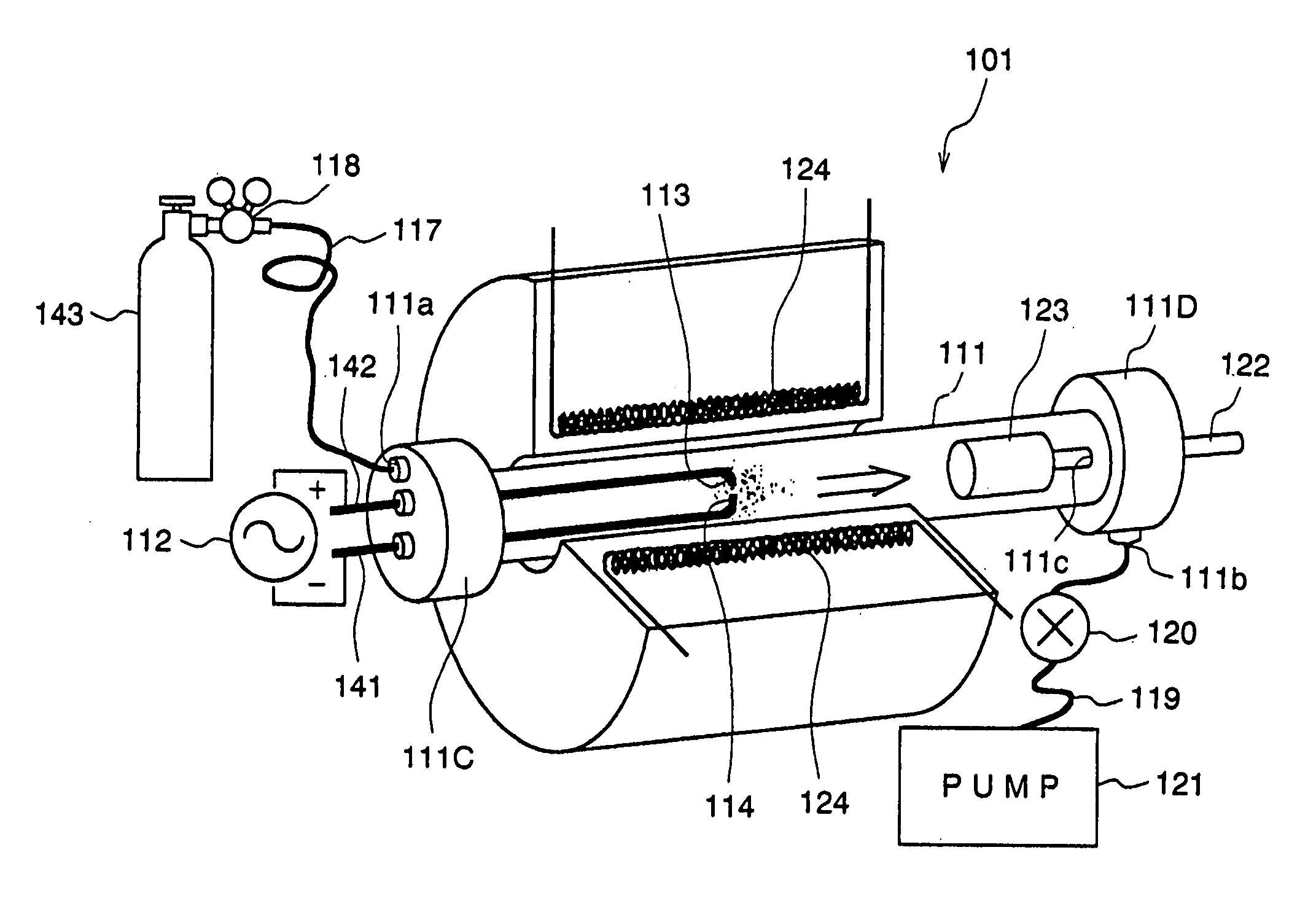
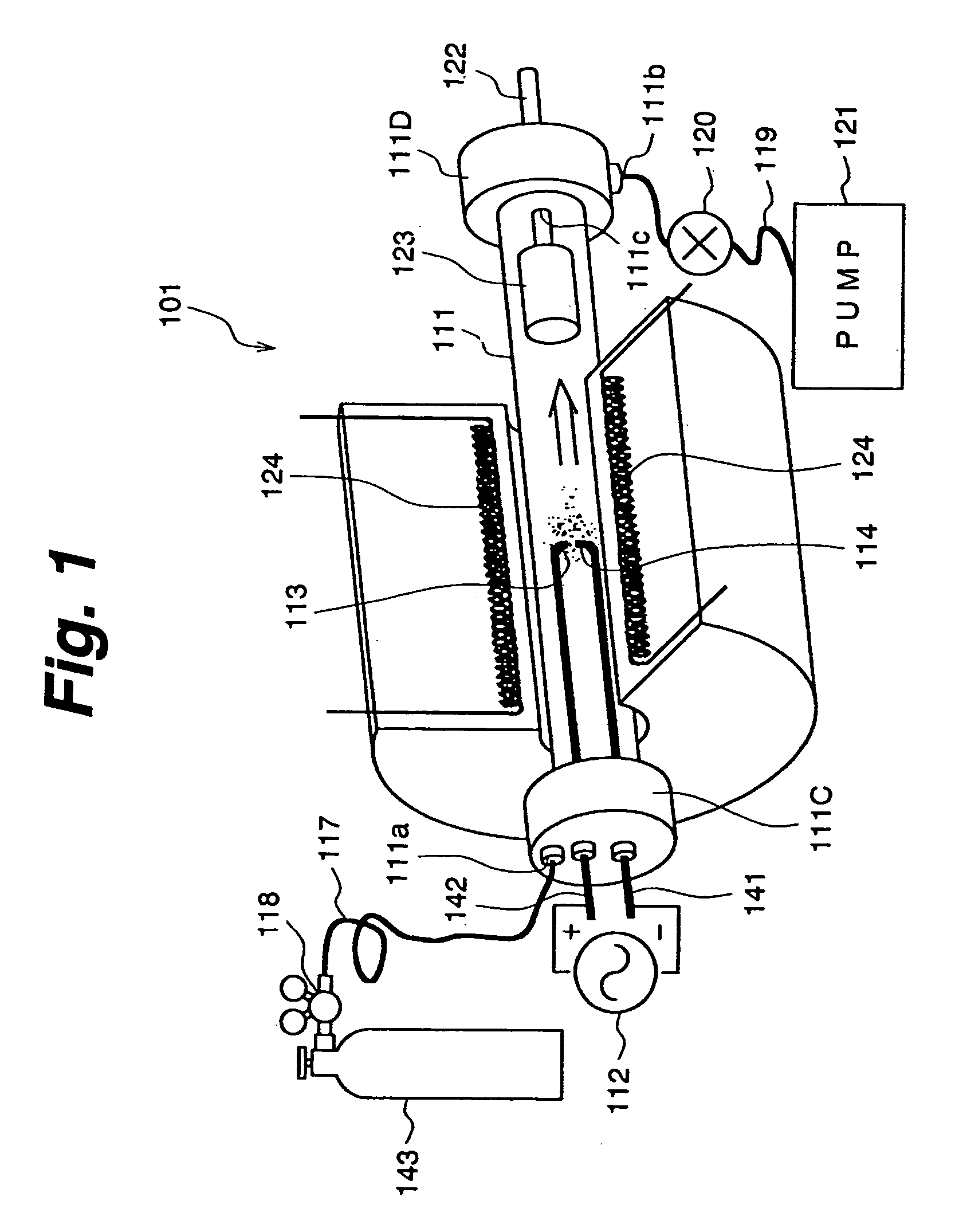
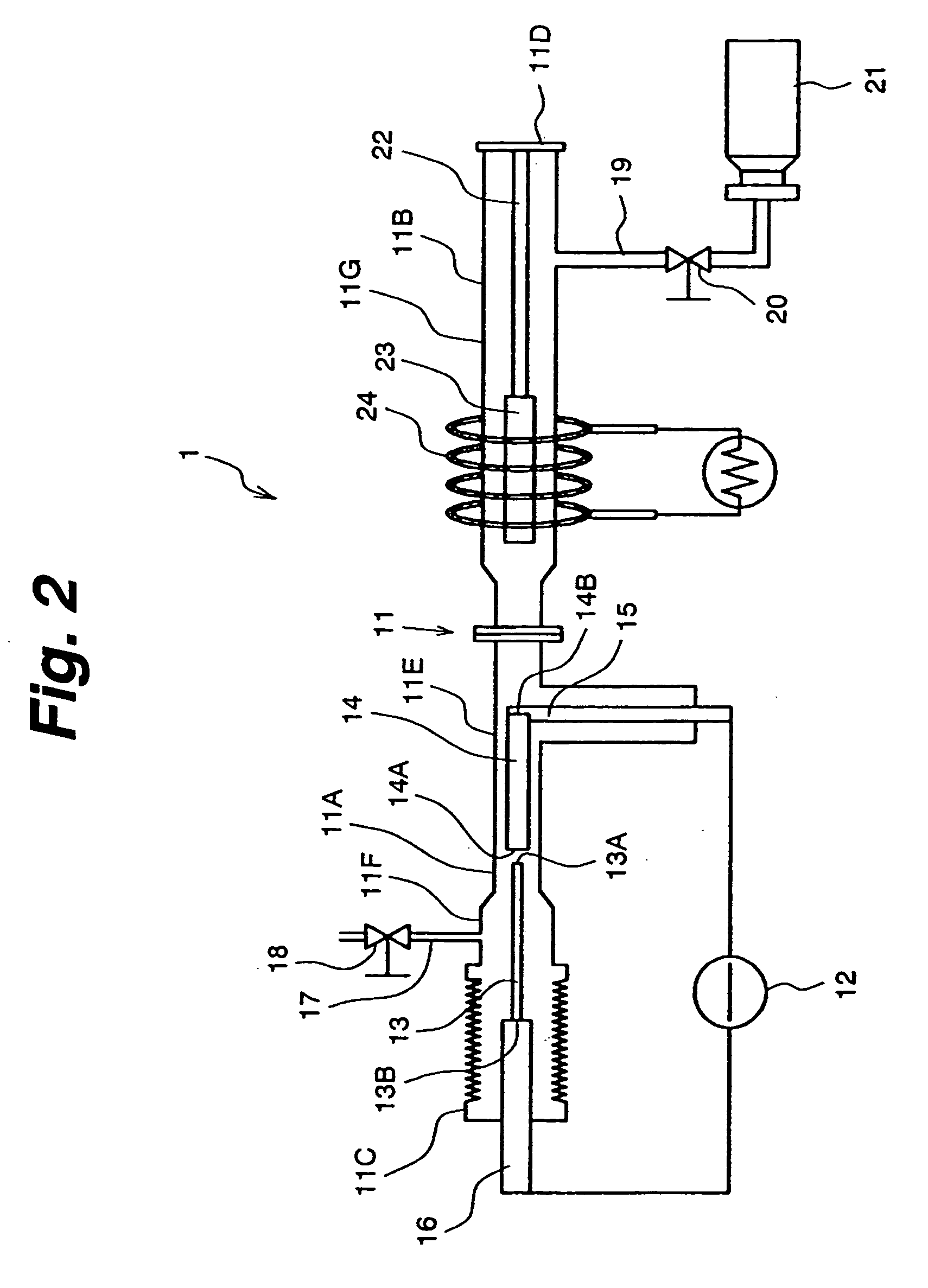
A carbonaceous material manufacturing apparatus includes a reaction tube and a gas supply portion. An anode and a cathode defining an arc discharge portion is place in the reaction tube, and a capturer is located provided as well to capture carbonaceous materials generated. At the location of the capturer, an RF heater is disposed around the reaction tube. In a carbonaceous material manufacturing method, carbonaceous materials generated in the arc discharge portion are transported from a gas supply portion into the reaction tube by the gas supplied into the reaction tube, then heated by a RF heater in the capturer where the carbonaceous materials are not exposed to the atmospheric air, to thereby promote removal of impurities and growth of single-walled carbon nanotubes.

Description

[0001] This invention relates to a manufacturing method and a manufacturing apparatus of a carbonaceous material and, more particularly, to those for manufacturing single-walled carbon nanotubes or other carbonaceous materials by using arc discharge.[0002] Carbon nanotubes are new materials first reported by S. Iijima in Nature, Vol. 354 (1991) 56 in 1991. Especially, single-walled carbon nanotubes (SWNT) have been figured out theoretically to change in electronic physicality from a metallic nature to a semiconductive nature, depending upon the way of winding of its helix, i.e. so-called chirality, and it is remarked as a hopeful electronic material of the next generation. Actually, there are various proposals of its applications to nanoelectronics materials, field electron emission emitters, highly directional radiation sources, soft X-ray sources, one-dimensional conduction materials, high-heat conduction materials, hydrogen storage materials, and others. Additionally, binding fun...

Claims

the structure of the environmentally friendly knitted fabric provided by the present invention; figure 2 Flow chart of the yarn wrapping machine for environmentally friendly knitted fabrics and storage devices; image 3 Is the parameter map of the yarn covering machine
Login to View More

Application Information

Patent Timeline
01 Apr 2004
Publication
US20040062992A1
IPC
B82B3/00; B01D53/22; B01D69/04; B01D71/02; B01J19/08; B01J31/12; C01B31/02; D01F9/127
CPC
B82Y30/00; B82Y40/00; C01B31/0233; Y10S977/844; D01F9/127; Y10S977/75; C01B2202/02; C01B32/162
Inventors
KAJIURA, HISASHI; TSUTSUI, SHIGEMITSU