
Projection lens for a microlithographic projection exposure apparatus
a technology of exposure apparatus and projection lens, which is applied in the direction of photomechanical apparatus, printers, instruments, etc., can solve the problems of non-uniform illumination, aberration, and inability to accept imaging errors and/or contrast losses in the image plane of the optical system, and achieve the effect of improving the projection lens, low cost and reducing the disturbance of the polarization distribution
- Summary
- Abstract
- Description
- Claims
- Application Information
AI Technical Summary
Benefits of technology
Problems solved by technology
Method used
Image

Examples
Embodiment Construction
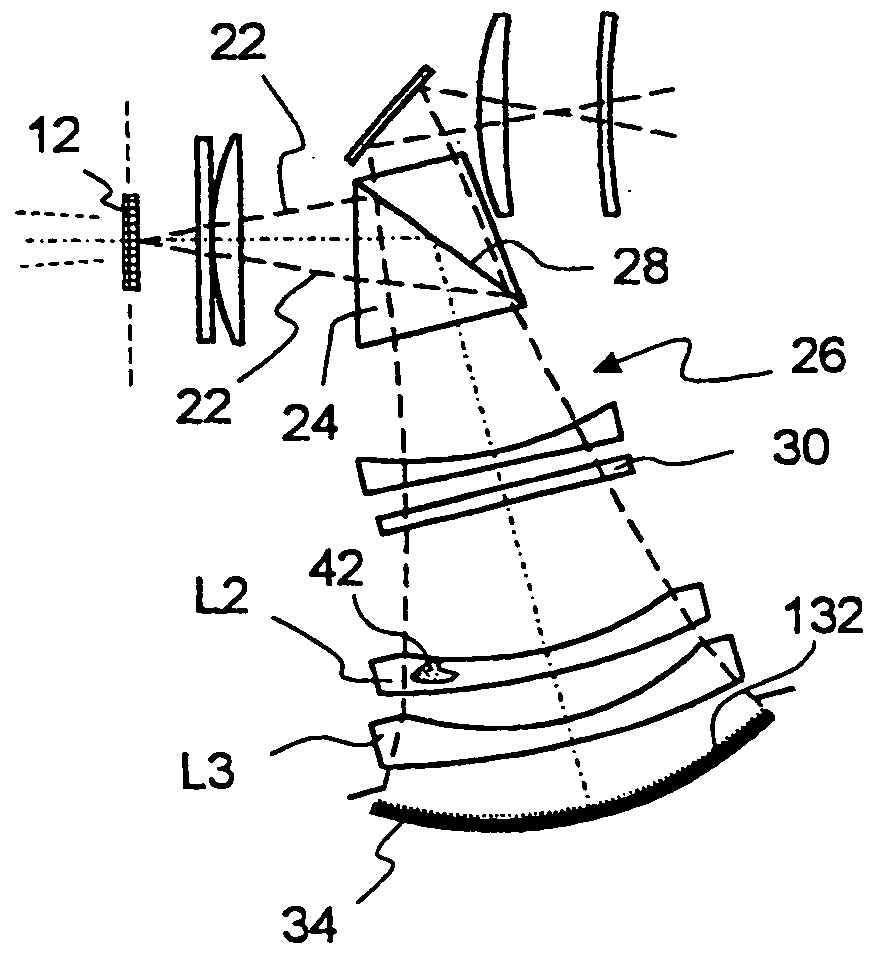
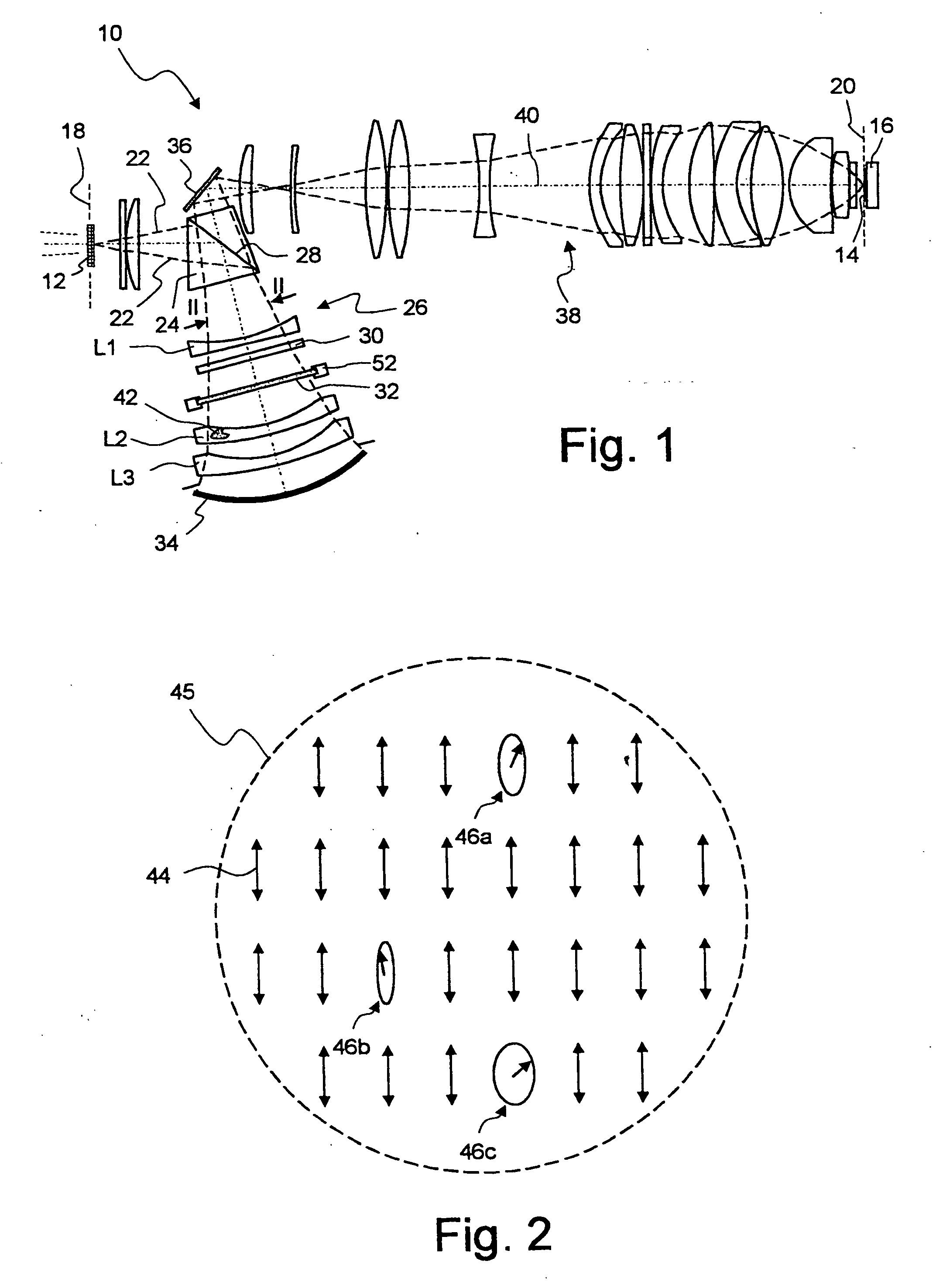
[0028]FIG. 1 shows, in simplified form, a projection lens of a microlithographic projection exposure apparatus in a meridional section. The projection lens, which is denoted in its entirety by 10, is provided to image, in a reduced form, structures contained in a reticle 12 on a photosensitive layer 14 that is deposited onto a substrate 16. The reticle 12 is disposed in an object plane 18 and the photosensitive layer 14 is disposed in an image plane 20 of the projection lens 10.
[0029] In FIG. 1, initially unpolarized projection light 22, as indicated by broken lines, is generated by an illumination system, not shown, of the projection exposure apparatus and has a wavelength λ=157 nm in the exemplary embodiment shown. The projection light 22 enters, after passing through the reticle 12 and two optical elements not denoted in greater detail, a catadioptric section 26 that is separated from the remaining part by a beam-splitter cube 24.
[0030] In the beam-splitter cube 24, a first pol...
PUM
| Property | Measurement | Unit |
|---|---|---|
| transmittance | aaaaa | aaaaa |
| reflectance | aaaaa | aaaaa |
| phase distribution | aaaaa | aaaaa |
Abstract
Description
Claims
Application Information
 Login to View More