Check patentability & draft patents in minutes with Patsnap Eureka AI!

Data processing apparatus and method for moving data between registers and memory

a data processing apparatus and register technology, applied in the direction of instruments, computation using denominational number representation, architecture with multiple processing units, etc., can solve the problems of increasing code size, not representing a generic solution, and real performance benefits of simd approach cannot be fully realized, so as to achieve efficient access to memory

Active Publication Date: 2005-06-09
ARM LTD
View PDF62 Cites 36 Cited by
  • Summary
  • Abstract
  • Description
  • Claims
  • Application Information

AI Technical Summary

Benefits of technology

[0016] By such an approach, the required data elements can be accessed in a very efficient manner by loading from, or storing to, a continuous block of memory, whilst in addition enabling any required rearrangement of the data to take place during the access. Thus, in the event of a load from memory, the data elements are then stored in the registers in an appropriate order to enable the SIMD operation to proceed without further delay, whilst in the event of a store operation, data elements that have been subjected to a SIMD operation are stored back to memory in the correct structure format without any further delay.
[0029] In one embodiment of the present invention, the single access instruction identifies the number of structures to access. This hence provides additional flexibility, in that it is then possible in the instance of a load instruction to load a subset of data elements that does not completely fill an entire register. Similarly, when performing a store instruction, it enables a subset of data elements within a register to be stored back to memory.

Problems solved by technology

However, the real performance benefits of the SIMD approach can only be fully realised if the data elements can be arranged in the appropriate order within the register without significant overhead.
It may be desired to perform a particular operation on all of the red components retrieved, and accordingly a problem that arises is how to arrange the red components in a manner such that a SIMD operation can then be applied to them.
Whilst use of these techniques can avoid the need to reorder the data before the SIMD operation is performed, both of these approaches are relatively complex, and significantly increase code size by requiring different instructions and / or processes to be defined for different operations.
Accordingly, such approaches do not represent a generic solution.
In addition, it can be seen that such approaches present a large overhead in terms of wasted resource bandwidth.
For example, if a particular register has the capacity to store eight data elements, but some of the locations within the register contain data elements which are not going to be subjected to the SIMD operation, then it is not possible to get the maximum potential benefit from the use of the SIMD operation.
This can significantly adversely affect the potential benefit to be realised from use of the SIMD operation.
Accordingly, the increased complexity in the load / store hardware required to implement such striding functions is deemed worthwhile.
However, data processing systems that may be used to perform the earlier described SIMD operations on data elements placed side-by-side within particular registers typically do wish to access continuous blocks of memory, and accordingly it would not be desirable to increase the complexity of the basic load / store hardware in order to support such striding functions.
Accordingly, it will be appreciated that employing such an approach would not only increase the complexity of the load / store hardware, but would also have a very significant adverse impact on the speed with which the data can be accessed.

Method used

the structure of the environmentally friendly knitted fabric provided by the present invention; figure 2 Flow chart of the yarn wrapping machine for environmentally friendly knitted fabrics and storage devices; image 3 Is the parameter map of the yarn covering machine
View more

Image

Smart Image Click on the blue labels to locate them in the text.
Viewing Examples
Smart Image
  • Data processing apparatus and method for moving data between registers and memory
  • Data processing apparatus and method for moving data between registers and memory
  • Data processing apparatus and method for moving data between registers and memory

Examples

Experimental program
Comparison scheme
Effect test

Embodiment Construction

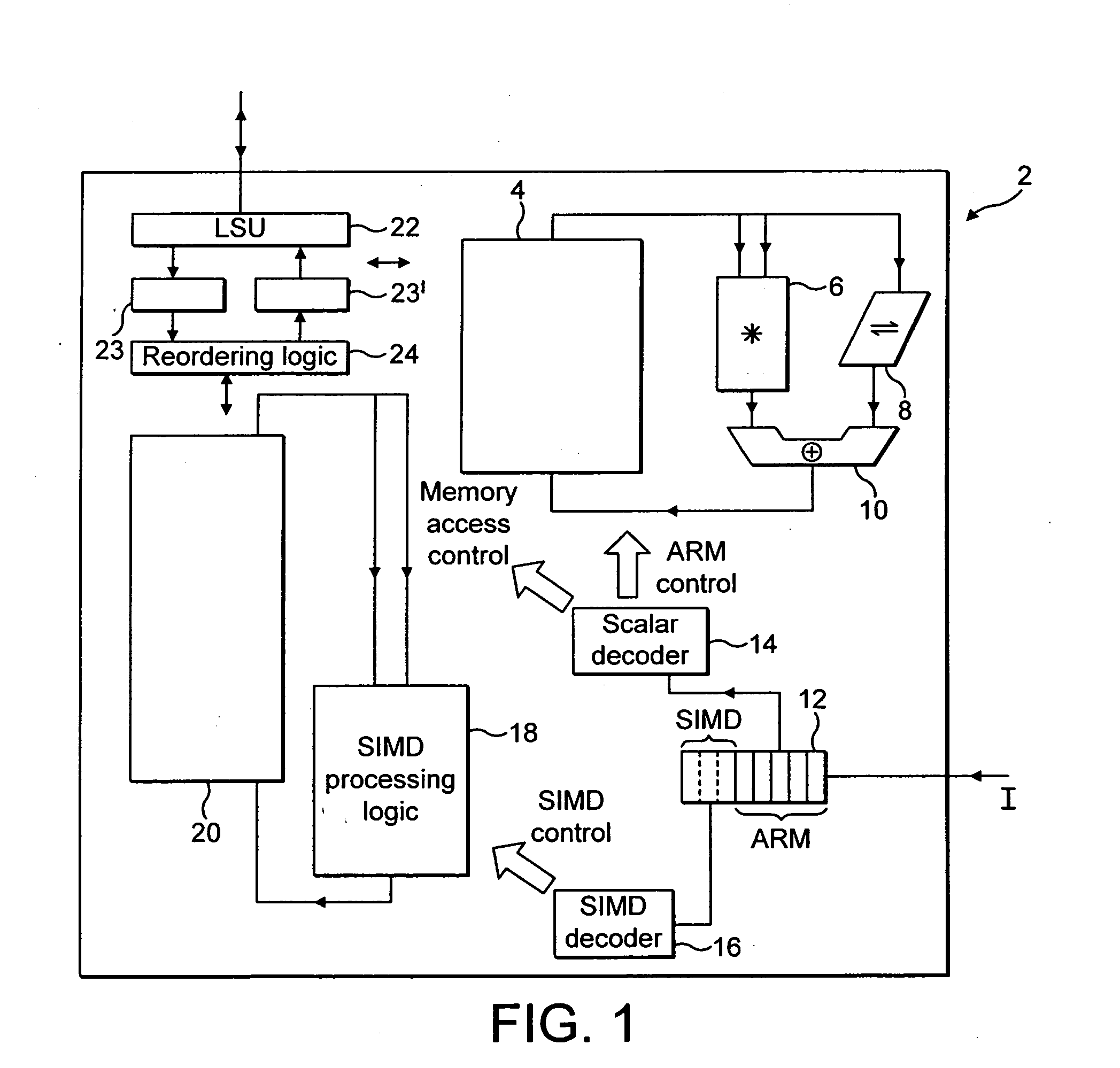
[0100]FIG. 1 schematically illustrates a data processing system (integrated circuit) 2 incorporating both a scalar data processing functionality and a SIMD data processing functionality. The scalar data processing portion can be considered to be a standard ARM processor core incorporating a scalar register data store 4, a multiplier 6, a shifter 8, an adder 10, an instruction pipeline 12 and a scalar decoder 14 as well as many other circuit elements which have not, for the sake of clarity, been illustrated. In operation, such a scalar processor core stores fixed length 32-bit data values within the scalar register data store 4 and manipulates these using the multiplier 6, shifter 8 and adder 10 under control of data processing instructions passed along the instruction pipeline 12 and supplied to the scalar decoder 14. The scalar decoder 14 produces control signals which control the operation of the scalar processing elements in a conventional way.

[0101] As illustrated in FIG. 1 the...

the structure of the environmentally friendly knitted fabric provided by the present invention; figure 2 Flow chart of the yarn wrapping machine for environmentally friendly knitted fabrics and storage devices; image 3 Is the parameter map of the yarn covering machine
Login to View More

PUM

No PUM Login to View More

Abstract

A data processing apparatus and method are provided for moving data between registers and memory. The data processing apparatus comprises a register data store having a plurality of registers operable to store data elements. A processor is operable to perform in parallel a data processing operation on multiple data elements accessed in at least one of the registers. Access logic is operable in response to a single access instruction to move a plurality of data elements between specified registers and a continuous block of memory in which data elements are stored as an array of structures having a structure format, the structure format having a plurality of components. The single access instruction identifies the number of components in the structure format, and the access logic is further operable to rearrange the plurality of data elements as they are moved such that each specified register stores data elements of one component whilst in memory the data elements are stored as the array of structures.

Description

BACKGROUND OF THE INVENTION [0001] 1. Field of the Invention [0002] The present invention relates to a data processing apparatus and method for moving data between registers and memory. [0003] 2. Background of the Invention [0004] When it is necessary to perform a particular data processing operation on a number of separate data elements, one known approach for accelerating the performance of such an operation is to employ a SIMD (Single Instruction Multiple Data) approach. In accordance with the SIMD approach, multiple of the data elements are placed side-by-side within a register, and then the operation is performed in parallel on those data elements. [0005] However, the real performance benefits of the SIMD approach can only be fully realised if the data elements can be arranged in the appropriate order within the register without significant overhead. Typically, prior to performing the SIMD operation, the relevant data elements will need to be loaded from memory into the registe...

Claims

the structure of the environmentally friendly knitted fabric provided by the present invention; figure 2 Flow chart of the yarn wrapping machine for environmentally friendly knitted fabrics and storage devices; image 3 Is the parameter map of the yarn covering machine
Login to View More

Application Information

Patent Timeline
no application Login to View More
Patent Type & Authority Applications(United States)
IPC IPC(8): G06F9/30G06F9/312
CPCG06F9/30025G06F9/30167G06F9/30145G06F9/3004G06F9/30036G06F9/30032G06F9/30043G06F9/30112G06F9/30038G06F9/38G06F9/3854G06F15/8007G06F9/30G06F12/00
Inventor FORD, SIMON ANDREWSYMES, DOMINIC HUGOROSE, ANDREW CHRISTOPHERLUTZ, DAVID RAYMONDHINDS, CHRISTOPHER NEAL
Owner ARM LTD
Features
  • R&D
  • Intellectual Property
  • Life Sciences
  • Materials
  • Tech Scout
Why Patsnap Eureka
  • Unparalleled Data Quality
  • Higher Quality Content
  • 60% Fewer Hallucinations
Social media
Patsnap Eureka Blog
Learn More