Liquid crystal display

US20050151916A1Inactive Publication Date: 2005-07-14SEIKO INSTR INC
2 Cites 0 Cited by

Patent Information

Authority / Receiving Office
US · United States
Current Assignee / Owner
Publication Date
2005-07-14
Estimated Expiration
Not applicable · inactive patent

Smart Images

  • Figure 1
    Figure 1
  • Figure 2
    Figure 2
  • Figure 3
    Figure 3
Patent Text Reader

Abstract

A plurality of first layer wirings (15) and a plurality of second layer segment electrodes (20 and 21) are insulated by a plurality of color filters (16) and a smoothing film (18). A plurality of through-holes are formed in portions of a plurality of black matrices by patterning and then a plurality of second layer electrodes are formed, thereby connecting the plurality of first layer wirings to the plurality of second layer segment electrodes.
Need to check novelty before this filing date? Find Prior Art

Description

BACKGROUND OF THE INVENTION

[0001] 1. Field of the Invention

[0002] The present invention relates to a structure of a passive matrix color liquid crystal display using super-twisted nematic (referred to as STN) liquid crystal etc., and more particularly, to a structure of a liquid crystal display whose display area is driven to have two or more divided screens.

[0003] 2. Description of the Related Art

[0004] A passive matrix liquid crystal display has a liquid crystal layer interposed between a common electrode substrate and a segment electrode substrate and pixels arranged in matrix. Examples of a driving method for a passive matrix type liquid crystal display include a voltage averaging method, smart addressing (SA) method, and multi line addressing (MLA) method.

[0005] Whichever driving method is used, increase of the number of common lines in a display area results in decrease of the ON / OFF ratio of the effective value of the driving voltage to be applied to the liquid crystal, ...

Examples

Embodiment Construction

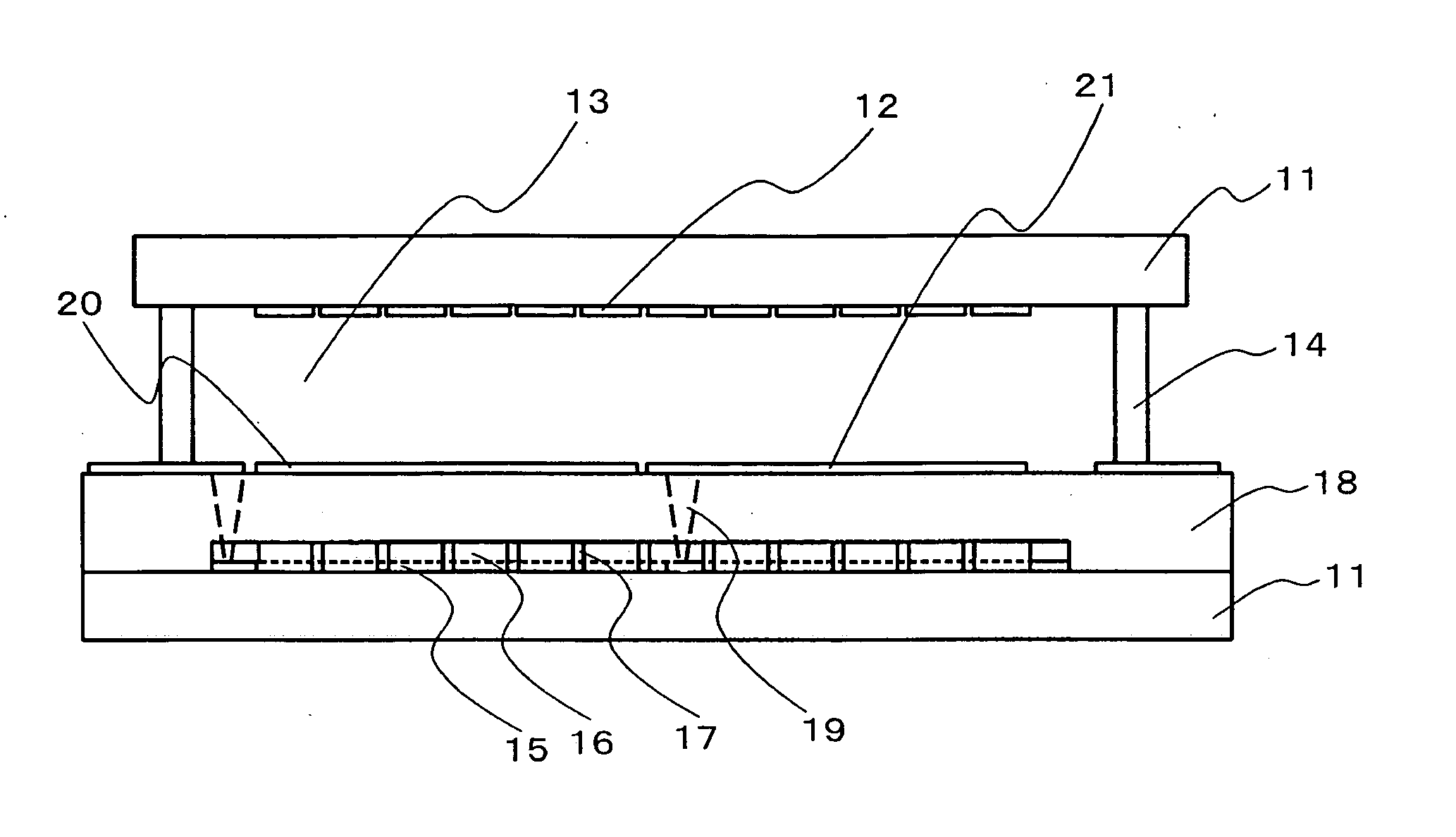
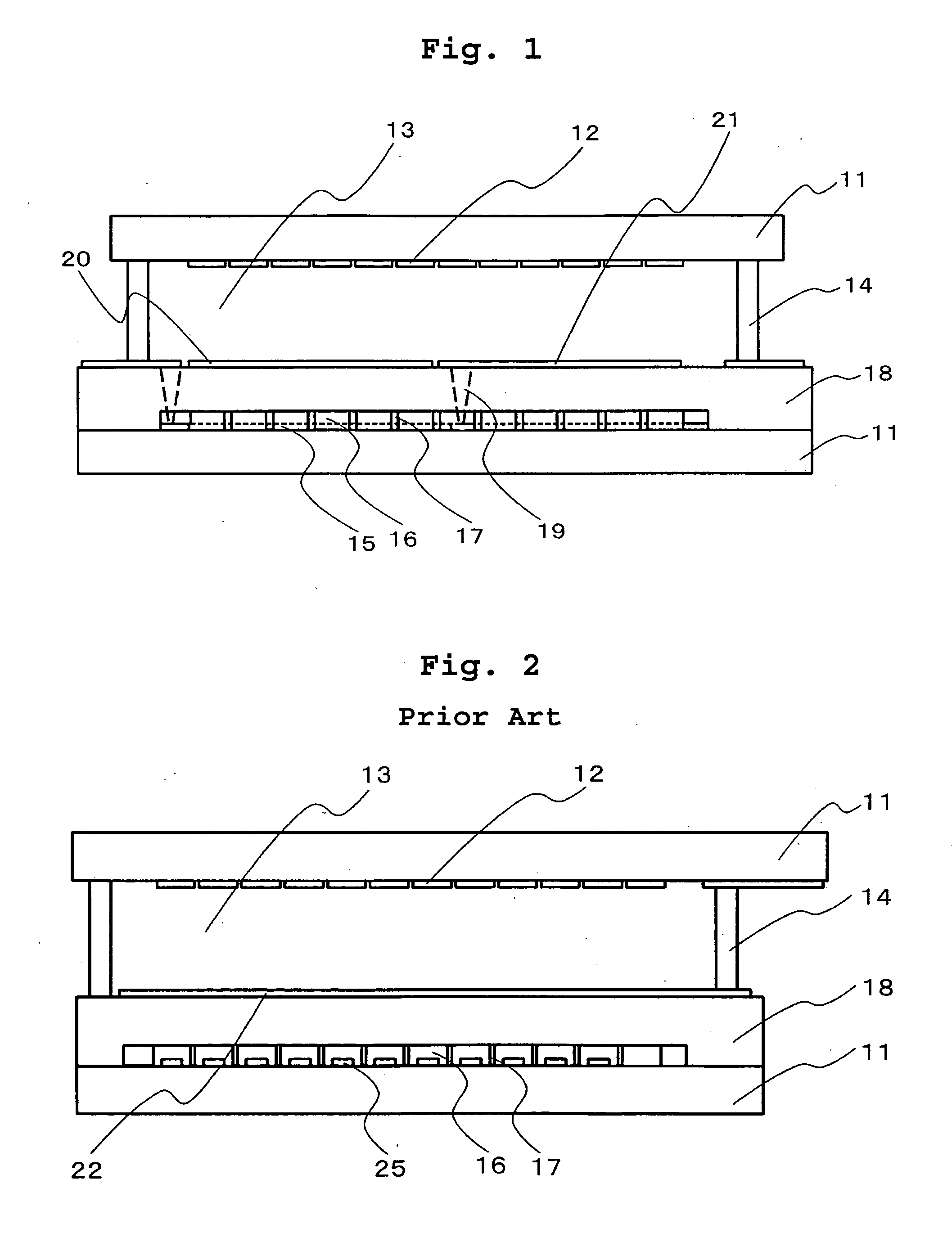
[0018]FIG. 5 shows an example of a liquid crystal display of the present invention, in which one liquid crystal panel is driven divisionally in the first screen 53 and in the second screen 54. FIG. 1 is a cross-sectional view showing the transparent liquid crystal display of the present invention, taken from the FIG. 5 along the line A-A′ of the panel 53 and 54.

[0019] At first aluminum is deposited by sputtering on a glass substrate 11 to which color filters are formed later and then the first layer wirings 15 are formed by patterning. When the aluminum thin film on pixel portions are left at this time as reflecting plates electrically separated from wiring electrodes, a semi-transparent liquid crystal panel will be made. Acrylic resin dispersed with pigment is applied on the reflecting plates by spinner, and then patterned. This process is repeated to form color filters 16 and black matrices 17. Acrylic resin is further applied on the color filters 16 and the black matrices 17 by ...