[0004] The object of the present invention is to create a method of the type stated initially, which enables removal of a cover from a storage box in a reliable manner under sterile conditions.
[0005] Due to the fact that the
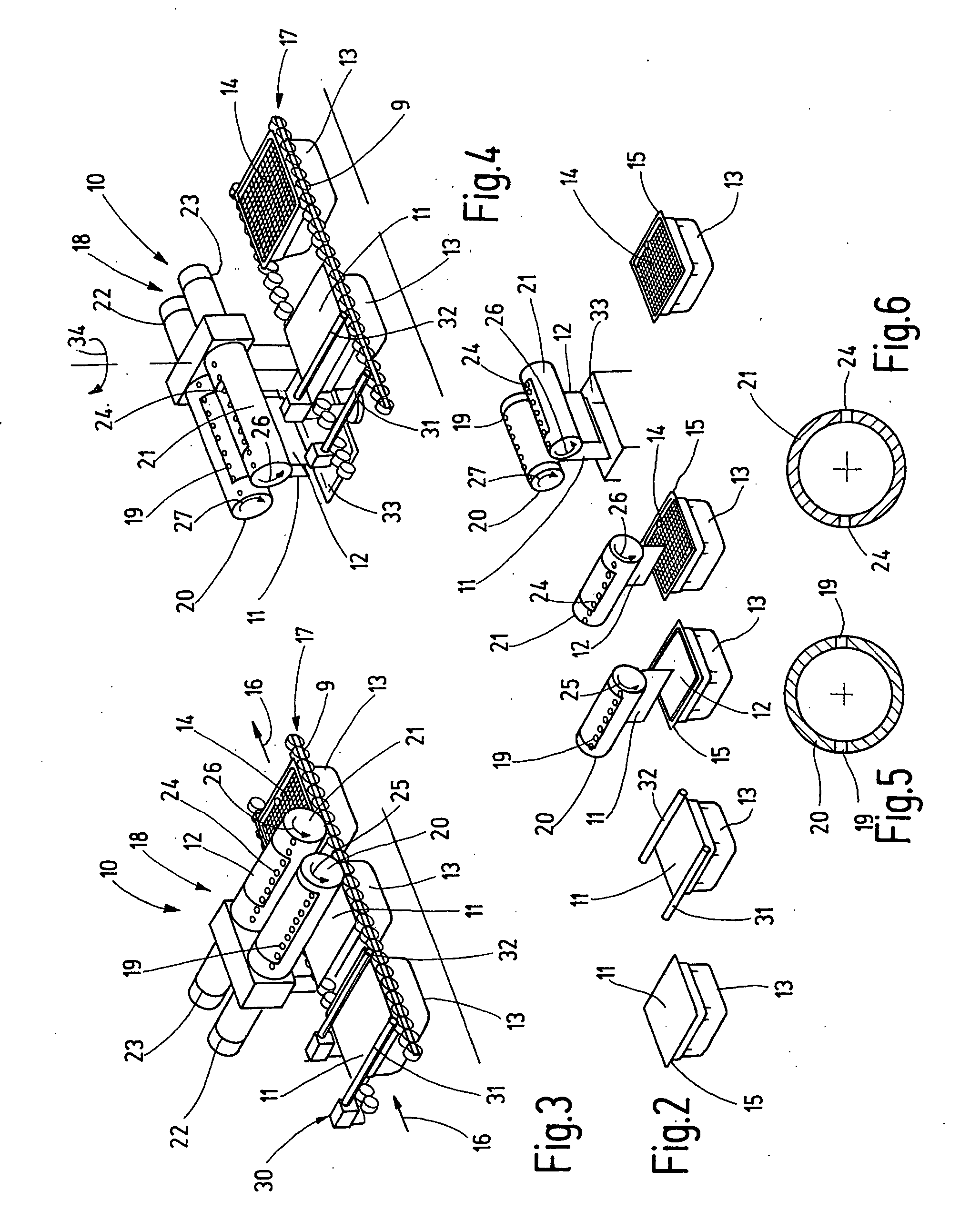
adhesive strength of the cover is reduced in the region of a few of the sealed edges, e.g., just the transverse edges, and the cover is removed from the storage box by peeling it off, reliable removal of the cover is attainable and, in fact, without the risk that the cover will tear or not be removed completely, whereby this method requires only a small amount of mechanical outlay. The invention makes use of the knowledge that
adhesive bonds have the least amount of resistance to separation by peeling, therefore making it possible, with great
advantage, to carry out peeling with a small amount of force and in a reliable manner without the risk of tearing, even when storage box covers are involved. It is advantageous when the reduction in the adhesive strength of the cover takes place in the region of a seal of a few of the sealed edges, e.g., the transverse edges. The reduction in the adhesive strength of the cover can be accomplished in an advantageous manner via warming at least in the region of a few of the sealed edges, e.g., the transverse edges. It can be advantageous when the cover is acted upon from above by
heating energy, in particular
radiant heat, acting upon the region of a few of the sealed edges, in particular the transverse edges, at the least.
[0006] A further advantageous configuration provides that the cover is acted upon with a
suction force and is removed from the storage box using this
suction force. It can be advantageous when the cover is acted upon with a
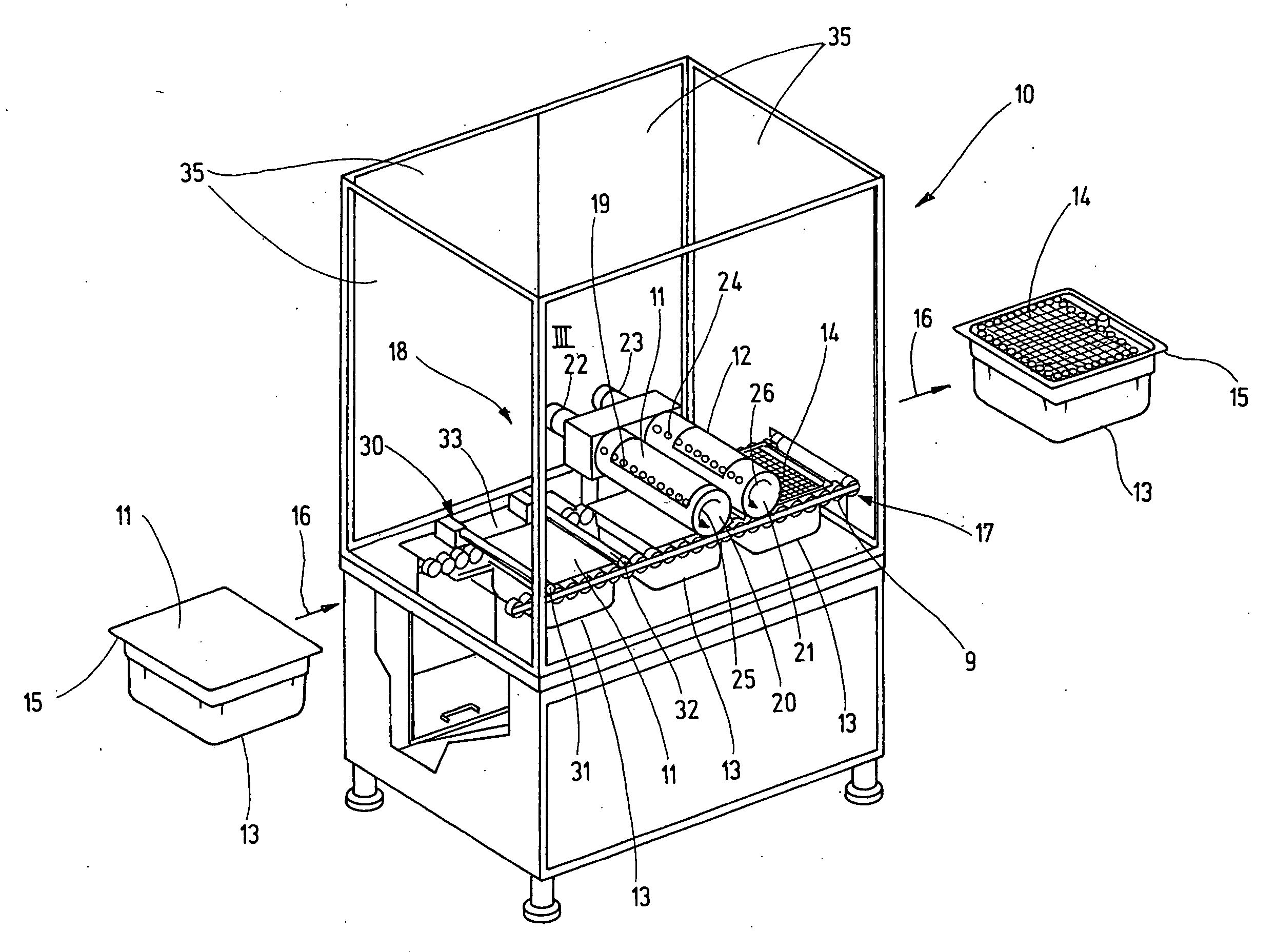
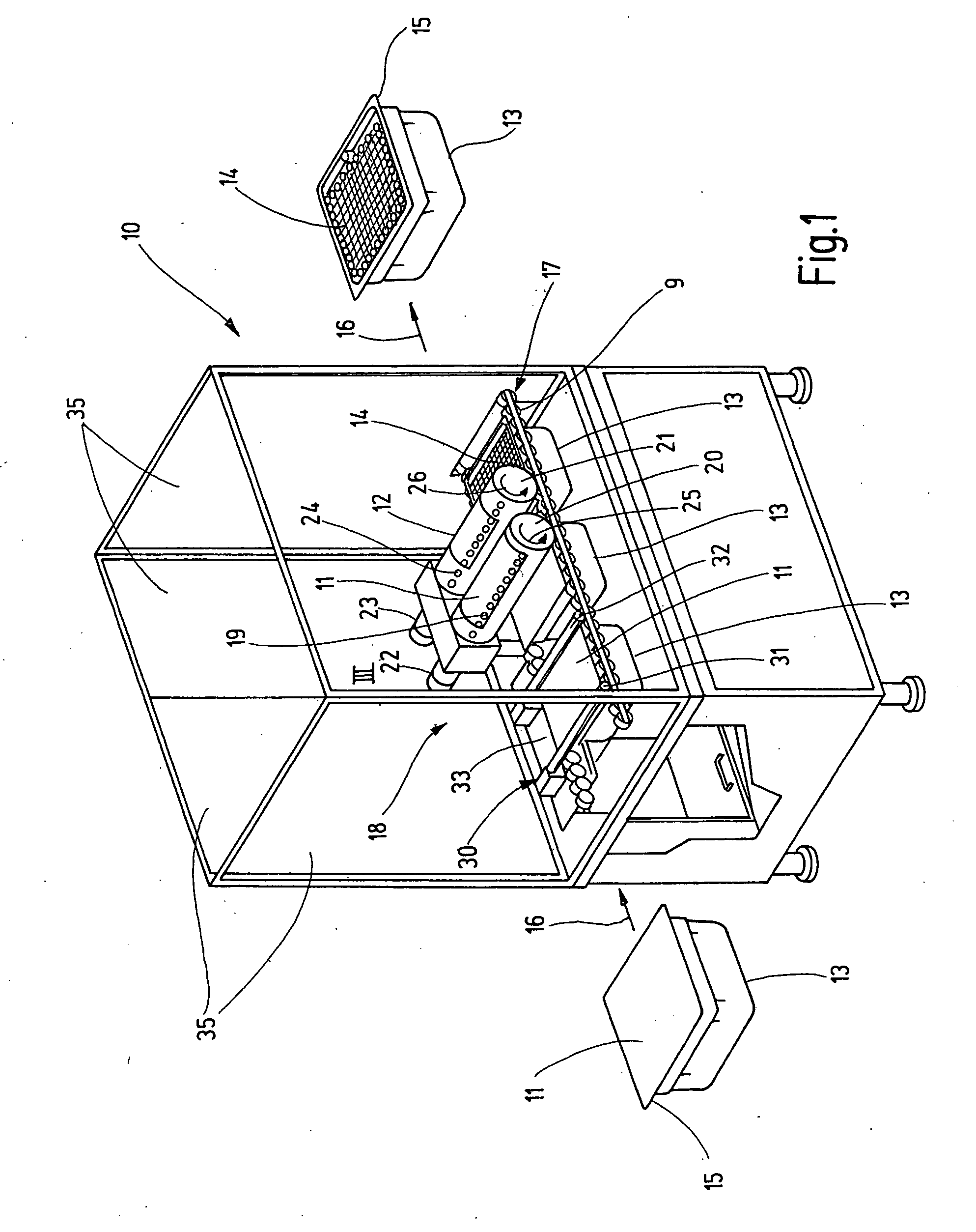
suction force at least in the region of a transverse edge and is removed from the associated transverse edge of the storage box using the suction force at least in the region of this transverse edge. The cover is peeled off in an advantageous manner by rolling it off of the storage box. It is advantageous when the cover is separated from the storage box by peeling it off in the region of the sealed edges, the storage box being held down while this is taking place. The peeling away of the cover by rolling it up is initiated simultaneously with the application of the suction force, whereby the cover can be rolled onto a roller positioned above the storage box. The suction force can be applied using suction devices, for example, in particular suction cups, located lengthwise in at least one row on the roller, with suction openings or the like which are connected to a vacuum source. The cover, which has been removed from the storage box and rolled up, can be unrolled in the opposite or same direction of the rolling-up, outside the region of the storage box and, as a result of the suction force being reduced, is released and dropped through a discard opening.
[0007] In this manner, a lid-like top cover, which is sealed to the storage box at the edges, is capable of being removed in a reliable, fast and economical manner under sterile conditions.
[0010] In this case it is advantageous when, in continuous sequence as the storage boxes are conveyed along, a first cover is removed in a first step by reducing the adhesive strength of the cover in the region of a few sealed edges, in particular the transverse edges, and peeling it off of the storage box and, in a subsequent, second step, a second cover which is contained loosely in the storage box is removed from the storage box. It can be advantageous when the removed and rolled-up first cover and, therefore, at least nearly simultaneously therewith, the removed and rolled-up second cover are unrolled preferably in opposite directions, outside the region of the storage box, and, as a result of the particular suction force being reduced, they are dropped through the same discard opening. By using this method to discard the covers, they can hang down nearly vertically very close together and be dropped into the same discard opening below; the discard opening can be narrow in size due to the closeness of the covers. From the discard opening, the items are then sent to the outside through a channel, a slot or the like, for example.
[0011] A further object of the present invention is a device for removing at least one cover from a storage box having the features of claim 22. Further advantageous features and embodiments of the present invention result from the related subclaims. This device enables sterile handling by utilizing placement inside an
isolator. No
manual handling by operating personnel is required, since the device enables automatic,
continuous operation. The device is compact, simple, operationally reliable, and economical due to its simple design.


 Login to View More