
Liquid crystal display device
a display device and liquid crystal technology, applied in static indicating devices, instruments, non-linear optics, etc., can solve the problems of uneven display, alignment defect, and inability to efficiently apply electric field components parallel to the substrate surface to the liquid crystal layer, so as to reduce the frequency of alignment defects and prevent display failures. , good display quality
- Summary
- Abstract
- Description
- Claims
- Application Information
AI Technical Summary
Benefits of technology
Problems solved by technology
Method used
Image

Examples
first embodiment
[0186]FIG. 16 is a schematic plan view of one pixel that is enclosed by a light shield film, that is, the main structure of a liquid crystal display device according to the invention.
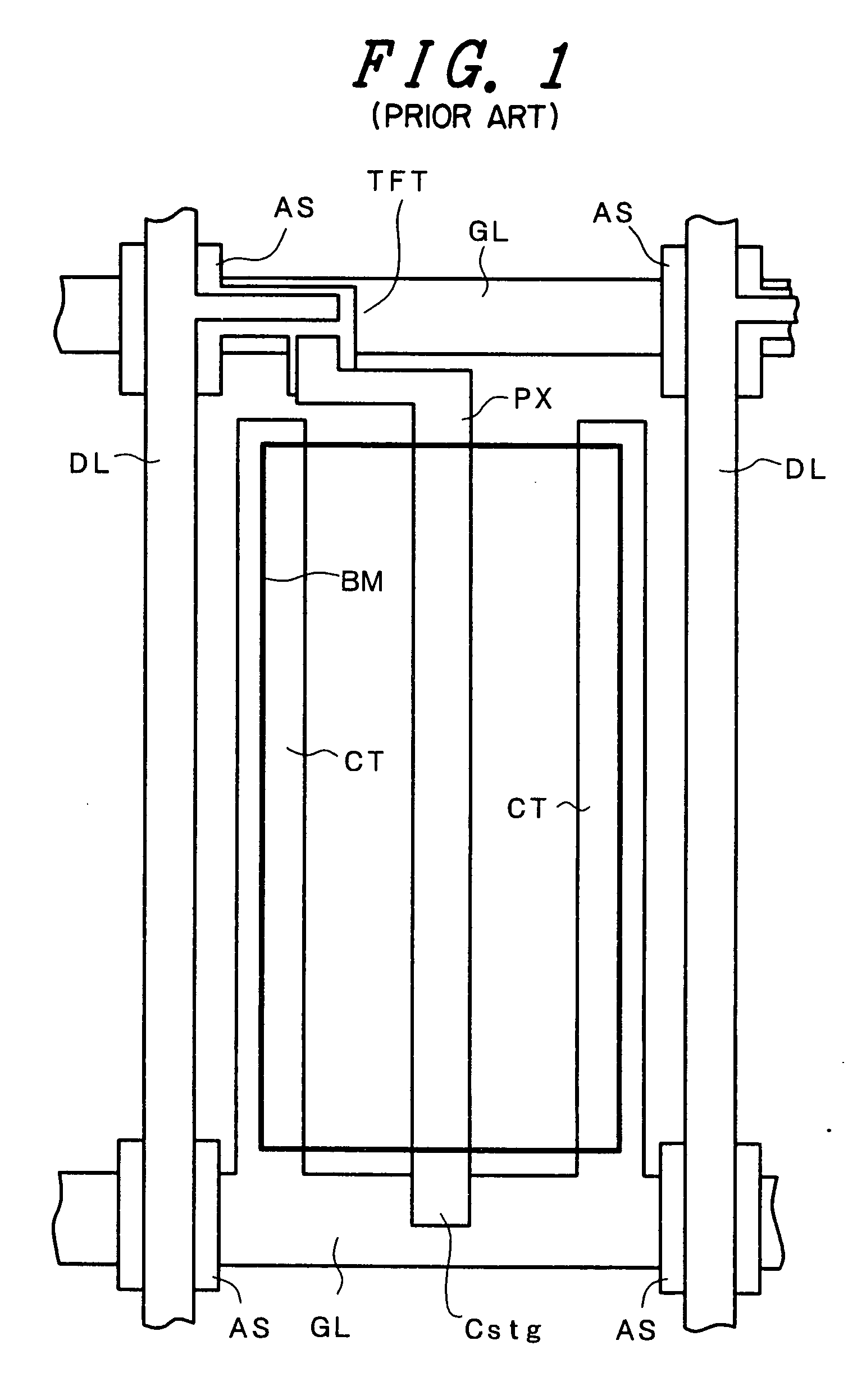
[0187] Referring to FIG. 16, when a thin-film transistor TFT that is constituted of a video signal line DL, a scanning signal line GL, and an a-Si film is turned on, a signal voltage of the video signal line DL is transmitted to a pixel electrode PX and held by a storage capacitor portion Cstg that is composed of an counter voltage signal line CL and the pixel electrode PX (a dielectric film (insulating film) PS1 formed between the counter voltage signal line CL and the pixel electrode PX is not shown in FIG. 16).
[0188] A liquid crystal existing between the pixel electrode PX and the counter electrode CT is driven by the signal held by the storage capacitor portion Cstg.
[0189] The counter voltage signal line CL is located approximately at the center of the opening (pixel region) of a black matrix BM, ...
second embodiment
[0194]FIG. 18 is a schematic plan view of one pixel that is enclosed by a light shield film, that is, the main structure of a liquid crystal display device according to the invention.
[0195] This embodiment has the same configuration as the first embodiment of FIG. 16 except that the numbers of comb-teeth portions of pixel electrodes PX and counter electrodes CT are increased. This configuration is suitable for a liquid crystal display device having a large screen.
third embodiment
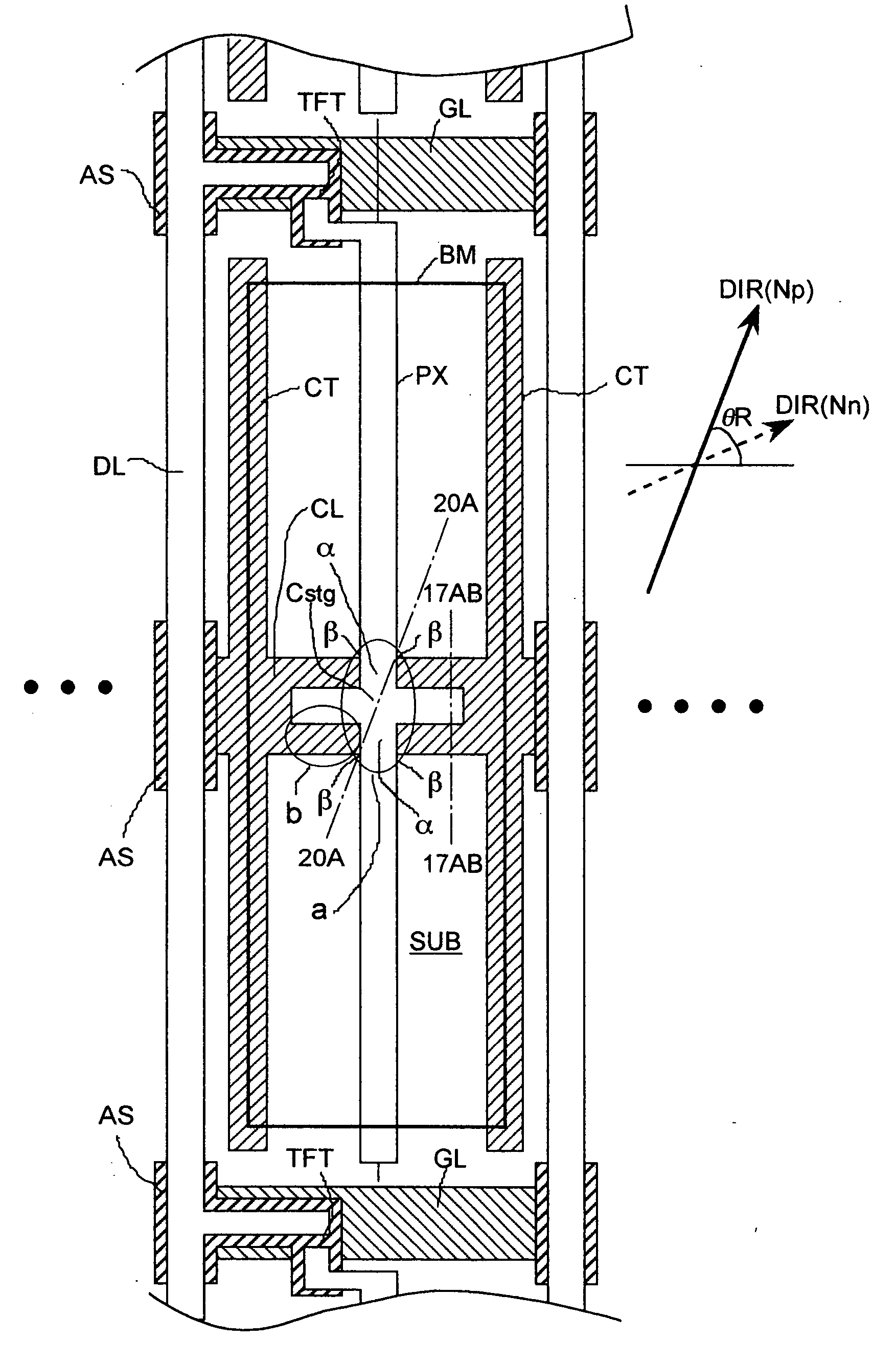
[0196]FIG. 19 is a schematic plan view of one pixel that is enclosed by a light shield film, that is, the main structure of a liquid crystal display device according to the invention. FIGS. 20(A) and 20(B) are sectional views taken along line 20A-20A in FIG. 16 and line 20B-20B in FIG. 19, respectively.
[0197] In the first embodiment, as shown in FIG. 16, the portions of the pixel electrode PX that are connected to the storage capacitor Cstg cross the level differences at the peripheries of the counter voltage signal line CL.
[0198] In the portions indicated by symbol a in FIG. 16 (also indicated by symbol a in FIG. 20(A)) of the pixel electrode PX at the crossing portions, the inclination angle is approximately equal to the inclination angle θCL of the gently sloped peripheries the counter voltage signal line CL (lower layer). Therefore, even the probability that a large level difference causes a rubbing defect is low.
[0199] However, in the peripheral portions (indicated by symbol ...
PUM
| Property | Measurement | Unit |
|---|---|---|
| thickness | aaaaa | aaaaa |
| thickness | aaaaa | aaaaa |
| widths | aaaaa | aaaaa |
Abstract
Description
Claims
Application Information
 Login to View More