Addition reaction-curable liquid silicone rubber compositions and process of preparing same
- Summary
- Abstract
- Description
- Claims
- Application Information
AI Technical Summary
Benefits of technology
Problems solved by technology
Method used
Image

Examples
examples
[0099] Examples and Comparative Examples of the invention are given below by way of illustration and not by way of limitation. It is to be noted that the term “room temperature” means 25° C. in the following Examples and Comparative Examples.
example 1
[0100] Charged into a kneader were a dimethylpolysiloxane capped at both backbone ends thereof with vinyldimethylsiloxy groups and having a viscosity of about 30,000 mPa·s at 25° C. (55 parts by weight), a dimethylpolysiloxane capped at both backbone ends thereof with trimethylsiloxy groups, containing vinylmethylsiloxane units at 10 mole % of the total siloxane units and having a viscosity of about 700 mPa·s at 25° C. (5 parts by weight), hexamethyldisilazane (8 parts by weight), water (2 parts by weight), and “Aerosil™ 300” having a specific surface area of about 300 m2 / g as measured by the BET adsorption method (product of Nippon Aerosil Co., Ltd.; 40 parts by weight). Those components were then mixed at room temperature for 1 hour. Subsequently, the dimethylpolysiloxane capped at both backbone ends thereof with vinyldimethylsiloxy groups and having the viscosity of about 30,000 mPa·s at 25° C. (20 parts by weight) was added, followed by mixing at room temperature until the resul...
example 2
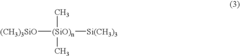
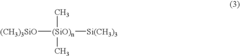
[0110] Charged into a kneader were the dimethylpolysiloxane capped at both backbone ends thereof with vinyldimethylsiloxy groups and having the viscosity of about 30,000 mPa·s at 25° C. (50 parts by weight), the dimethylpolysiloxane capped at both backbone ends thereof with trimethylsiloxy groups, containing vinylmethylsiloxane units at 10 mole % of the total siloxane units and having the viscosity of about 700 mPa·s at 25° C. (5 parts by weight), a dimethylpolysiloxane capped at both backbone ends thereof with trimethylsiloxy groups and having a viscosity of about 100 mPa·s at 25° C. (5 parts by weight), hexamethyldisilazane (8 parts by weight), water (2 parts by weight), and “Aerosil™ 300” having the specific surface area of about 300 m2 / g as measured by the BET adsorption method (product of Nippon Aerosil Co., Ltd.; 40 parts by weight). Those components were mixed at room temperature for 1 hour. Subsequently, the temperature was raised to 150° C., at which the mixing was continue...
PUM
| Property | Measurement | Unit |
|---|---|---|
| Temperature | aaaaa | aaaaa |
| Temperature | aaaaa | aaaaa |
| Temperature | aaaaa | aaaaa |
Abstract
Description
Claims
Application Information
 Login to View More