Unlock instant, AI-driven research and patent intelligence for your innovation.

Route input system

a technology of input system and route, which is applied in the direction of program control, total factory control, instruments, etc., can solve the problems of not considering the impact of yield, damage to tools, and complicated fully automated semiconductor fabs that have an important task, etc., to achieve efficient and low cost operation of manufacturing lines, enhance the advantage of ris, and improve quality and consistency.

Inactive Publication Date: 2006-05-18
GOOGLE LLC
View PDF11 Cites 7 Cited by
  • Summary
  • Abstract
  • Description
  • Claims
  • Application Information

AI Technical Summary

Benefits of technology

[0014] The present invention addresses the above-described need by providing a system which imposes a level of rigor and formality on the communications process, leading to more reliable results, more quickly than is presently available. This is done by providing a software-enabled process which facilitates consistent communication among the various entities involved in route creation, where the entities have different tasks and objectives.
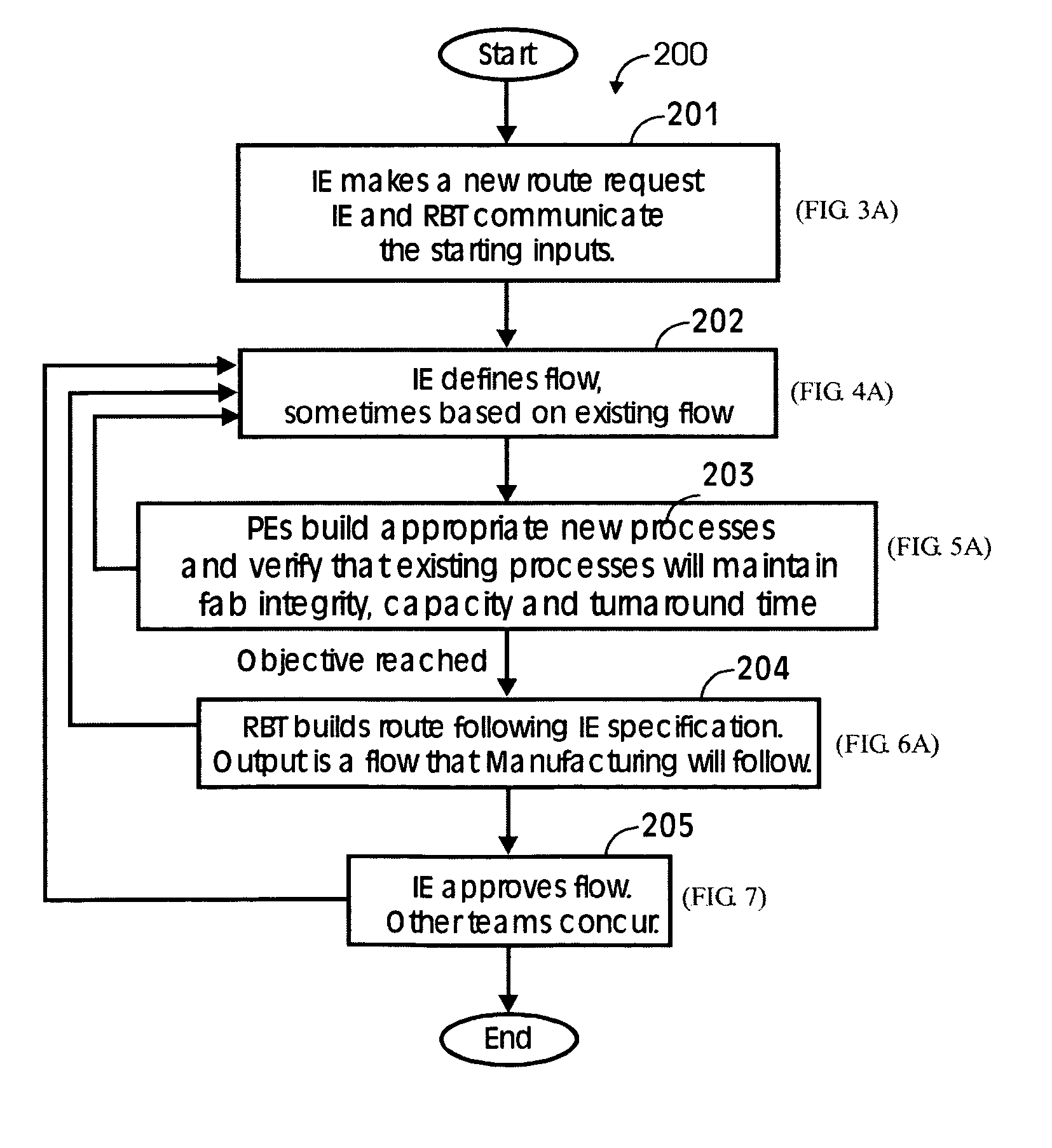
[0019] According to an additional aspect of the invention, a computerized method of building a new route which is a sequential series of manufacturing process steps for manufacturing a product comprises: defining an Integration Engineer (IE) entity responsible for what the product should look like and making input to the route build process; defining a Route Builder (RBT) entity responsible for executing building of the route that will generate the product; and defining a Process Engineer (PE) entity responsible for the processes and the tools which actually build the product; defining a manufacturing entity responsible for implementing the manufacturing process by building the product; allowing the IE entity to make a new route request by communicating with the RBT entity, identifying starting inputs, and together deciding if the new route has any overlap with existing routes so that an existing route can be used as a starting point for the new route; allowing the IE entity to define a flow; allowing the PE entity to create any new processes requested by the IE entity or reject the request to create said processes; allowing the RBT entity to build the route following the IE entity's specification; and allowing the IE entity to approve the flow.
[0021] The Route Input System (RIS) of the present invention provides a way to control the process of building a route to manufacture product, and manages the communication between the multiple teams involved in the process. In particular, the RIS of the present invention permits the communication between the route requester (IE) and the route builder (RBT) to be controlled in an efficient and consistent manner. The RIS thus assures a high level of quality and consistency in the route build process, which translates to a more efficient and lower cost operation of the manufacturing line.
[0022] The RIS of the present invention may be used with any MES, even a completely manual one. When implemented on a computer system, the advantage of the RIS is enhanced by having access to two of the MES databases: one containing the existing operations and one containing the existing routes.

Problems solved by technology

In general, however, a fully automated semiconductor fab is so complicated that they have an important task.
Poor ordering (sequencing) of process steps can result in damage to the tools.
Manufacturing typically does not consider the yield impacts in their efforts to expedite the processing of the product.
However, the input phase of the route creation activity is typically uncontrolled and based largely on ad hoc communications (e.g. email) among the various entities.
The result of this practice is that too much information is given on some aspects of the route, and not enough on others.
Such ad hoc communication solutions are not efficient and not appropriate in a high cost and possibly fully automated manufacturing environment.

Method used

the structure of the environmentally friendly knitted fabric provided by the present invention; figure 2 Flow chart of the yarn wrapping machine for environmentally friendly knitted fabrics and storage devices; image 3 Is the parameter map of the yarn covering machine
View more

Image

Smart Image Click on the blue labels to locate them in the text.
Viewing Examples
Smart Image
  • Route input system
  • Route input system
  • Route input system

Examples

Experimental program
Comparison scheme
Effect test

Embodiment Construction

[0028] In the description that follows, numerous details are set forth in order to provide a thorough understanding of the present invention. It will be appreciated by those skilled in the art that variations of these specific details are possible while still achieving the objectives of the present invention.

[0029]FIG. 1 is a diagram showing the three teams (entities) involved in the design process (creating the process flow), plus the manufacturing entity which is responsible for implementing the design process, and the general lines of communication among various entities. The various entities include:

[0030] 1. Integration Engineers (IE): People who know what the final product should look like. IE makes input to the route build process.

[0031] 2. Route Build Team (RBT): People who decide how to execute the building of the route that will generate the final desired product. This team is not found in all manufacturing environments. However, a fully automated semiconductor fab is s...

the structure of the environmentally friendly knitted fabric provided by the present invention; figure 2 Flow chart of the yarn wrapping machine for environmentally friendly knitted fabrics and storage devices; image 3 Is the parameter map of the yarn covering machine
Login to View More

PUM

No PUM Login to View More

Abstract

A software-enabled Route Input System (RIS) process facilitates consistent communication among the various entities involved in route creation, where the entities have different tasks and objectives. The primary teams are the process flow definers (IE), individual process owners (PE) and the execution team that assembles the process steps into a final manufacturing flow (RM). The IE and PE provide process flow sequence and / or process operation details required by the RBT. Additional business rules are applied by the execution team to process the input data into its final form. The RIS assures a high level of quality and consistency in the route build process, which permits more efficient and lower cost operation of the manufacturing line. The RIS may be used with any Manufacturing Execution System (MES).

Description

BACKGROUND OF THE INVENTION [0001] This invention relates to techniques for creating “routes” for a manufacturing process flow, and more particularly to creating routes for fabrication processes for semiconductor devices. As used herein, a “route” is a sequential series of manufacturing process steps. [0002] Multiple teams of people are needed to define and create a manufacturing process flow for semiconductor device fabrication. Individuals and groups belonging to these teams are referred to herein as “entities.” These entities include: [0003] (1) Integration Engineer (IE): An entity, also referred to as “requestor”, who knows the final product configuration (that is, what the finished product should look like), and defines the process flow. The IE makes input to the route build process. [0004] (2) Route Builder (RBT): An entity who decides how to execute the processes available to build the product. The RBT assembles individual process steps into the final manufacturing process fl...

Claims

the structure of the environmentally friendly knitted fabric provided by the present invention; figure 2 Flow chart of the yarn wrapping machine for environmentally friendly knitted fabrics and storage devices; image 3 Is the parameter map of the yarn covering machine
Login to View More

Application Information

Patent Timeline
no application Login to View More
IPC IPC(8): G05B19/418
CPCG05B19/41865G05B2219/32306G05B2219/32328Y02P90/02
Inventor VAREKAMP, PATRICK R.
Owner GOOGLE LLC
Features
  • R&D
  • Intellectual Property
  • Life Sciences
  • Materials
  • Tech Scout
Why Patsnap Eureka
  • Unparalleled Data Quality
  • Higher Quality Content
  • 60% Fewer Hallucinations
Social media
Patsnap Eureka Blog
Learn More