

Power and signal distribution system for use in interior building spaces
a power and signal distribution system and interior building technology, applied in relays, emergency protective arrangements for limiting excess voltage/current, transportation and packaging, etc., can solve the problems putting significant limitations on the total power available for devices, and reducing the efficiency of the device, so as to preserve mechanical functionality and general installation characteristics, the effect of reducing the overall consumption of electrical energy
- Summary
- Abstract
- Description
- Claims
- Application Information
AI Technical Summary
Benefits of technology
Problems solved by technology
Method used
Image

Examples
Embodiment Construction
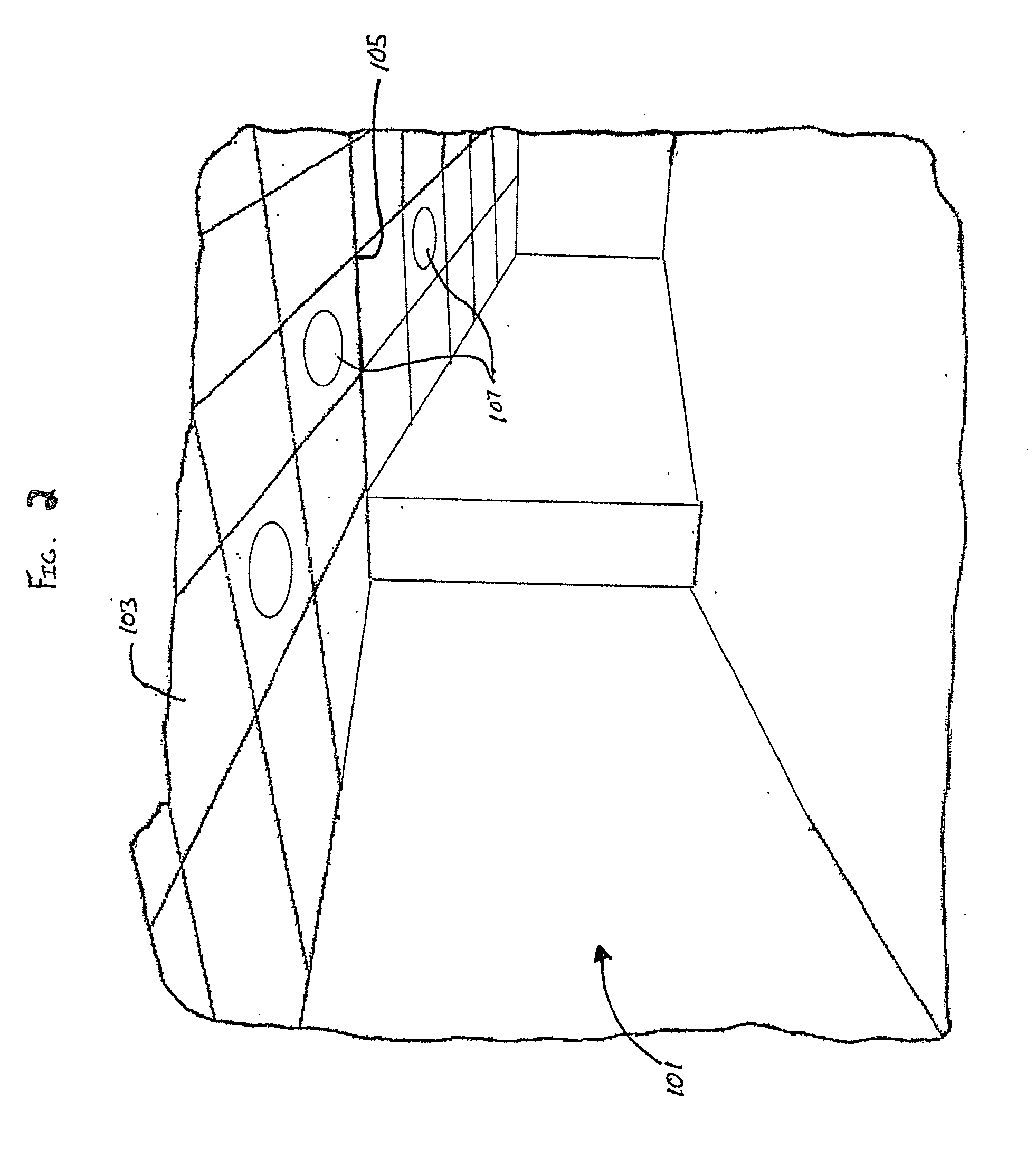
[0024] The present invention includes a system for distributing power and or signals within an electrified ceiling framework system. In particular, the present invention includes a framework, preferably mounted onto the structural overhead of a room space 101, that is capable of providing power to low voltage electrical devices 107. FIG. 2 shows a room space 101 having a ceiling 103 supported by a ceiling grid framework 105. The framework 105 is arranged to allow connections of conductive elements on or within the framework 105 to provide selective power distribution and / or selective signal distribution. For example, power for the electrical devices 107 is provided by conductive elements or conductors 201 (see FIG. 3) placed upon surfaces of the ceiling grid framework 105. The ceiling 103 may include decorative tiles, acoustical tiles, insulative tiles, lights, heating ventilation and air conditioning (HVAC) vents, other ceiling elements or covers and combinations thereof. Electrica...
PUM
 Login to View More
 Abstract
Description
Claims
Application Information
 Login to View More