[0013] The design approach according to the present invention, that continues these considerations, described in detail in the following text, is able to avoid the above-named disadvantages of the related art, and at the same time may offer the required properties at least for a part of the data, and especially achieve a desired, prespecifiable
Hamming distance (in particular a
Hamming distance of 2 or 3), in response to a clearly lower expenditure.
[0016] Such non-code data words are usually required in order to characterize the beginning of a transmission, for instance, or to distinguish between the kind of the following data, and, in the case of a continuous transmission, also to make possible the
synchronizing of the newly added receivers. Thus, for example, there are
bus systems, that is, communications systems, in which the data are organized in so-called frames that begin with a
preamble. This
preamble has to differ from the code data words. If the coding criteria for the
receiver are known, it no longer has to incorporate all code data words in the case of a required error detection or error correction, but only half. That way the required
Hamming distance between the remaining code words is expediently maintained better, without increasing the
code redundancy.
[0017] Thus, the present invention advantageously relates to a method for error handling in the transmission of coded data in the form of at least one data word via a communications
system having at least two subscribers, a
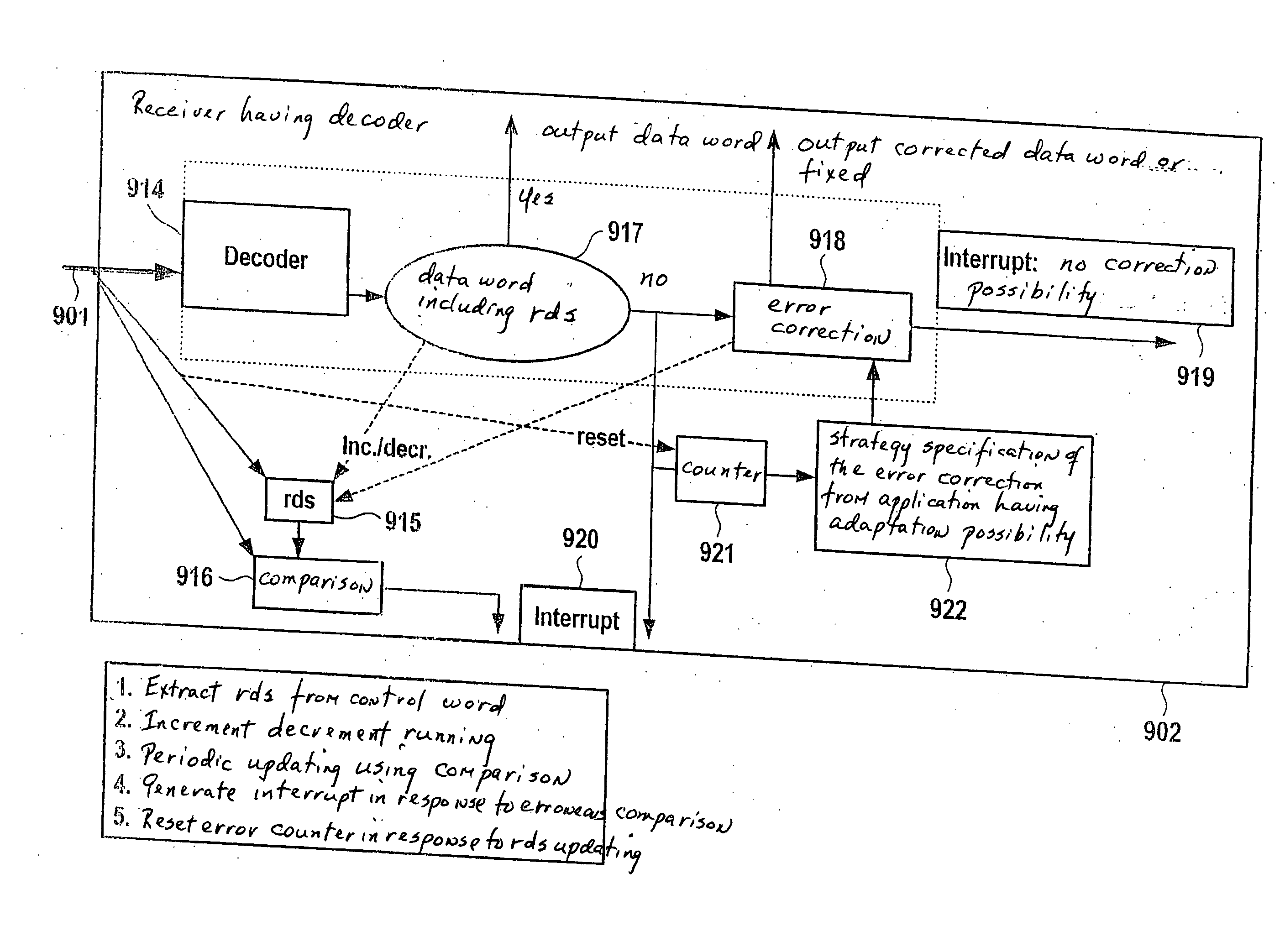
code word according to a specifiable cording rule being selected for the at least one data word; the data being represented as bits which are able to assume two different values, ones and zeros. In an expedient manner, in this context, a running digital sum, the so-called running digital sum RDS is formed in such a way that a summed difference of the total number of ones and the total number of zeros is formed at least through the data word, and this running digital sum RDS is transmitted from the first to the second subscriber, the second transcriber determining the running digital sum for the following code data word of the first subscriber and then comparing it to the one then being transmitted, an error being detected in response to a deviation. Furthermore, the transmitted running digital sum is stored in the receiver, and updated with each received data word, that is, the running digital sum is newly calculated after each data word, on the basis of the previous running digital sum and the number of ones and zeros in the data word that was just received. Provided no error occurs in the transmission, in the receiver, for each position of a data word, exactly the same information is present which the
transmitter had during the coding of this data word corresponding to the coding rule. Now each code data word can be checked as to whether the selection of the
code word is plausible or whether, under the present conditions, the inverted code data word should have been used. Not only the running digital sum is drawn upon for the checking of the plausibility, but also whether at the beginning of the received data word, according to the coding rule, a level change should take place for balanced code words (PV) and whether this level change is taking place (PE). This means that the decision for the current code data word is advantageously made a function of the current running digital sum rds and the coding rules. Because of the transmission and the constant updating, this RDS value is known to the receiver, that is, especially to a second subscriber, whereby the selection of the possible code data words may then be limited to about one half. It is therefore advantageously provided to transmit the RDS periodically, in particular, and to continue to process it on this basis in the receiver, i.e. especially in the second subscriber, until the next updating. Then, according to the present invention, using the newly received RDS value, the
correctness of the current code data words can be confirmed with respect to the data correction that has already been undertaken, or, if applicable, an error may be detected in response to a deviation.


 Login to View More