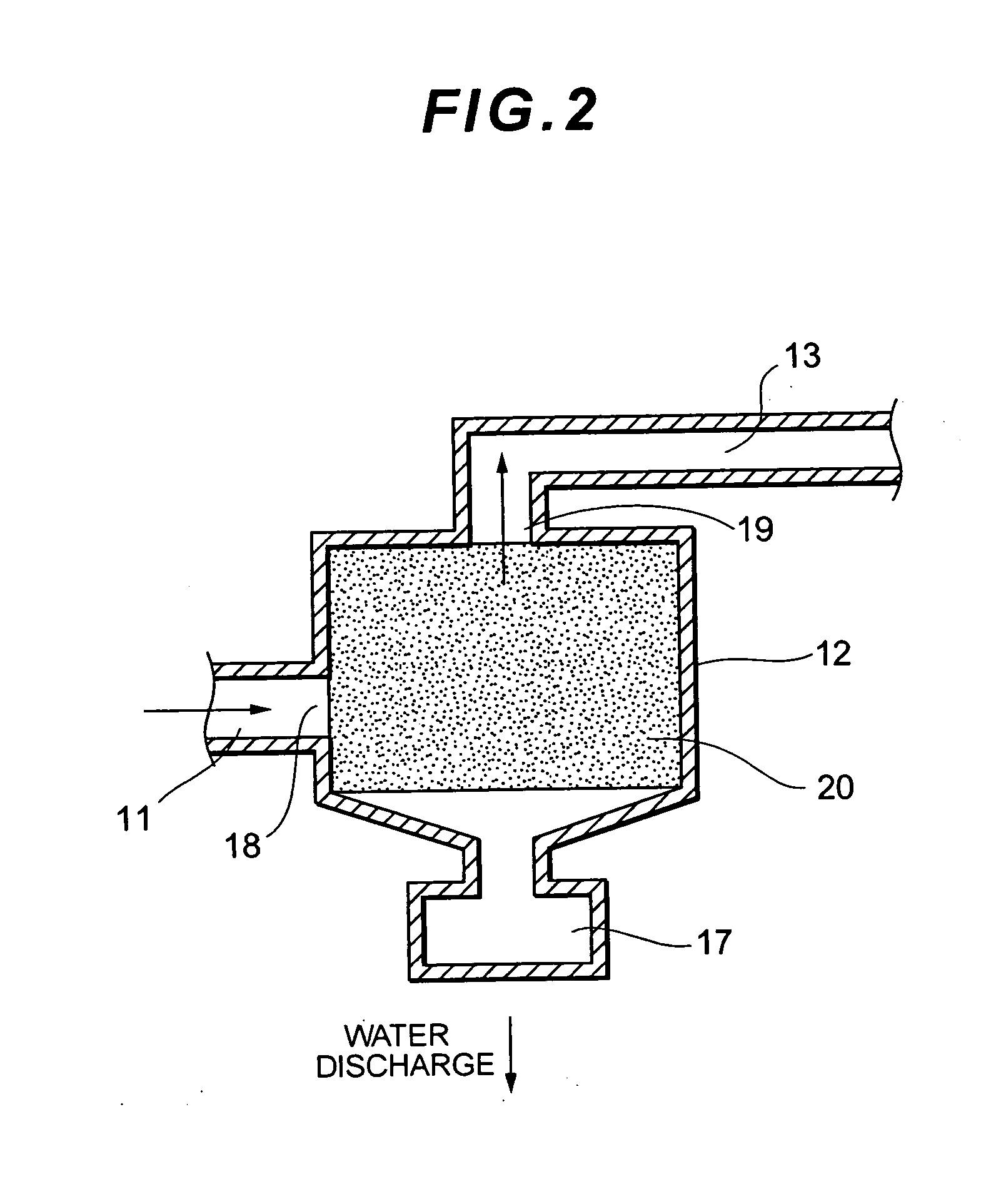
[0018] The fuel cell system according to the invention may be configured so that a gas-liquid separator is provided in the exhaust gas passage, and the
impurity removal member is placed on the inside wall surface of the gas-liquid separator. In addition to the advantageous effects described above, this configuration makes it easier for the moisture trapped (or adsorbed) by the
impurity removal member to dribble over the inside wall of the gas-liquid separator and, therefore, it is possible to remove the moisture more efficiently.
[0019] Moreover, the fuel cell system according to the invention may be configured so that a gas-liquid separator is provided in the exhaust gas passage, and the impurity removal member is placed in such a manner that a space is formed between the inside wall surface of the gas-liquid separator and the outside surface of the impurity removal member. Because of this configuration, the area where the fluid entering through a gas-liquid inlet comes into contact with the impurity removal member, that is, the inflow area for the fluid to flow into the impurity removal member can be increased. Therefore, in addition to the advantageous effects described above, it is possible to further reduce pressure loss and further enhance refinement (or purification) efficiency.
[0020] The impurity removal member can be configured so that it increases a flow resistance (a resistance caused when a gas passes) the closer it is to a gas outlet of the gas-liquid separator. Because of this configuration, in addition to the advantageous effects described above, it is possible to prevent the gas from flowing intensively around the gas outlet of the gas-liquid separator.
[0021] If the impurity removal member is placed inside the gas-liquid separator, a space originally existing in the gas-liquid separator can be used as a loading space to receive the impurity removal member. Therefore, there is no need to increase the size of the fuel cell system in order to install the impurity removal member. Also, only the very minimum components are required to install the impurity removal member and, therefore, it is possible to curb any cost increases.
[0022] Furthermore, the fuel cell system according to the invention can be configured so that a gas-liquid separator is provided in the exhaust gas passage, and the impurity removal member is located downstream from the gas-liquid separator. This configuration makes it possible to efficiently and securely remove the moisture that was not removed by the gas-liquid separator, along with the impurities mixed in the moisture.
[0023] Also, in the fuel cell system according to the invention, the impurity removal member can be treated to make it water-repellent. This water-repellent treatment makes it possible to more efficiently remove the moisture particles mixed in the exhaust gas flowing through the exhaust gas passage.



 Login to View More
  Login to View More