
Signal analysis system and calibration method for multiple signal probes
- Summary
- Abstract
- Description
- Claims
- Application Information
AI Technical Summary
Benefits of technology
Problems solved by technology
Method used
Image

Examples
Embodiment Construction
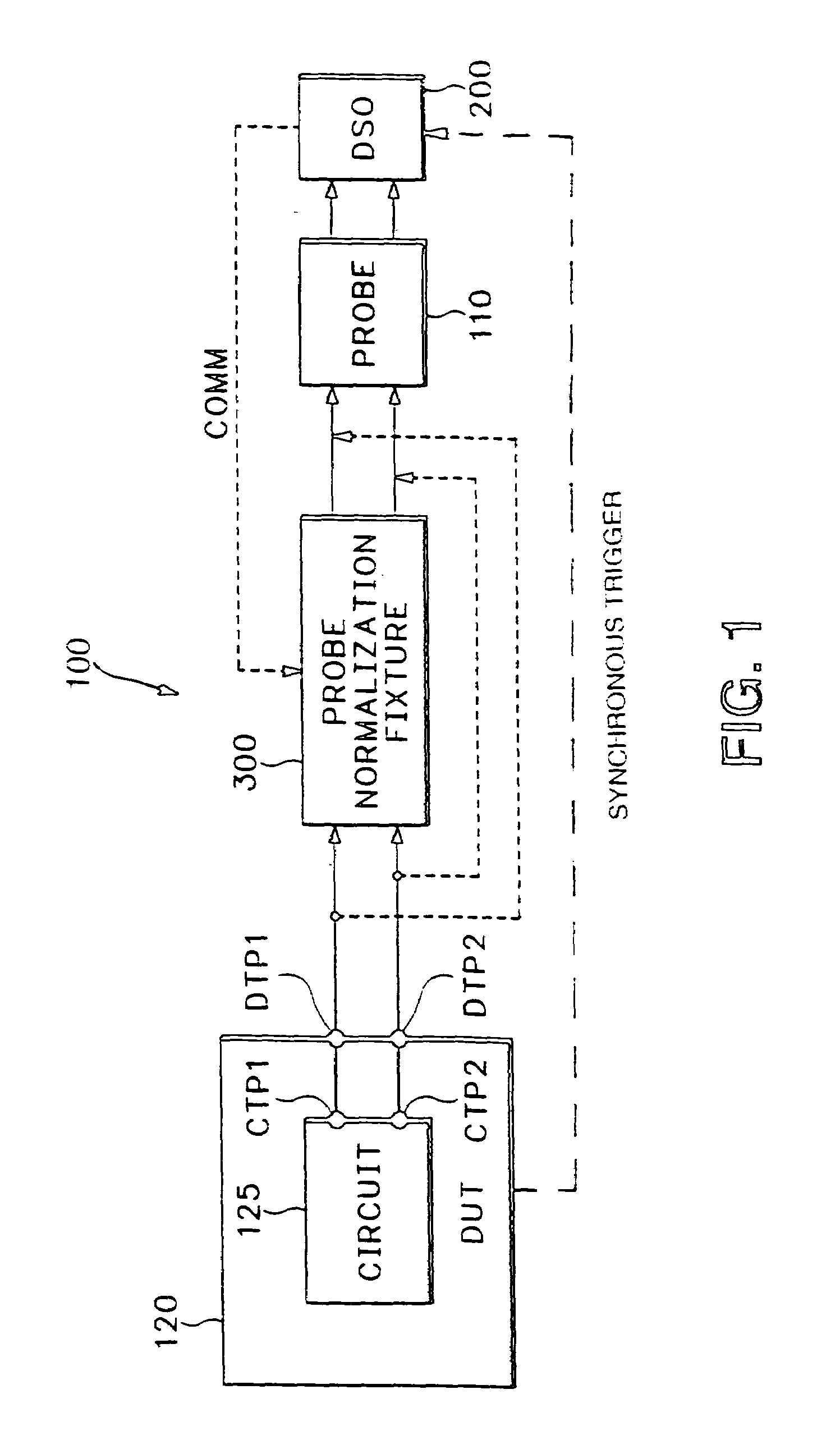
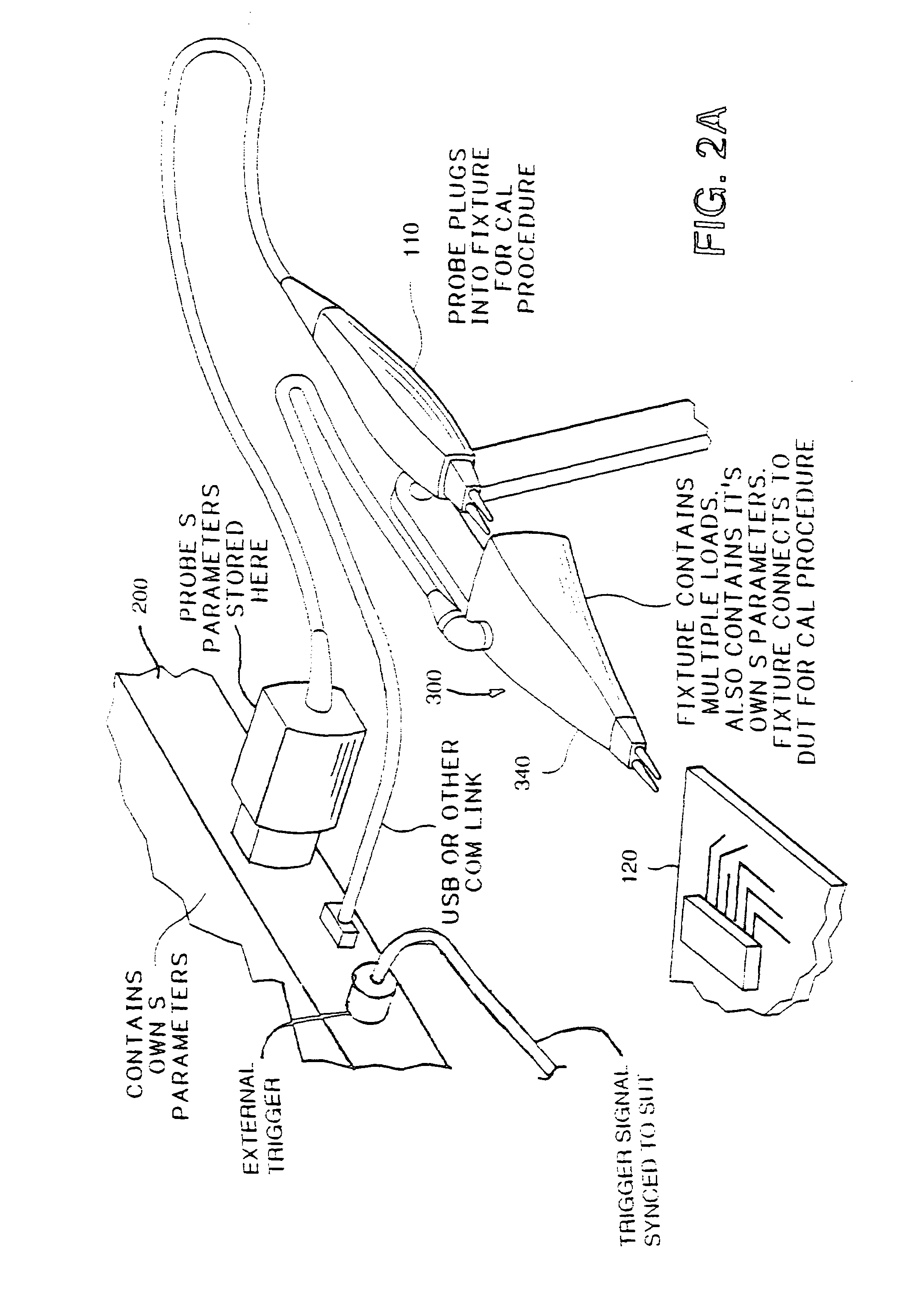
[0027]FIG. 1 depicts a high level block diagram of a signal analysis testing system 100 including a device under test arranged in accordance with various embodiments of the present invention. Specifically, a probe 110 is operably coupled to a signal analysis device such as a digital storage oscilloscope (DSO) 200 to provide thereto a signal under test (SUT) received from a device under test (DUT) 120. A probe normalization fixture 300 is selectively interposed between the DUT 120 and probe 110.
[0028]The invention operates to calibrate a signal path including the probe 110 and, optionally, DSO input channel to remove (i.e., de-embed) their respective signal degrading effects from the measurement of the DUT (or circuit) including transmission errors in the system. This de-embedding process is conducted by characterizing the probe 110 and other elements using a two-port S parameter or T parameter representation, which representation may be used to adjust impedance normalization paramet...
PUM
 Login to View More
 Abstract
Description
Claims
Application Information
 Login to View More