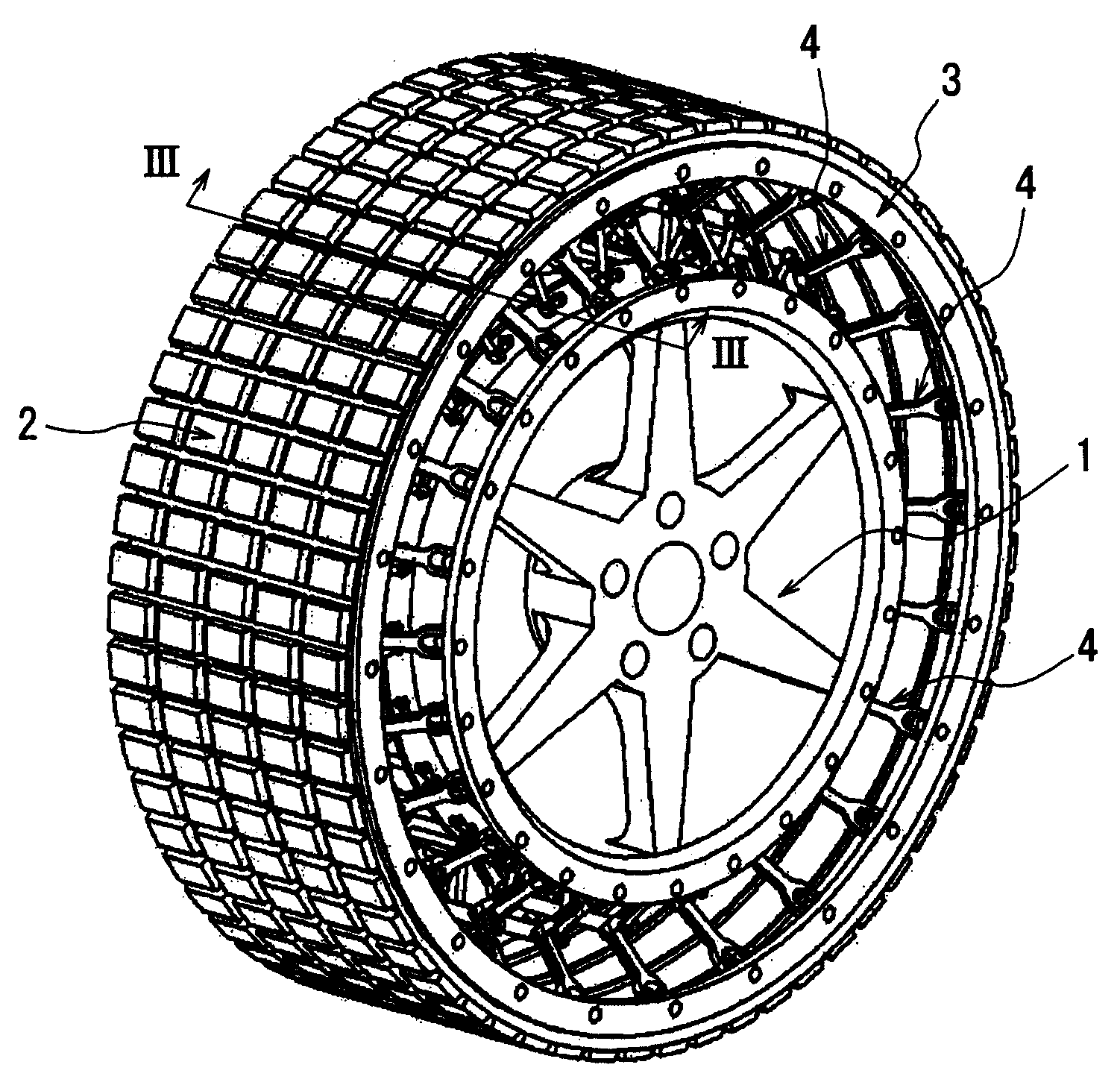
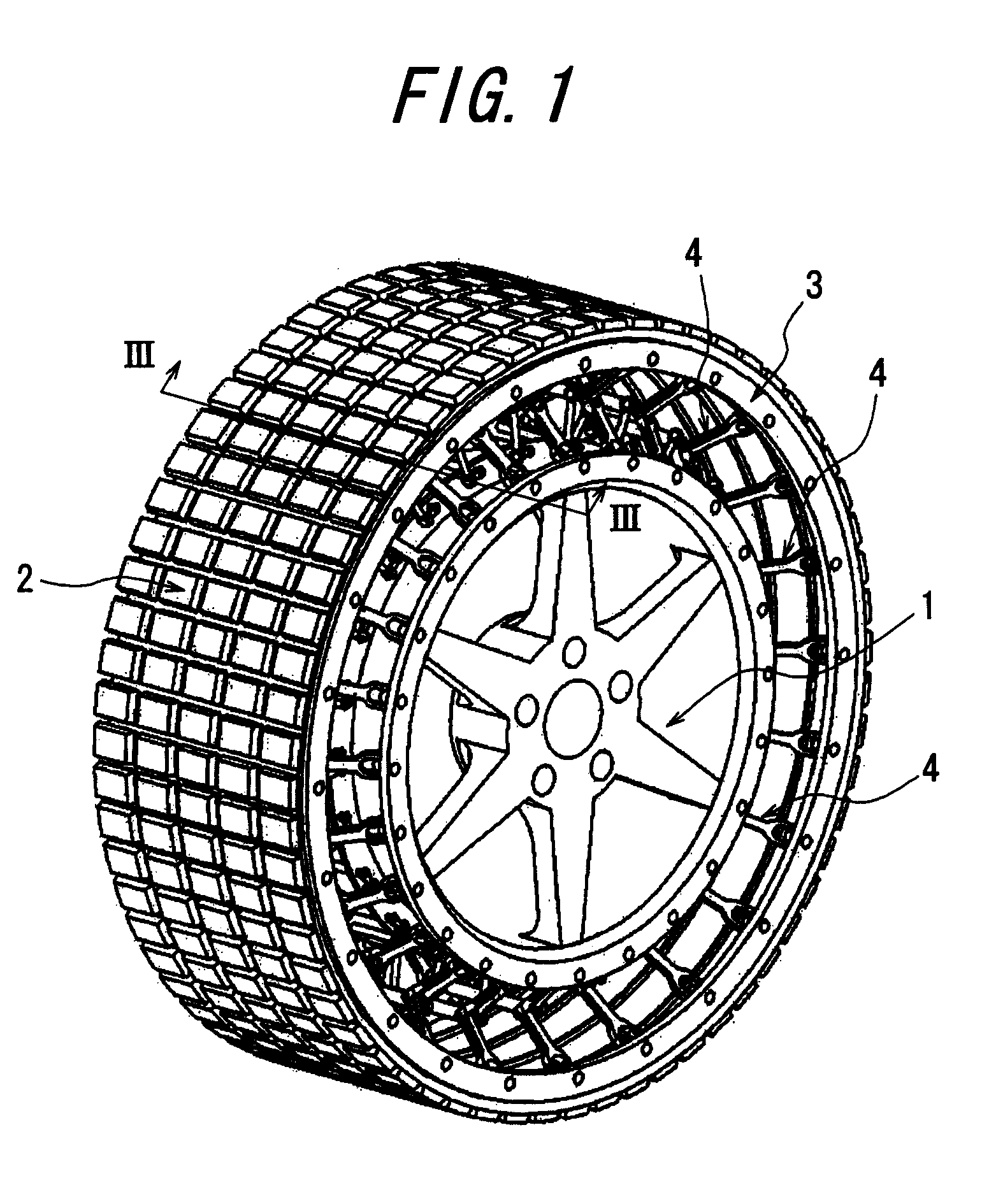
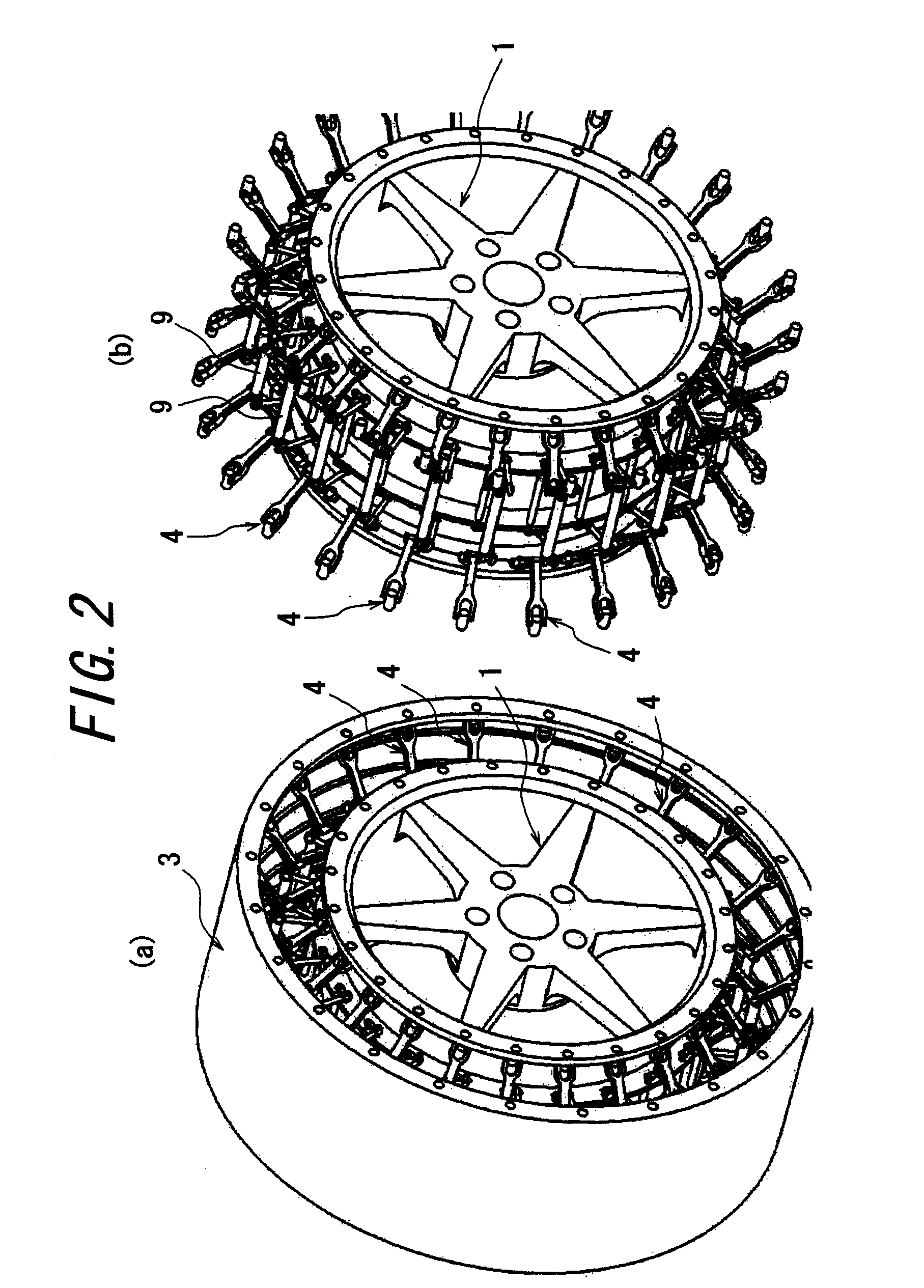
[0014]According to the first aspect of the non-pneumatic tire of the present invention, one ore more kinds of elastic means imparting a required stiffness against relative displacements in the
radian, circumferential and width directions with respect to the rim and ring members is provided on the link mechanisms consisting of the pair of link members which are aligned, for example, in the meridian direction and which connect the rim member with the ring member on which the
tread is formed. This can eliminate a necessity of filling an air pressure or any other
internal pressure into the tire provided with a
tread on the circumferential face of the ring member, and can easily provide vertical, longitudinal and lateral stiffnesses of required magnitudes to the tire on the basis of a pre-selected elastic force and according to the amount of the displacement from the
neutral position, with the stiffnesses being independent with each other.
[0015]When one of the elastic means consists of a spring member which connects respective hinge connections of the second ends of the links of the pair of link members with each other and which has a natural length under a unloaded condition, the various required stiffnesses can be effectively exerted by the spring member.
[0016]That is, under an action of a
vertical load on the tire, a compressive or tensile reactive force is produced on the spring member by a displacement of the link member in the compressive direction in the grounding surface side of the tire tread due to a displacement of the ring member approaching to the rim member, so that a required
vertical stiffness can be exerted on the tire. On the other hand, under an action of a longitudinal load on the tire, a tensile or compressive reactive force is produced on the spring member by a
relative displacement of the link member in the elongation direction in the grounding surface side due to a
relative displacement of the ring member in a leading or lagging phase with respect to the rim member, so that a required longitudinal stiffness can be exerted on the tire. Further, under a lateral load on the tire, a tensile or compressive reactive force is produced on the spring member by an increase of the distance between the pair of link members and the hinge connection due to a
relative displacement of the ring member in the width direction of the rim member, so that a required
lateral stiffness can be exerted on the tire.
[0017]In such a tire, when another one of the elastic means consisting of a
torsion spring member such as a
torsion spring or a rubber
bushing which is arranged at the connection of the first end of at least one of the link of the link members and which imparts a stiffness against swing displacements of the link in the circumferential direction is provided in addition to the above-mentioned spring means, the longitudinal stiffness of the tire can be selectively enhanced under an action of the
torsion spring member.
[0018]Moreover, when there is provided a further elastic means consisting of a torsion bar disposed between the hinge connection of the second ends of the links of the pair of link members via a pair of connecting rods having moment arms, the
lateral stiffness of the tire can be selectively increased by a torsional force applied to the torsion bar via the moment arm due to a mutual change of the
radial position of the above-mentioned hinge connection or, in other words, the radial height of the hinge connection from the rim member on the occasion of a relative displacement of the ring member in the width direction caused by the action of a lateral load to the tire.
[0019]According to the second aspect of the non-pneumatic tire of the present invention, particularly a torsion spring member imparting a stiffness against swing displacements of the links in the meridian direction is disposed between the respective hinge connections of the second ends of the links of the pair of link members constituting the link mechanism, so that the torsion spring member on the hinge connections can effectively exert the stiffnesses of the magnitudes according to the amounts of the swing displacements of the links from the
neutral position against relative displacements in the radial, circumferential and width directions of the tire.



 Login to View More
  Login to View More