
Electrostatic chuck with heater and manufacturing method thereof
- Summary
- Abstract
- Description
- Claims
- Application Information
AI Technical Summary
Benefits of technology
Problems solved by technology
Method used
Image

Examples
example 1
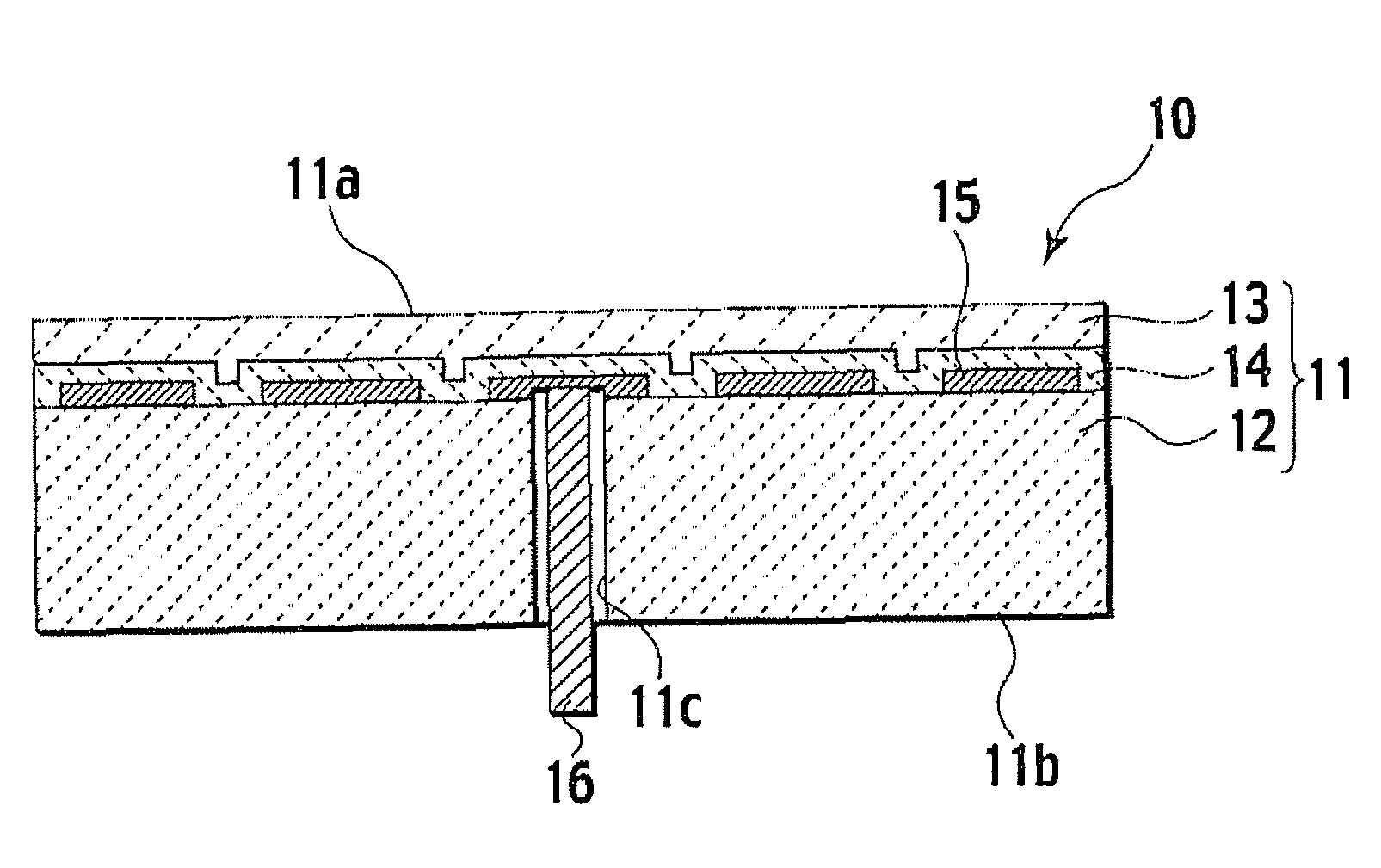
[0114]Example 1 is an example of manufacturing the electrostatic chuck shown in FIG. 3 in accordance with the steps shown in FIG. 5A to FIG. 5F.
[0115]As the raw material powder of the alumina sintered body, alumina powder with a purity of 99.9 wt % and an average particle diameter of 0.5 μm was prepared. To the alumina powder, there were added water, a dispersant, and polyvinyl alcohol (PVA) as a binder. Then, a resultant was mixed by a trommel for 16 hours, and raw material slurry was prepared. The obtained raw material slurry was shifted through a sieve with an aperture of 20 μm, and impurities were removed therefrom. Then, the slurry was sprayed and dried by using the spray dryer, and granules of alumina with an average particle diameter of approximately 80 μm were prepared. The granules thus obtained were calcined at 500° C. in an atmospheric pressure oxidation furnace.
[0116]Next, the granules of alumina were filled into the metal mold, and were pressed with 50 kgf / cm2 by a unia...
example 2
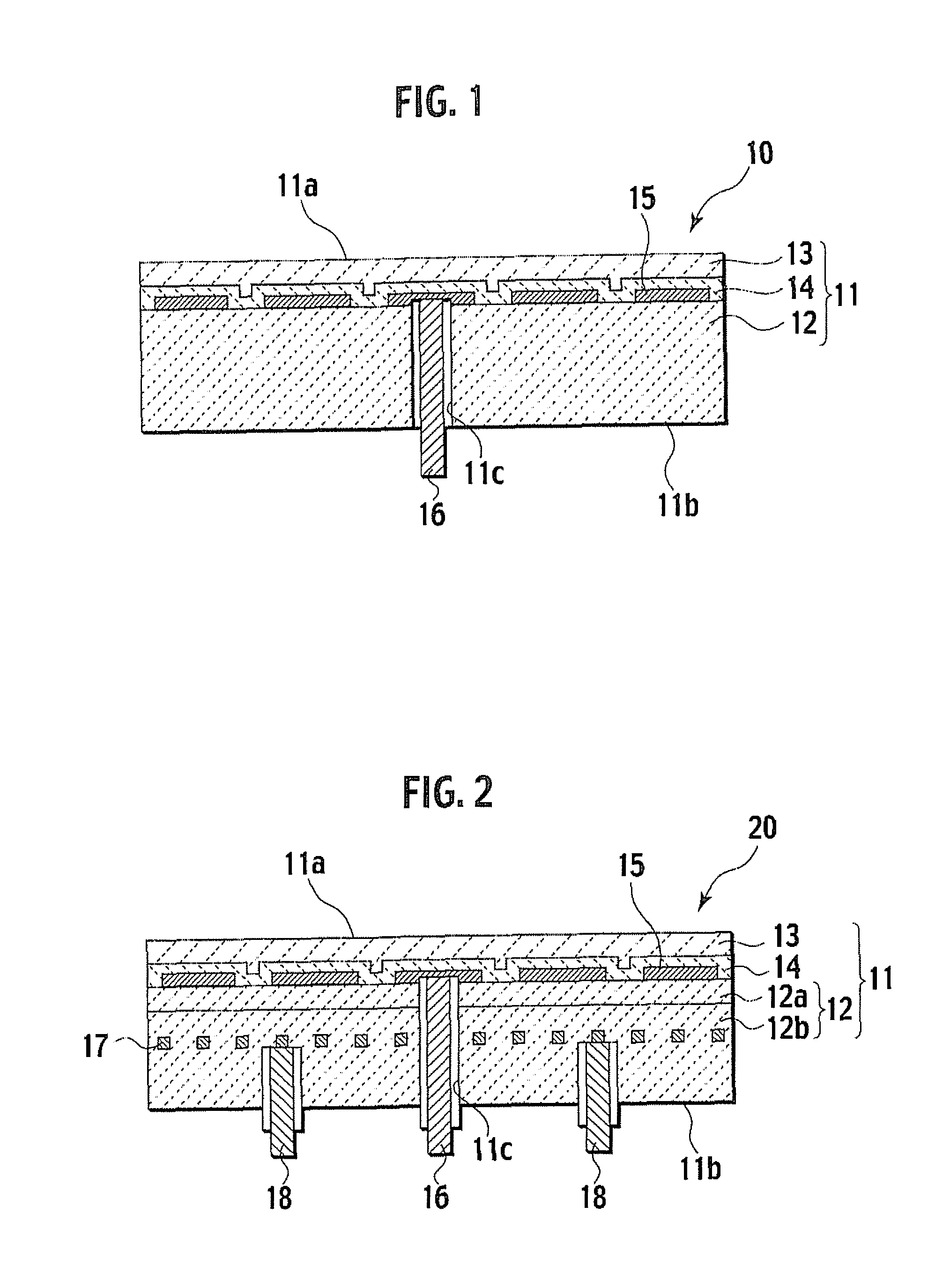
[0123]Example 2 is an example of manufacturing the electrostatic chuck with a heater in accordance with the steps shown in FIG. 6A to FIG. 5F.
[0124]As the raw material powder of the alumina sintered body, alumina powder with a purity of 99.9 wt % and an average particle diameter of 0.5 μm was prepared. To the alumina powder, there were added water, a dispersant, and polyvinyl alcohol (PVA) as a binder. Then, a resultant was mixed by the trommel for 16 hours, and raw material slurry was prepared. The obtained raw material slurry was shifted through the sieve with an aperture of 20 μm, and impurities were removed. Then, the slurry was sprayed and dried by using the spray dryer, and granules of alumina with an average particle diameter of approximately 80 μm were prepared. The granules thus obtained were calcined at 500° C. in the atmospheric pressure oxidation furnace.
[0125]Next, the granules of alumina were filled into the metal mold, and were pressed with 50 kgf / cm2 by the uniaxial ...
example 3
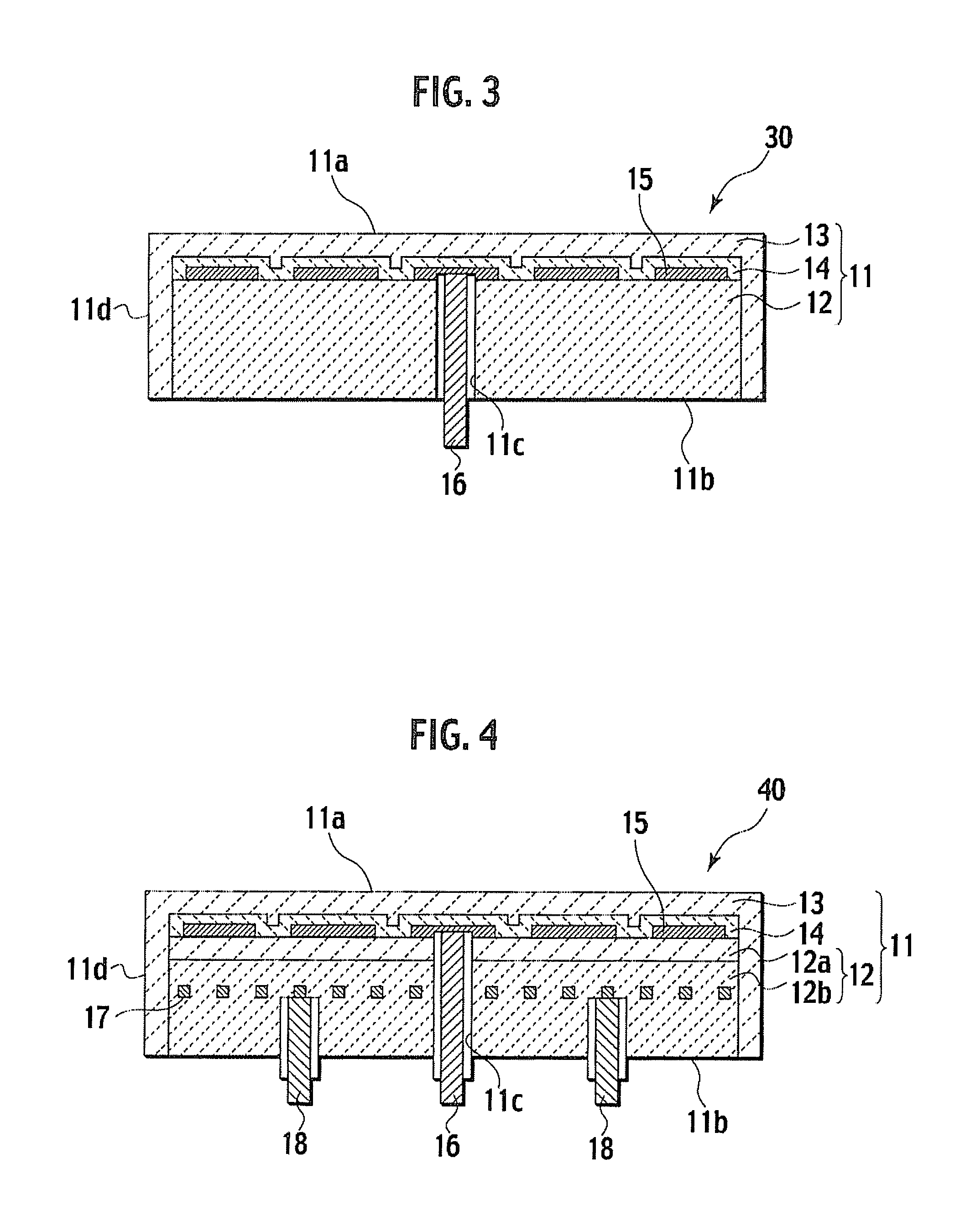
[0142]Example 3 is an example of manufacturing the electrostatic chuck with a heater, which is shown in FIG. 4.
[0143]As the raw material powder of the alumina sintered body, alumina powder with a purity of 99.9 wt % and an average particle diameter of 0.5 μm was prepared. To the alumina powder, there were added water, a dispersant, and polyvinyl alcohol (PVA) as a binder. Then, a resultant was mixed by the trommel for 16 hours, and raw material slurry was prepared. The obtained raw material slurry was shifted through the sieve with an aperture of 20 μm, and impurities were removed. Then, the slurry was sprayed and dried by using the spray dryer, and granules of alumina with an average granule diameter of approximately 80 μm were prepared. A carbon amount of the obtained granules was 1.2 wt % to 1.8 wt %.
[0144]Next, a part of the obtained granules was separated by a predetermined amount, and the predetermined amount of the granules was calcined at 500° C. in the atmospheric pressure ...
PUM
| Property | Measurement | Unit |
|---|---|---|
| Temperature | aaaaa | aaaaa |
| Length | aaaaa | aaaaa |
| Length | aaaaa | aaaaa |
Abstract
Description
Claims
Application Information
 Login to View More