

By-product removal for wafer bonding process
a wafer bonding and by-product technology, applied in the field of three-dimensional integrated circuits, structure and manufacturing processes for forming three-dimensional integrated circuits, can solve the problems of reducing the density of two-dimensional components, requiring a minimum size of these components, and reducing the quality of bonding, so as to achieve the effect of improving the bonding quality
- Summary
- Abstract
- Description
- Claims
- Application Information
AI Technical Summary
Benefits of technology
Problems solved by technology
Method used
Image

Examples
Embodiment Construction
[0017]The making and using of the presently preferred embodiments are discussed in detail below. It should be appreciated, however, that the present invention provides many applicable inventive concepts that can be embodied in a wide variety of specific contexts. The specific embodiments discussed are merely illustrative of specific ways to make and use the invention, and do not limit the scope of the invention.
[0018]A novel method for forming three-dimensional (3D) integrated circuits is provided. The intermediate stages of manufacturing a preferred embodiment of the present invention are illustrated. Throughout the various views and illustrative embodiments of the present invention, like reference numbers are used to designate like elements.
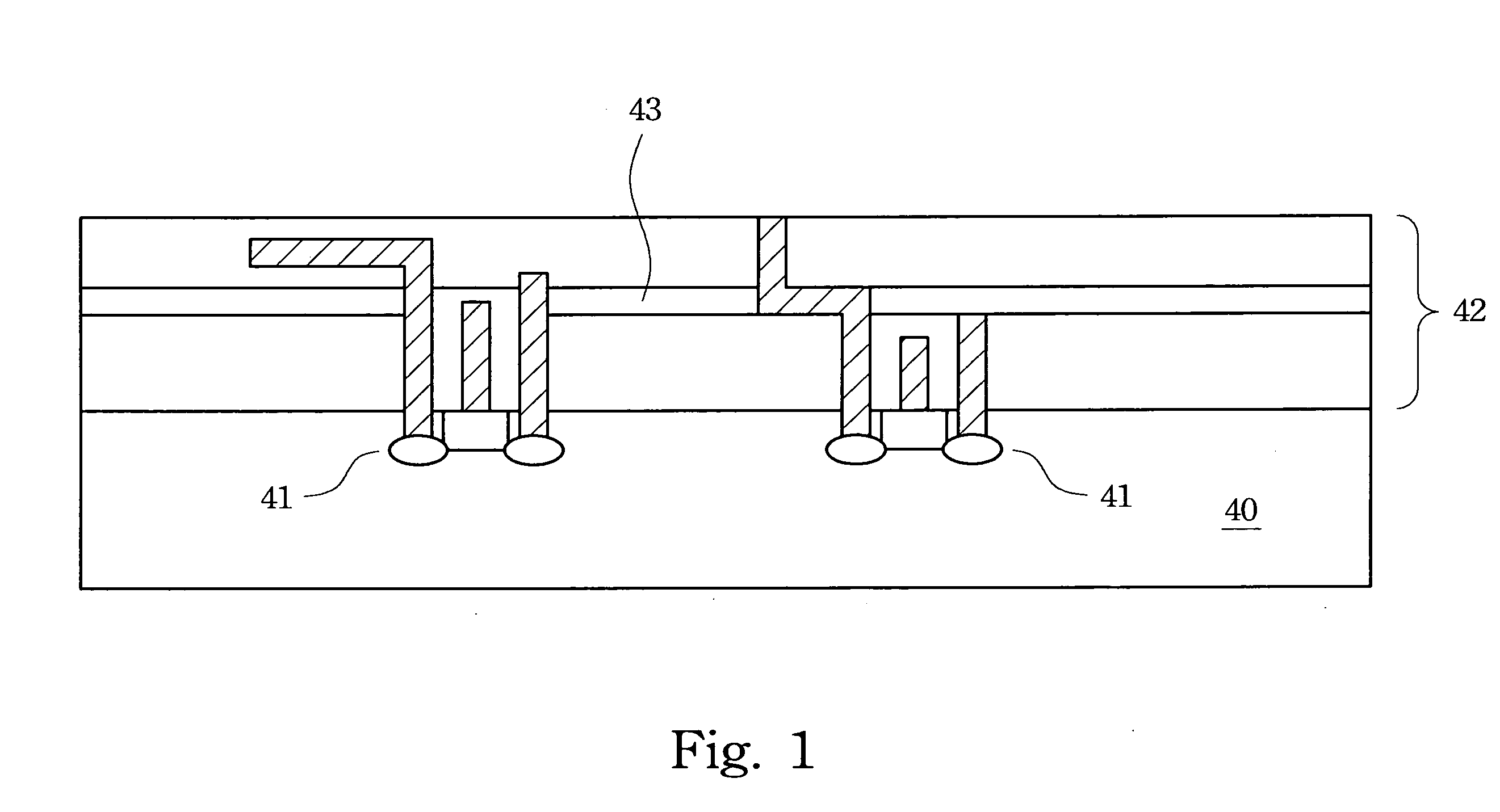
[0019]In FIG. 1, a first wafer is provided. In the preferred embodiment, the first wafer has a semiconductor substrate 40 on which devices 41 are formed. As schematically shown, an interconnect structure 42 is formed over semiconductor substrat...
PUM
 Login to View More
 Abstract
Description
Claims
Application Information
 Login to View More