
Novel Dehydrogenases, the Derivatives thereof, and Method for the Production of Optically Active Alkanols
Patent Information
- Authority / Receiving Office
- US · United States
- Current Assignee / Owner
- Publication Date
- 2008-09-11
- Estimated Expiration
- Not applicable · inactive patent
Smart Images

Figure 1 
Figure 2 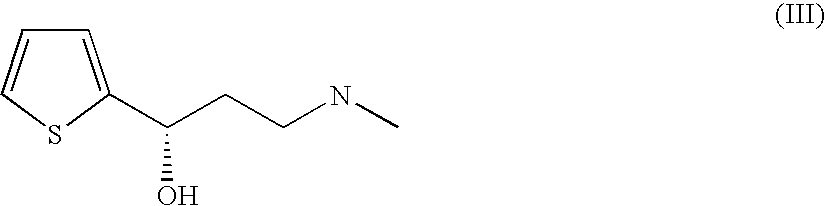
Figure 3
Abstract
Description
[0001] The present invention relates to proteins having an enzymatic activity for reducing substituted alkanones such as 3-methylamino-1-(2-thienyl)-propan-1-one. The invention furthermore relates to nucleic acids coding for said proteins, nucleic acid constructs, vectors, genetically modified microorganisms and to methods for preparing optically active substituted alkanols, in particular (S)-alkanols, such as, for example, (S)-3-methylamino-1-(2-thienyl)-(S)-propanol.PRIOR ART
[0002] Dehydrogenases are versatile catalysts for the enantioselective reduction of aldehydes or ketones to give the corresponding alcohols. A distinction is made between (R)- and (S)-specific dehydrogenases. These catalysts are increasingly being used for industrial synthesis of optically active alcohols. Optical activity is the precondition of selective action of many pharmaceutical and agrochemical active compounds. Here, one enantiomer may have the desired action and the other enantiomer a genotoxic action. ...
Examples
example 1
[0140]Relative activity of the dehydrogenases of the invention for various substrates (optical purity in % ee is indicated in brackets)
Comparative enzymeADH-3 enzymeADH-4 enzymeEP 1152054SubstrateSEQ ID NO: 2SEQ ID NO: 4SEQ ID NO: 1Acetophenone16.08 (>99%) 3.14 (70%) 0.84 (>99%)m-DICAP 100 (>99%)56.38 (12%) 2.3 (>99%)CMAP34.46 (90%)24.89 (88%)29.44 (98%)
[0141]The reaction was carried out without cofactor regeneration.
Reaction Mixture:
[0142]180 μl of 50 mM Kpi buffer, including 1 mM MgCl2
[0143]20 μl of enzyme solution
[0144]200 μl of NADPH, 10 mM stock solution
[0145]100 μl of substrate, 1 M stock solution 500 μl of hexane
[0146]The reaction mixture was incubated at 37° C. and 1000 rpm for approx. 20 hours. It was then centrifuged at 20° C., the clear supernatant was removed and analyzed by chiral gas chromatography.
example 2
[0147]Relative activity of the dehydrogenases of the invention for various substrates (optical purity in % ee is indicated in brackets) with cofactor regeneration.
[0148]The reaction was carried out in a manner similar to example 1. Cofactor regeneration was carried out by way of addition of glucose and glucose dehydrogenase in a monophasic liquid system.
Comparative enzymeADH-3 enzymeADH-4 enzymeEP 1152054SubstrateSEQ ID NO: 2SEQ ID NO: 4SEQ ID NO: 1Acetophenone 8.9 (>99% S)not determined 0.7 (>99% S)m-DICAP 100 (>99% R)55.8 (25% S)47.1 (93% R)p-DICAP18.9 (>99% R)62.1 (44% S)62.5 (>99% R)FCA99.5 (>99% R)53.6 (58% S)50.4 (>99% R)
example 3
[0149]Relative activity of the dehydrogenases of the invention for various substrates (optical purity in % ee is indicated in brackets) with cofactor regeneration in the 2-phase system.
[0150]The reaction was carried out in a manner similar to example 2. Cofactor regeneration was carried out by way of addition of glucose and glucose dehydrogenase in a two-phase liquid system (MTBE: aqueous).
Comparative enzymeADH-3 enzymeADH-4 enzymeEP 1152054SubstrateSEQ ID NO: 2SEQ ID NO: 4SEQ ID NO: 1Acetophenone71.2 (>99% S) 0.4 (70% S) 0.2 (>99% S)m-DICAP 100 (>99% R)24.6 (6% S) 14 (>99% R)p-DICAP30.4 (>99% R)27.6 (42% S)24.2 (>99% R)FCA99.5 (>99% R)15.3 (46% S)12.6 (>99% R)CMAP 100 (>99% R)77.1 (97% S)46.8 (>99% R)Abbreviations:m-DICAP: 2,3′-dichloro-acetophenonep-DICAP: 2,4′-dichloro-acetophenoneFCA: 4′-fluoro-2-chloro-acetophenoneCMAP: 4-chloro-methoxyacetophenone