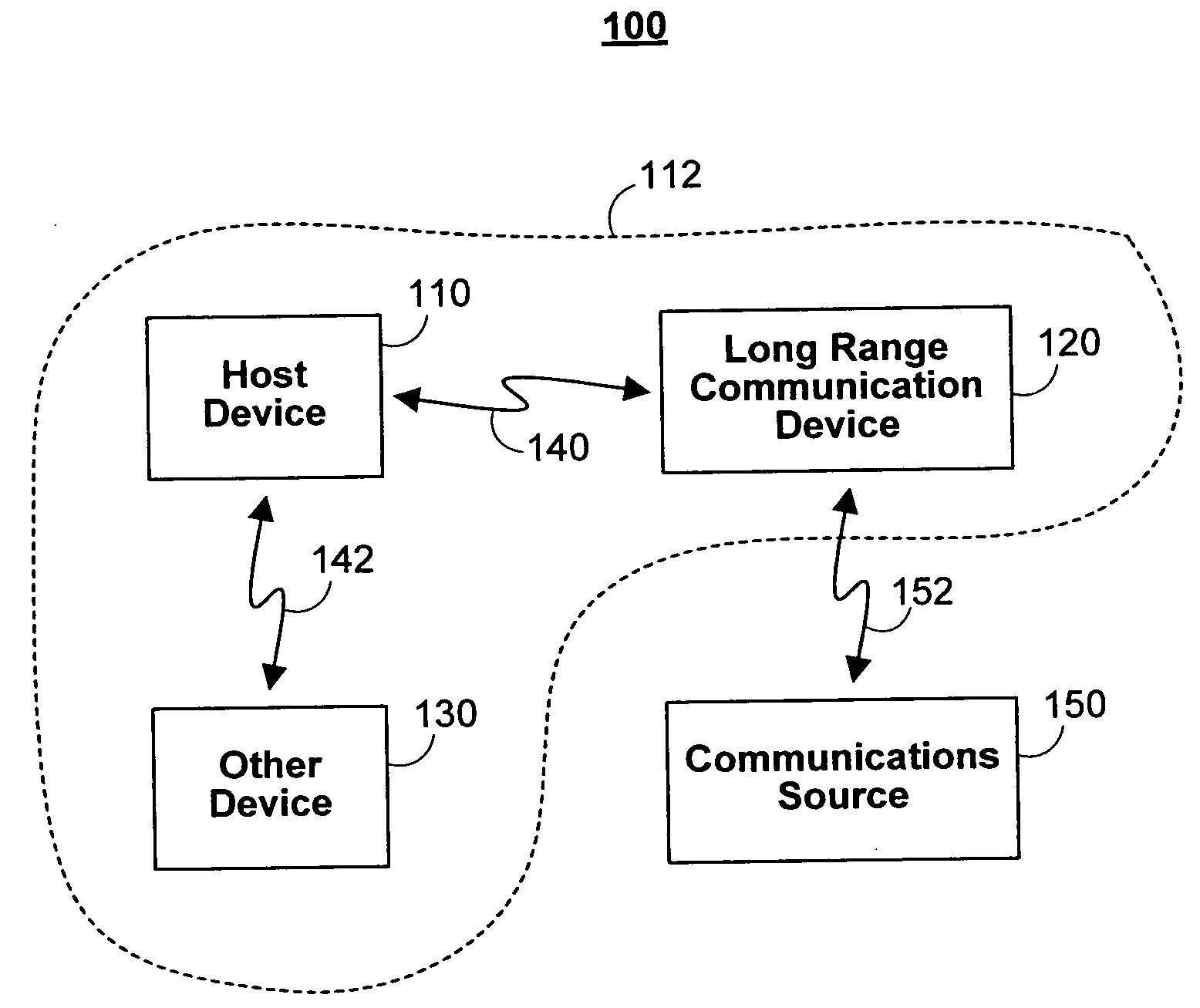
[0005]The host device can include an interface for enabling a user to access functions typically only provided in devices including long-range communications circuitry. For example, a user may place or take a
telephone call using the host device by wirelessly communicating with the long-range communications device via the short-range communications protocol. Thus, an
advantage of the invention is that the host device can serve as the interface for performing functions on both the host device and long distance
communication device.
[0006]In one embodiment, the long-range communication protocol device may include a
user interface. This
user interface may be accessed independent of the host device to, for example, place or take calls or access other applications or functions that may be executed on the multi-protocol device.
[0007]In another embodiment, the long-range
communication device may be a “dummy” device or an
RF module that includes both short and long-range communications circuitry and an optional power source. The
RF module may be constructed with or without a direct
user interface. In addition, the
RF module may be constructed to be a high efficiency, low cost, device that provides a host device access to a long-range communications protocol. In some embodiments, the RF module may be powered by an external power source such as an outlet.
[0008]RF modules may be ubiquitous in that they permeate every aspect of a person's life. For example, a user may keep a RF module on his or her person such in a purse, handbag or article of clothing, in a house, a transportation vehicle (e.g., a car), or an office. This way, a user need not worry about having to carry a long-range communications device wherever he or she may go, as a RF module may be kept in locations frequently visited by the user. In some applications, multiple RF modules may be kept in a location (e.g., a house or city). When the user moves from one location to another, the host device may determine which RF module to access when requiring use of a long-range communications protocol. In addition, the host device may maintain a communication event (e.g., a
telephone call) without interruption (e.g., a dropped call) when switching from one RF module to another or to a wireless phone.
[0009]Regardless of which long-range communications device is used, the host device can serve as the primary interface unit or host of a
personal area network that wirelessly interfaces that long-range
communication device. In some embodiments, the host device may be used to participate in communication events, such as telephone calls and text messages. For example, a user may scroll through a
list of contacts on the host device, select a contact, and initiate a call with the selected contact. In another example, while a user is listening to music, the host device can indicate to the user the occurrence of a communication event (e.g.,
telephone call or
text message) and provide the user with an opportunity to interact with the communication event.
[0010]In other embodiments,
peripheral devices may communicate with the host device or a
hybrid host / long-range communications device (e.g., a phone including short range communications circuitry) using a short range communications protocol.
Peripheral devices can be portable, handheld, miniature, or wearable devices. The
peripheral device can be used to control the operation of the host or
hybrid device or may be used to display information relating to a function or feature of the host or
hybrid device. For example, a
peripheral device may be a fashion accessory such as a watch that may display information (e.g., the name of the currently playing song or name of the person on the call) and also allow a user to control functions (e.g., playback, volume, or
telephony features such as end call and accept call) of the host device. Other peripheral devices may provide host control functions but may not have a display, and yet other peripheral devices may provide input (e.g., keyboard) and output (e.g., LCD or printer) functions.



 Login to View More
  Login to View More