
Derivatives of 2-nitro-1,3-imidazole coupled to amino acids and deoxyribose useful for the detection of hypoxic biological tissue
a technology of amino acids and deoxyribose, which is applied in the field of 2nitroimidazole derivatives, can solve the problems of low contrast in imaging processes, poor clinical routine use of nitroimidazoles or their derivatives, and the area of hypoxic tissue affected patients' affected areas
- Summary
- Abstract
- Description
- Claims
- Application Information
AI Technical Summary
Benefits of technology
Problems solved by technology
Method used
Image

Examples
example 1
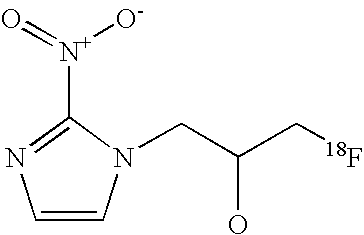
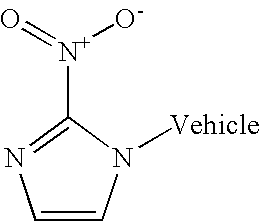
[0068]In the following an example of a synthesis of a 2-nitroimidazole derivative coupled to an amino acid is shown. As a coupling component e.g. a triol, here glycerol can be used. Many other variants of the reaction are conceivable. R1 is any substituted benzaldehyde derivative for the masking of 1,3-diol functions. Z is a leaving group for a substitution reaction, e.g. -Br or -tosylate. R′ and R″ are any NH2 or COOH protecting groups. L is any substituent. 18F is fluoride-18. The compound 1a shows the labelling precursor, the compound 2a the tracer.
example 2
[0069]In the following a further example of a synthesis of a 2-nitroimidazole derivative coupled to deoxyribose is shown. The possible variants of the synthesis are numerous. If it is started with a fluorinated deoxyribose in the first step the fluorinated products (tracer) 5 and 6 are obtained via the labelling precursors 3 and 4.
[0070]As end products an α / β-product mixture is obtained which can be chromatographically separated.
example 3
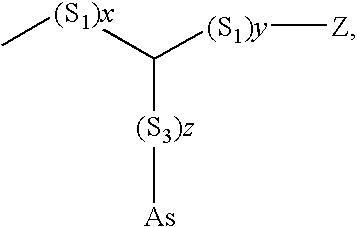
[0071]In the following an example of a synthesis of a 2-nitroimidazole derivative coupled to a fatty acid is shown (labelling precursor 7, tracer 8). The possible variants of the synthesis are numerous. Z corresponds to a leaving group for a nucleophilic substitution, R1 is a carbonyl protecting group (CH3, C2H5, CH2OCH3, CH2SCH3, CH2OCH2C6H5, CH2CCl3, C(CH3)3, CH2C6H5, CH2C6H2-2,4,6-(CH3)3) and Y can be a proton, a halogen atom, a hydroxyl function or an alkyl group. R2 is an ether group (methyl, ethyl, etc.) which can be selectively cleaved off if an ester group is obtained. The groups S1, S2 and S3 are selected from the alkyl, alkenyl, aryl, arylalkyl groups, ether, ester, amid bridges, linked, interrupted alkyl, alkenyl, aryl, arylalkyl groups; x, y, z is an integer from 0 to 8, OTs or TsO, respectively, is tosylate.
PUM
| Property | Measurement | Unit |
|---|---|---|
| chemical structure | aaaaa | aaaaa |
| pharmaceutical composition | aaaaa | aaaaa |
| concentration | aaaaa | aaaaa |
Abstract
Description
Claims
Application Information
 Login to View More