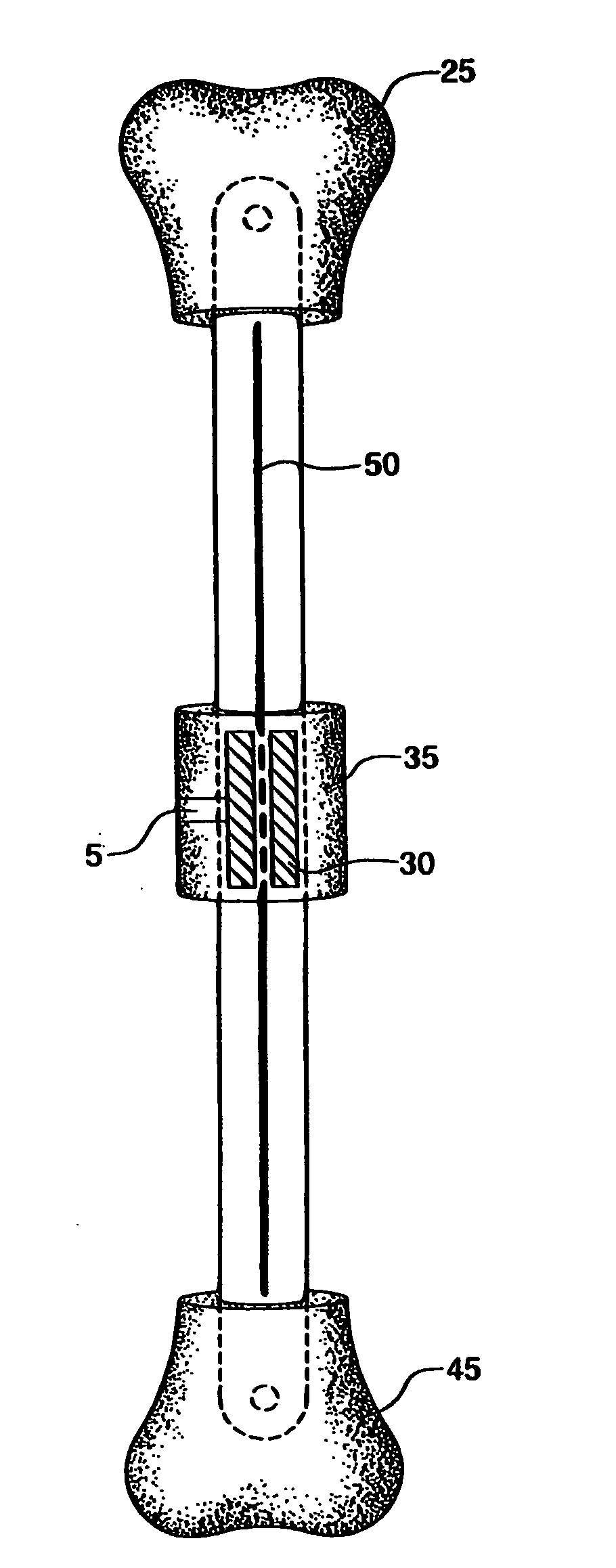
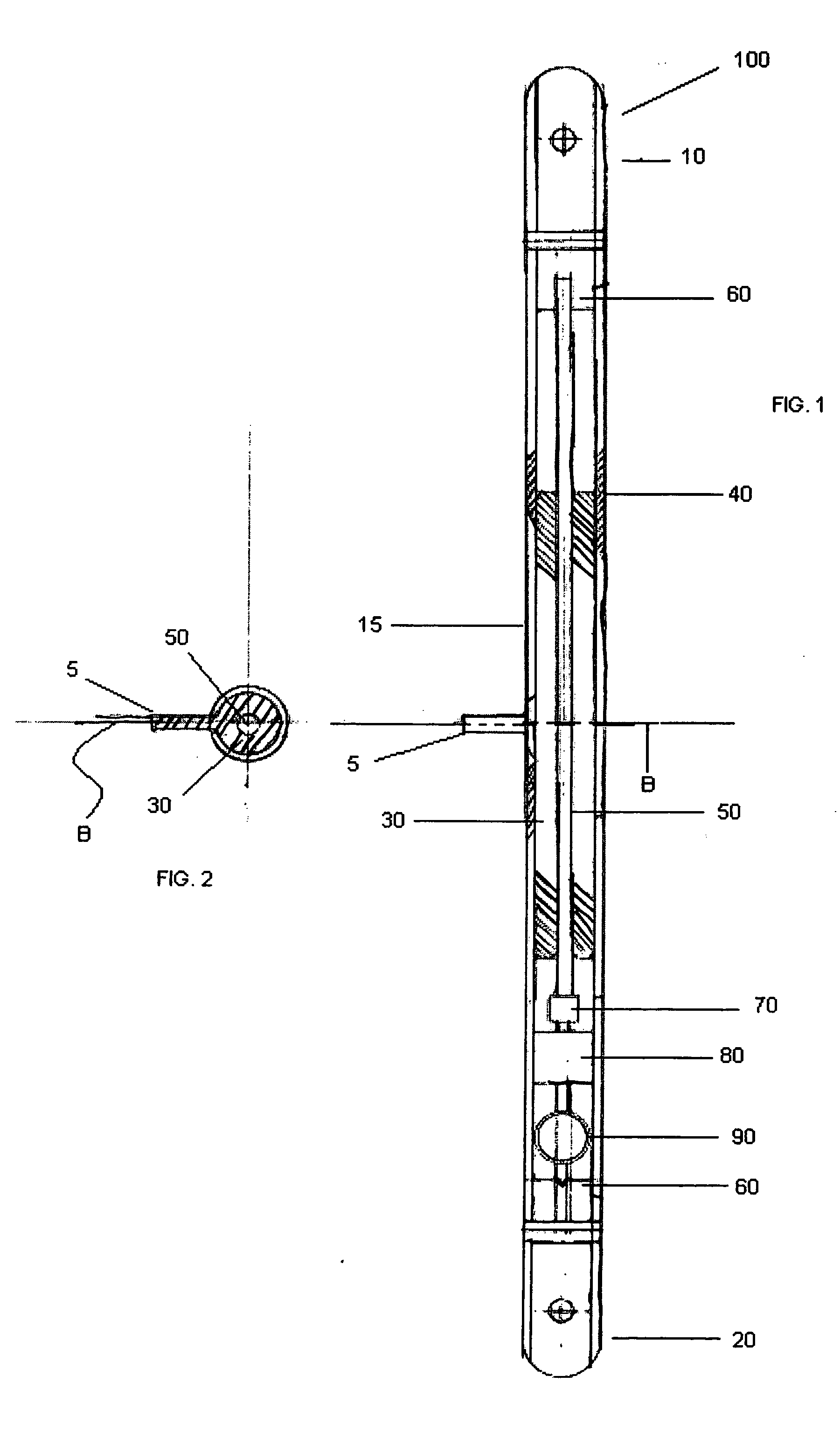
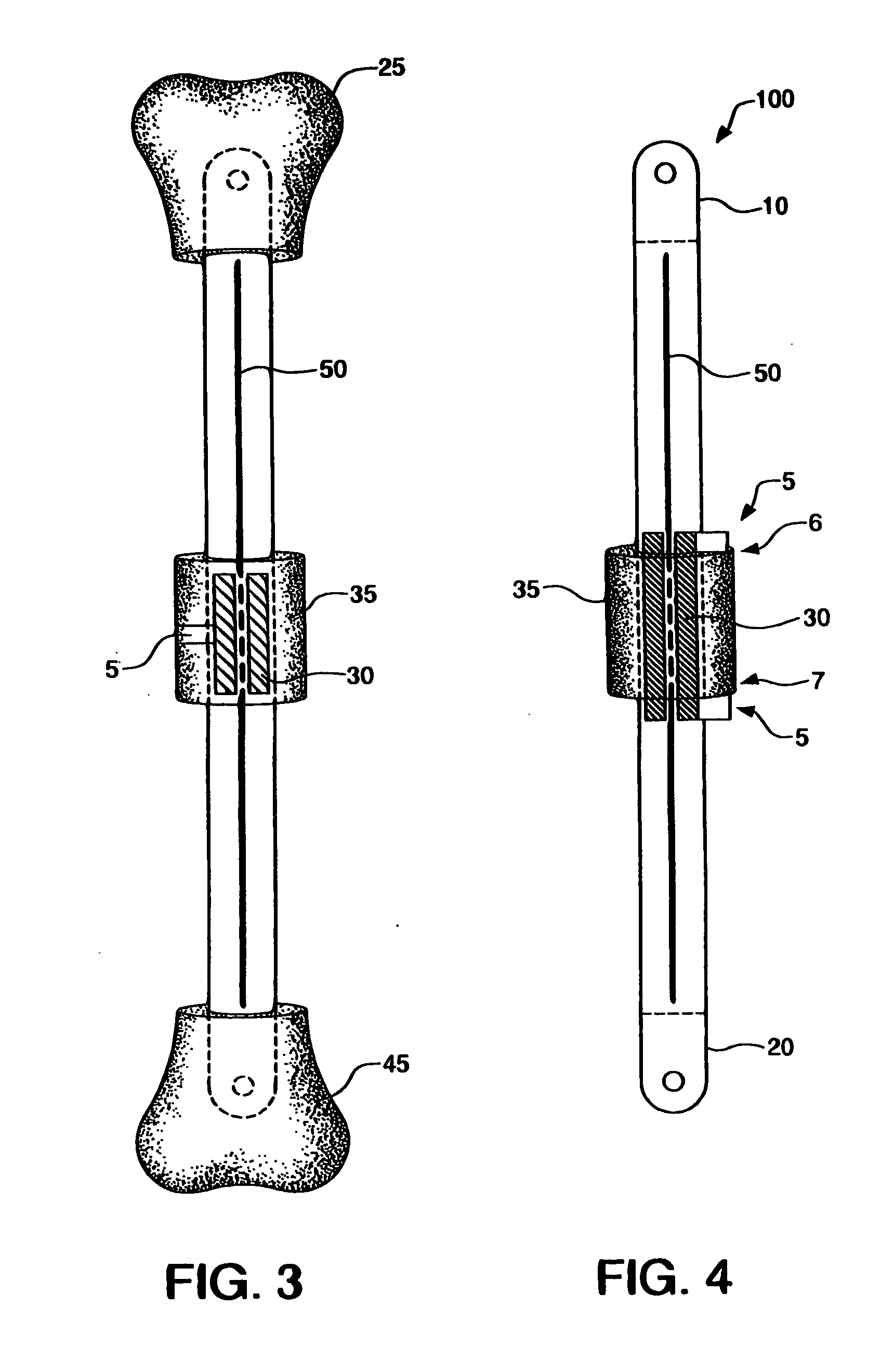
[0014]According to an embodiment of the present invention, the internal bone transport device has an external rod of substantially
fixed length (also referred to as “substantially
fixed length rod”) with two ends, each of which may be coupled, attached, or affixed to a different bone. The internal bone transport has at least one moveable member that is capable of moving along the internal rod. The moveable member is coupled to a bone and moved along the length of the external rod by an external
magnet that rotates a magnetic material housed within the external rod. The moveable member has a projecting member for
coupling the middle bone to the moveable member. An internal rod (also referred to as “longitudinally rotatable rod”), which may be threaded, is housed within the external rod and may optionally be coupled with a gearbox. The gearbox is coupled with the magnetic material such that when an external
magnetic field is created, the magnetic material is rotated. The rotation of the magnetic material in turn causes the gearbox to rotate the coupled internal rod. The rotation of the internal rod causes the moveable member to move lengthwise along the internal rod and substantially parallel to the external rod. Rotation of the internal rod does not cause the moveable member to rotate, but rather causes the moveable member to move in a substantially lengthwise direction within the external rod. The internal bone transport permits bidirectional movement of a bone lengthwise along the external rod.
[0015]According to an embodiment of the invention, the internal bone transport device has a hydraulic or fluid
actuator in combination with a compression or torsional spring instead of a magnetic
actuator. As in the previously described embodiments, the internal bone transport device of the fluid actuator embodiment has a substantially
fixed length rod with two ends; each end may be coupled, attached, or affixed to a different bone. The internal bone transport has at least one moveable member that is capable of moving along the internal rod. The moveable member is coupled to a bone and moved along the length of the substantially fixed length rod. One end of a compression spring is attached, or affixed to one end of the substantially fixed length rod, while the other end of the compression spring is attached, or affixed to the moveable member. A sealed variable volume fluid container such as, without limitation, a sealed
silicone bladder is positioned between the other end of the substantially fixed length rod and the moveable member. A flexible conduit has one end fluidly coupled to the fluid container, while the other end is fluidly coupled to a one-way valve. The fluid container and flexible conduit are filled with a fluid compatible with the body such as
saline. An actuator is positioned outside the device and may be positioned outside the body operable to control the one-way valve. The actuator is preferably a
remote control device such as a magnetic, electromagnetic,
radio frequency, and mixtures thereof controlled device. Movement of the moveable member is caused by the actuator opening the one-way valve to allow fluid to escape the variable volume fluid container and flexible conduit. This decreases the volume of fluid in the fluid container, thus, allowing the compression spring to act against the moveable member from the other side to cause the moveable member to move in a substantially lengthwise direction within the external rod.
[0016]According to an embodiment of the invention, two moveable members are used to transport a pair of bone segments towards one another. The internal bone transport device has a variable volume fluid container between the pair of moveable members. The device further includes a pair of compression springs such that each spring is attached, or affixed, at one end to a moveable member and at the other end to one end of the external rod. Upon actuation by an actuator, fluid is released from the variable-volume fluid container thus, allowing the compression springs to expand. The expansion of the compression springs transports each moveable member along the internal rods towards the other moveable member. Thus, a pair of bone segments is able to be transported at the same time.



 Login to View More
  Login to View More