
Ultra-rapid freezing device and method
- Summary
- Abstract
- Description
- Claims
- Application Information
AI Technical Summary
Benefits of technology
Problems solved by technology
Method used
Image

Examples
first embodiment
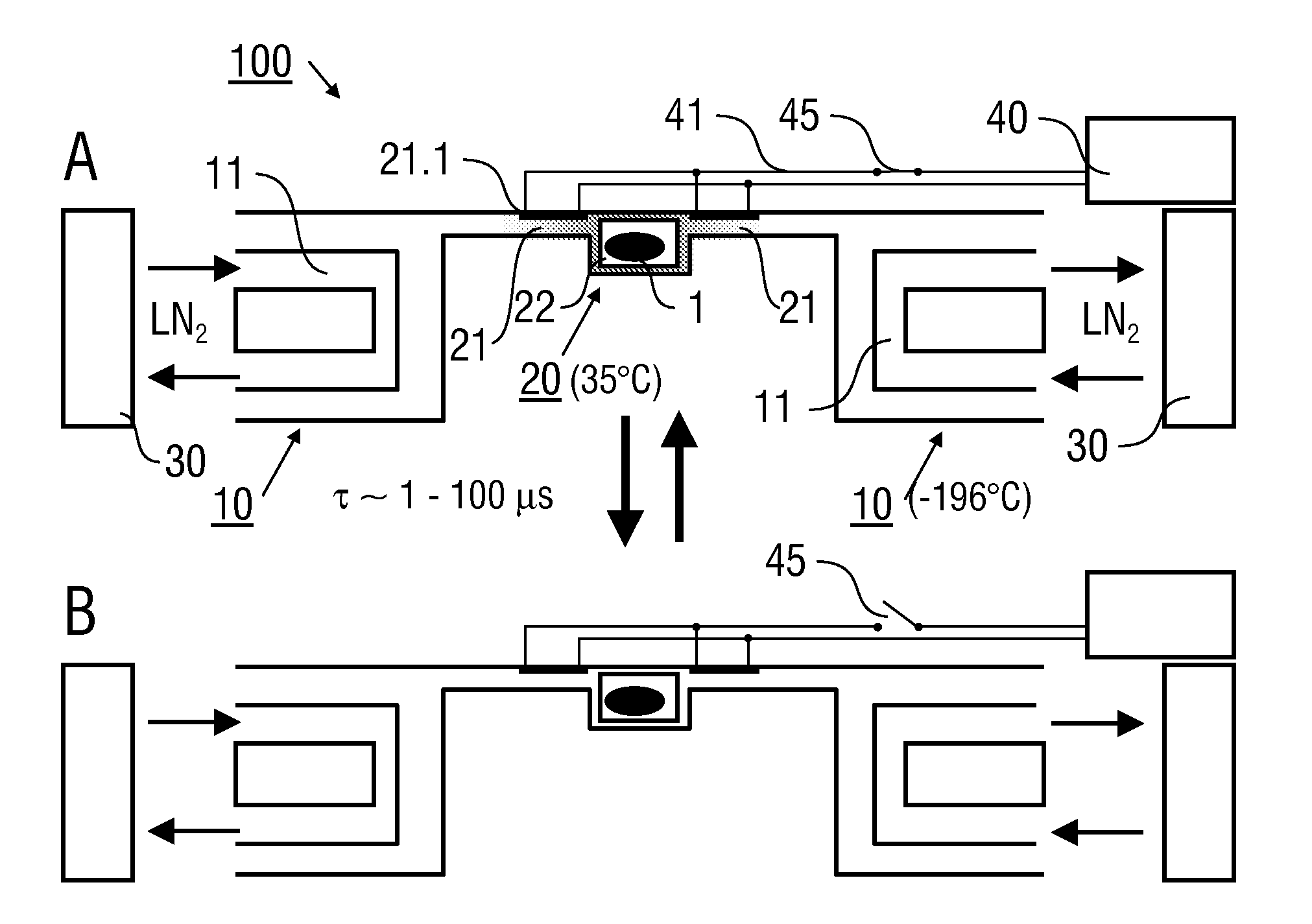
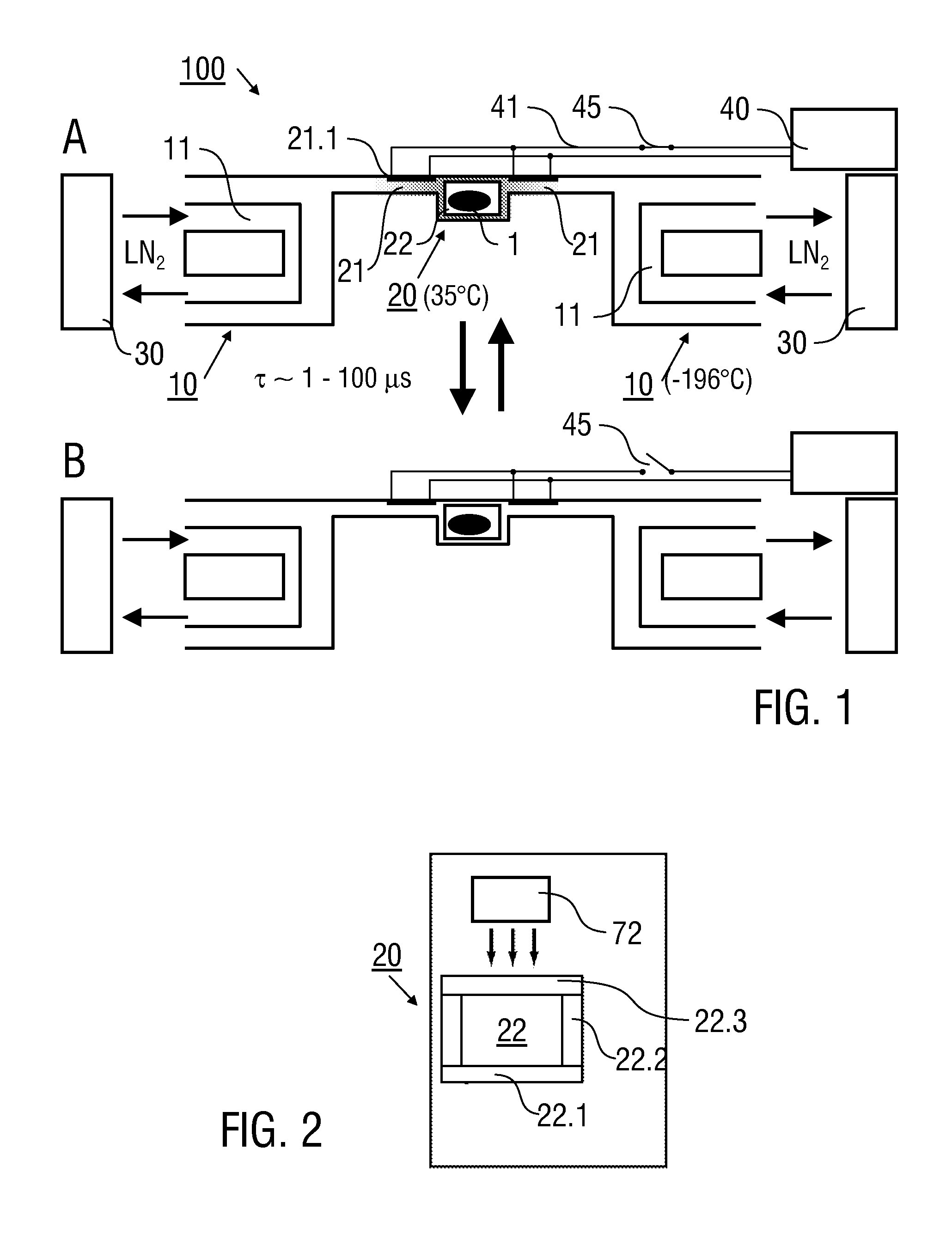
[0061]FIG. 1 illustrates an ultra-rapid freezing device 100 according to the invention in a heated state (FIG. 1A) and in a cooled state (FIG. 1B). The ultra-rapid freezing device 100 comprises the substrate chip 10 (partially shown) and the sample carrier 20. The cross-sectional view of FIG. 1 shows that the sample carrier 20 comprises a thin microfluidic channel 22 which is attached to the substrate chip 10 through heated support beams 21. The substrate chip 10 includes a cold reservoir formed by cooling medium channels 11. The cooling medium channels 11 are formed in the chip body on opposite sides of the sample carrier. The cooling medium channels 11 are connected with a coolant supply source 30 (schematically illustrated). The coolant supply source 30 comprises a reservoir of liquid nitrogen being connected via conduction lines and control valves (not shown) with the cooling medium channels 11.
[0062]The channel 22 of the sample carrier 20 (see also FIG. 2) has a rectangular cro...
third embodiment
[0088]FIG. 10A illustrates a schematic top view of the ultra-rapid freezing device 100 adapted for imaging of rapid transients of chemical or biochemical reactions. The ultra-rapid freezing device 100 comprises a plurality of sample carriers 20 each of which being connected with the substrate chip 10. The sample carriers 20 comprise a plurality of parallel channels 22 with inlets 22.4 and outlets 22.5. The sample carriers 20 are adapted for an electroporation of biological cells. To this end, electroporation electrodes 22.6 are integrated into the channels 22 as illustrated in the lower partial image of FIG. 10B.
[0089]Uptake and transport of fluorescent molecules after electroporation can be investigated by simultaneous imaging a plurality of cells 1, 2, 3, . . . suspended in a solution including fluorescent molecules. The cells 1, 2, 3 . . . are simultaneously subjected to a high voltage electroporation pulse at time t0. Subsequently, the cells 1, 2, 3, . . . are frozen with specif...
PUM
 Login to View More
 Abstract
Description
Claims
Application Information
 Login to View More