Polyelectrolyte membranes and methods for making
a polyelectrolyte membrane and polymer technology, applied in sustainable manufacturing/processing, non-aqueous electrolyte cells, non-metal conductors, etc., can solve the problems of high cost of use, cracks, tears or other deformations, and membranes can be too brittle, so as to achieve high conductive and dimensional stability
- Summary
- Abstract
- Description
- Claims
- Application Information
AI Technical Summary
Benefits of technology
Problems solved by technology
Method used
Image

Examples
example 1
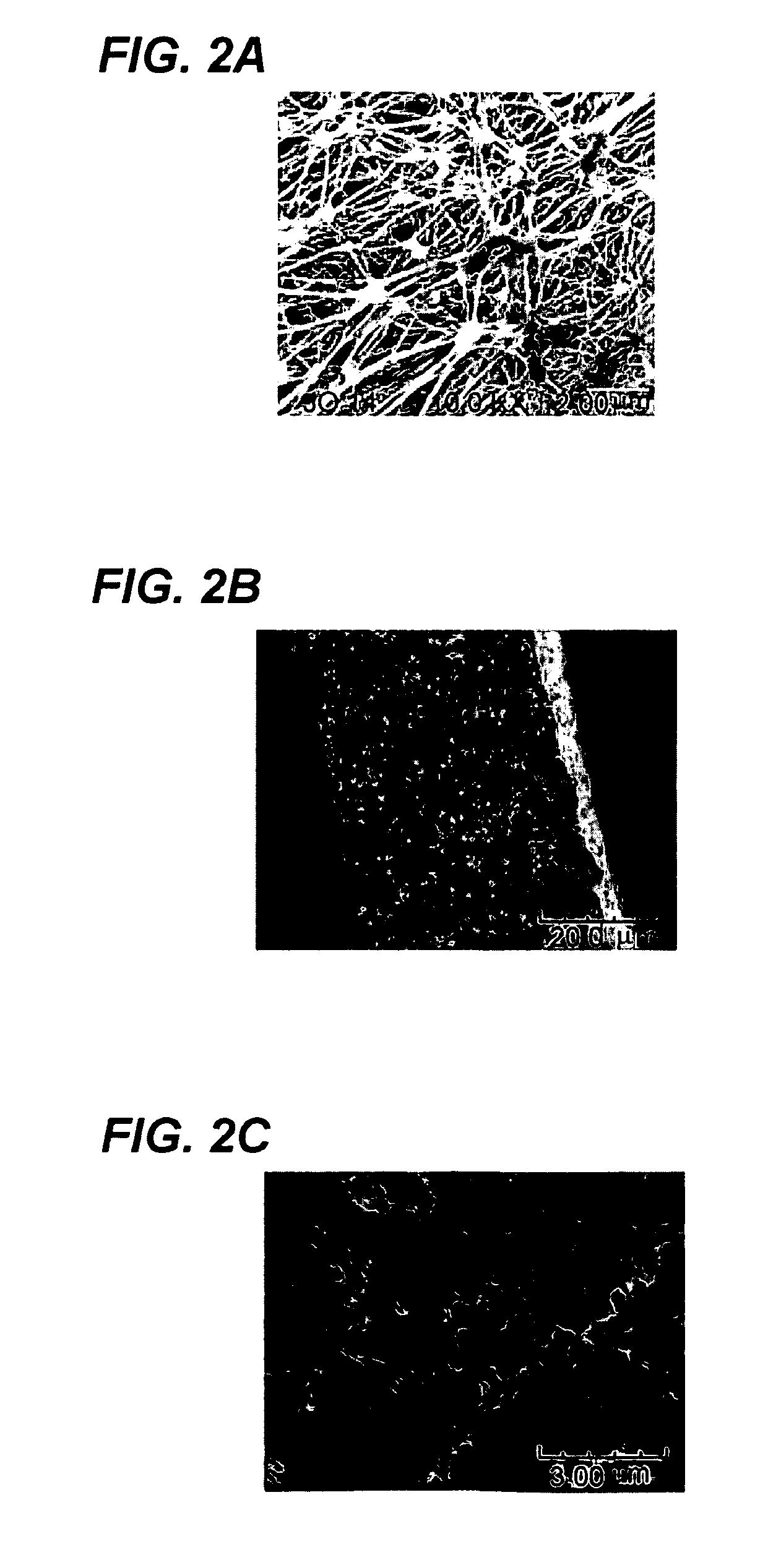
[0123]Diethylphosphatoethyltriethoxysilane (PhosTMOS) (available from Gelest Inc.) was hydrolyzed in concentrated HCl. The hydrolyzed silane was mixed with 20% by weight isopropanol to prepare a solution. The solution was cast on an ePTFE membrane to coat the membrane and the membrane was completely wet on both sides. The obtained membranes were dried at room temperature overnight and further heated at 150° C. in nitrogen. During the process, the sol-gel reaction of the silane produced corresponding metal oxide compounds with the acid functionality inside the pores of ePTFE.
[0124]An ePTFE membrane filed with diethylphosphatoethyltriethoxysilane and reacted in a sol-gel reaction is shown in FIG. 2. It shows that the metal oxide compounds with the acid functional groups obtained from the acid silane filled the pores of the ePTFE base membrane uniformly. FIG. 2A is a pictorial representation of a micrograph image (bar 2 μm) showing an ePTFE membrane before treatment. FIG. 2B is a picto...
example 2
[0128]2-(4-Chlorosulfonylphenyl)ethyltrimethoxysilane (CSTMOS) (available from Gelest Inc.) was impregnated into ePTFE using the sol-gel reaction in a mixture of isopropanol and water as described in Example 1.
[0129]FIG. 4 is a graph showing the in-plane conductivities of the ePTFE membrane impregnated and reacted in a sol-gel reaction with CSTMOS and a membrane prepared from Nafion® 112. The conductivities (S / cm) were obtained with different relative humidity at 80° C.
[0130]As shown on the graph, the ePTFE prepared with the sol-gel reaction of CSTMOS demonstrates remarkable conductivity. The value is 2.5 times higher than Nafion® 112 at 100% RH. The conductivity goes down with decreasing relative humidity, but outperforms the Nafion® 112 membrane over the wide range of relative humidity. CSTMOS is soluble in water and can leach out of the impregnated membrane. Example 3 demonstrates membranes having improved stability against water extraction.
example 3
[0131]In accordance with Example 1, ePTFE was impregnated with a mixture of 2-(4-chlorosulfonylphenyl)ethyltrimethoxysilane (CSTMOS) and tetraethoxysilane (TEOS) with different ratios as shown in Table 1. The membrane samples were dried for 24 hours at room temperature (25° C.) and cured. The curing times and temperatures are shown in Table 1.
TABLE 1Water / CuringCuring TimeSampleCSTMOSTEOSAlkoxyTemp (° C.)(hours)11.000.001.01002421.000.101.01002431.000.201.01002441.000.401.01002451.000.101.01502461.001.001.01502471.002.001.51507281.004.001.51507291.008.001.515072101.0012.001.515072
[0132]An extraction test was performed on the samples. The polymer samples were dried at 105° C. for 4 hours and then immediately weighed to obtain the dry weight (Wdry) for each sample. The samples were then placed in deionized water, heated at 30° C. for 4 hours, dried and weighed to obtain a weight at 30° C. (W30° C.). The samples were placed in deionized water, heated at 60° C. for 16 hours, dried and w...
PUM
| Property | Measurement | Unit |
|---|---|---|
| temperature | aaaaa | aaaaa |
| pore diameters | aaaaa | aaaaa |
| pore diameter | aaaaa | aaaaa |
Abstract
Description
Claims
Application Information
 Login to View More
 - R&D
- Intellectual Property
- Life Sciences
- Materials
- Tech Scout
- Unparalleled Data Quality
- Higher Quality Content
- 60% Fewer Hallucinations
Browse by: Latest US Patents, China's latest patents, Technical Efficacy Thesaurus, Application Domain, Technology Topic, Popular Technical Reports.
© 2025 PatSnap. All rights reserved.Legal|Privacy policy|Modern Slavery Act Transparency Statement|Sitemap|About US| Contact US: help@patsnap.com