Check patentability & draft patents in minutes with Patsnap Eureka AI!

Radar detection algorithm

a detection algorithm and radar technology, applied in the field of radar systems, can solve problems such as inability to accurately conclude the conclusion of the network device, interference between wireless networks and military radar systems, and inability to detect the location of the radar device,

Active Publication Date: 2010-01-28
MARVELL ASIA PTE LTD
View PDF5 Cites 4 Cited by
  • Summary
  • Abstract
  • Description
  • Claims
  • Application Information

AI Technical Summary

Benefits of technology

This approach effectively minimizes false radar detections, conserves resources, and maintains network performance by accurately identifying radar signals amidst noise, allowing for efficient channel management and reduced interference.

Problems solved by technology

As a result, wireless network signals may interfere with military radar communications.
Interference between publicly used wireless networks and military radar systems is undesirable for security reasons.
Some network devices may falsely detect radar on a channel.
For example, a network device may incorrectly conclude that noise such as a signal generated by a microwave appliance or other device is a radar signal.
The network will unnecessarily block the channel despite the fact that the detected signal is not a radar signal.
As false detections increase, additional channels may be blocked and fewer channels will remain available for network communications.
This can significantly degrade network performance.

Method used

the structure of the environmentally friendly knitted fabric provided by the present invention; figure 2 Flow chart of the yarn wrapping machine for environmentally friendly knitted fabrics and storage devices; image 3 Is the parameter map of the yarn covering machine
View more

Image

Smart Image Click on the blue labels to locate them in the text.
Viewing Examples
Smart Image
  • Radar detection algorithm
  • Radar detection algorithm
  • Radar detection algorithm

Examples

Experimental program
Comparison scheme
Effect test

Embodiment Construction

[0039]The following description of the preferred embodiment(s) is merely exemplary in nature and is in no way intended to limit the invention, its application, or uses. For purposes of clarity, the same reference numbers will be used in the drawings to identify similar elements. As used herein, the term module, circuit and / or device refers to an Application Specific Integrated Circuit (ASIC), an electronic circuit, a processor (shared, dedicated, or group) and memory that execute one or more software or firmware programs, a combinational logic circuit, and / or other suitable components that provide the described functionality. As used herein, the phrase at least one of A, B, and C should be construed to mean a logical (A or B or C), using a non-exclusive logical or. It should be understood that steps within a method may be executed in different order without altering the principles of the present invention.

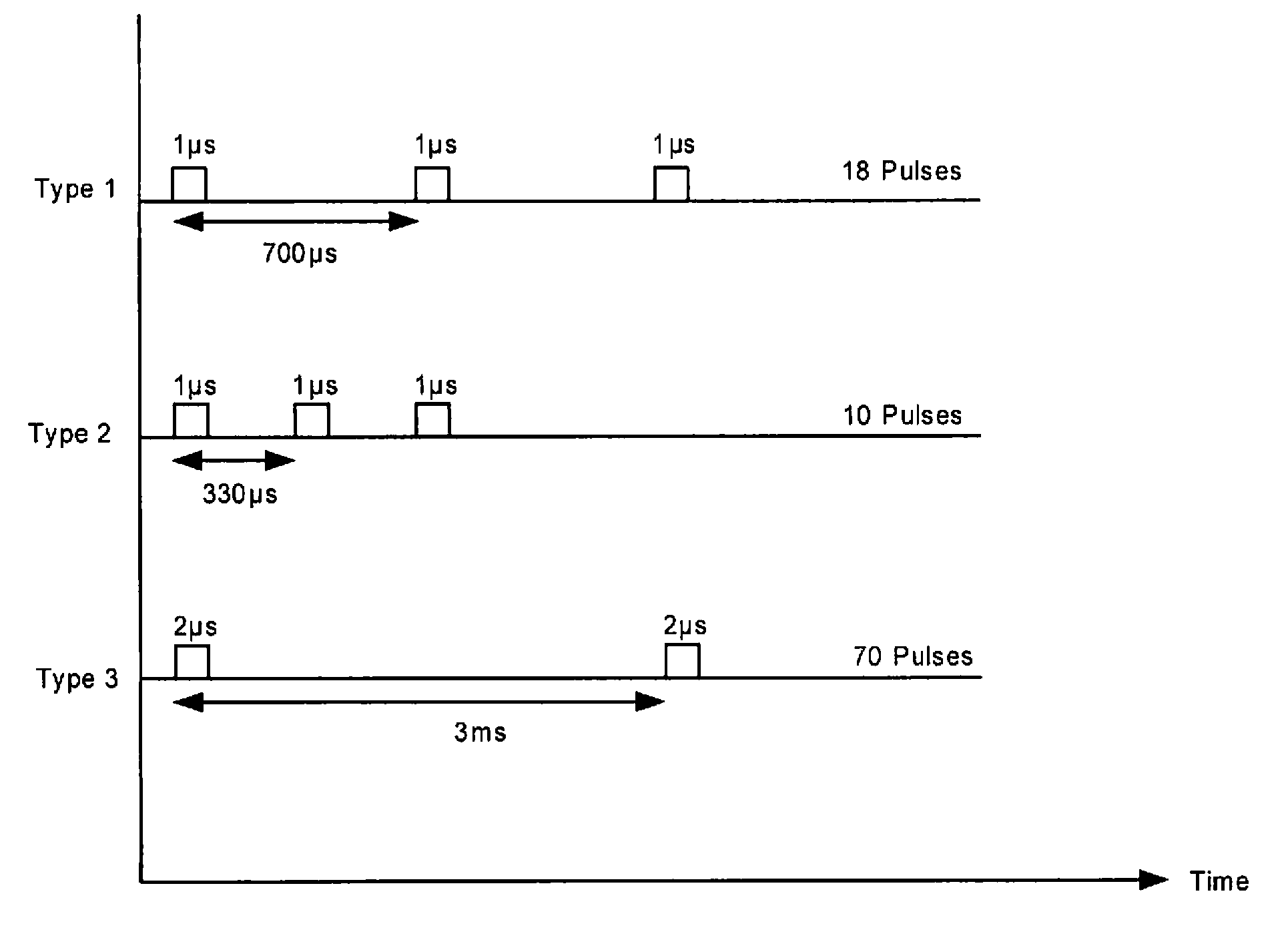
[0040]Referring now to FIG. 2, exemplary types of radar signals are shown. Typ...

the structure of the environmentally friendly knitted fabric provided by the present invention; figure 2 Flow chart of the yarn wrapping machine for environmentally friendly knitted fabrics and storage devices; image 3 Is the parameter map of the yarn covering machine
Login to View More

PUM

No PUM Login to View More

Abstract

A system includes a radio frequency transceiver. A baseband processor includes an automatic gain control module. The automatic gain control module has a gain that changes from and subsequently returns to a predetermined value each time the radio frequency transceiver receives a radio frequency signal. The baseband processor is configured to selectively generate an interrupt signal each time a radio frequency signal is received based on a magnitude of the change in the gain of the automatic gain control module and a length of time in which the gain returns to the predetermined value. A control module is configured to identify a radio frequency signal received by the radio frequency transceiver as a radar signal in response to the baseband processor having generated a plurality of interrupt signals at substantially equal time intervals.

Description

CROSS-REFERENCE TO RELATED APPLICATIONS[0001]This application is a continuation of U.S. patent application Ser. No. 11 / 298,017, filed Dec. 9, 2005, which claims the benefit of U.S. Provisional Application No. 60 / 706,388, filed Aug. 8, 2005. The disclosures of the above applications are incorporated herein by reference in their entirety.FIELD OF THE INVENTION[0002]The present invention relates to radar systems, and more particularly to radar detection algorithms.BACKGROUND OF THE INVENTION[0003]Radar is an acronym for Radio Detection and Ranging. The term “radio” refers to the use of radio frequency (RF) waves. The detection and ranging part of the acronym is accomplished by timing a delay between transmission of an RF pulse and its subsequent return. If the time delay is Δt, then the range may be determined by the simple formula:R=cΔt / 2where c=3×10⁸ m / s and is the speed of light. The factor of two in the formula accounts for the return trip.[0004]Referring now to FIG. 1, the common ...

Claims

the structure of the environmentally friendly knitted fabric provided by the present invention; figure 2 Flow chart of the yarn wrapping machine for environmentally friendly knitted fabrics and storage devices; image 3 Is the parameter map of the yarn covering machine
Login to View More

Application Information

Patent Timeline
no application Login to View More
Patent Type & Authority Applications(United States)
IPC IPC(8): H04B1/06H04B17/40
CPCG01S7/021H04K2203/36H04K3/822H04K3/226
Inventor KOPIKARE, MILINDLIN, HUI YAOYEE, JAMESVU, CHUONG
Owner MARVELL ASIA PTE LTD
Features
  • R&D
  • Intellectual Property
  • Life Sciences
  • Materials
  • Tech Scout
Why Patsnap Eureka
  • Unparalleled Data Quality
  • Higher Quality Content
  • 60% Fewer Hallucinations
Social media
Patsnap Eureka Blog
Learn More