
Methods and compositions of molecular profiling for disease diagnostics
a molecular profiling and disease technology, applied in the field of methods and compositions of molecular profiling for disease diagnostics, can solve the problems of no definitive diagnosis, sharp increase in the number of cancers, and no definitive diagnosis
- Summary
- Abstract
- Description
- Claims
- Application Information
AI Technical Summary
Benefits of technology
Problems solved by technology
Method used
Image

Examples
example 1
Gene Expression Product Analysis of Thyroid Samples
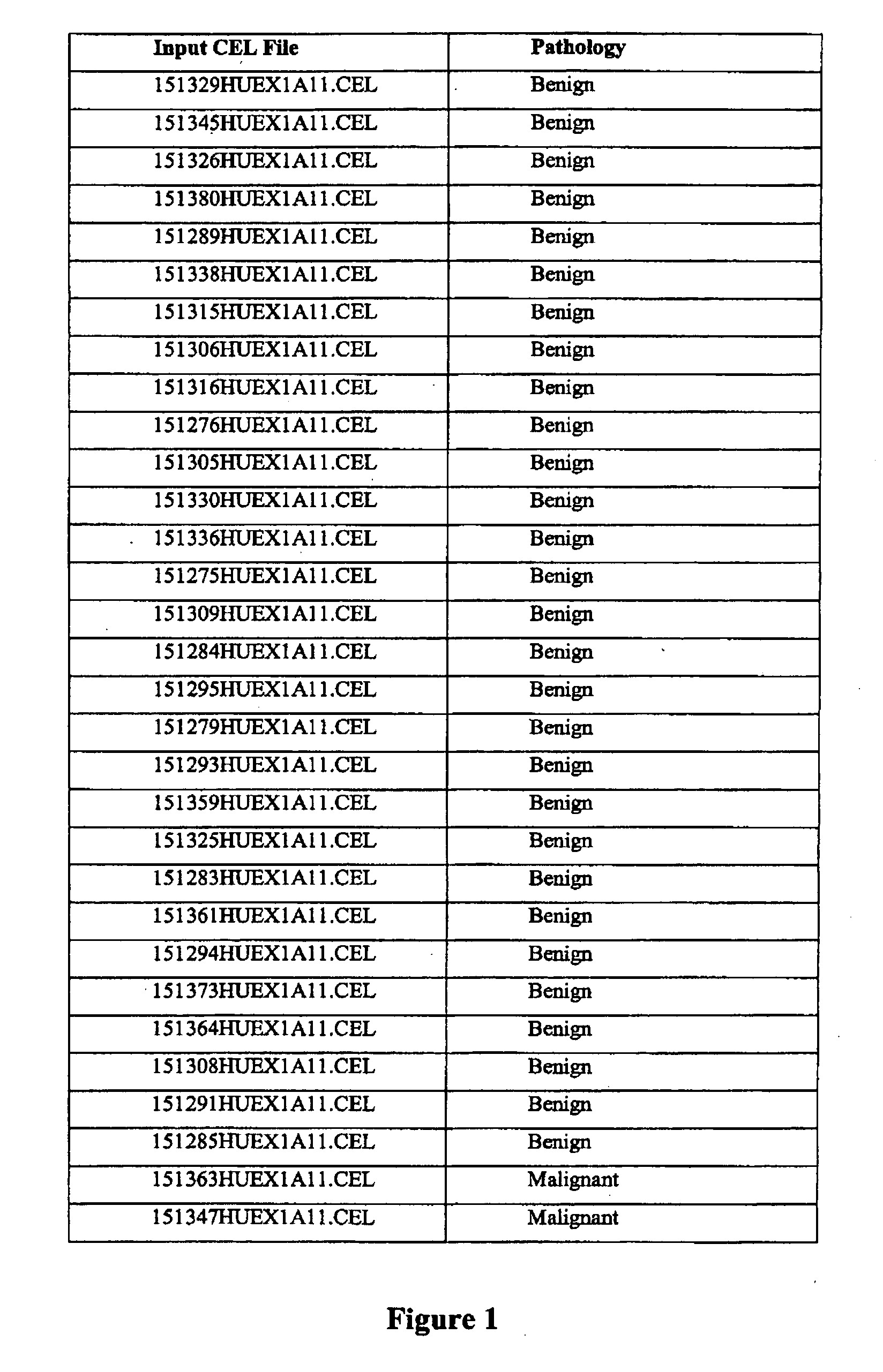
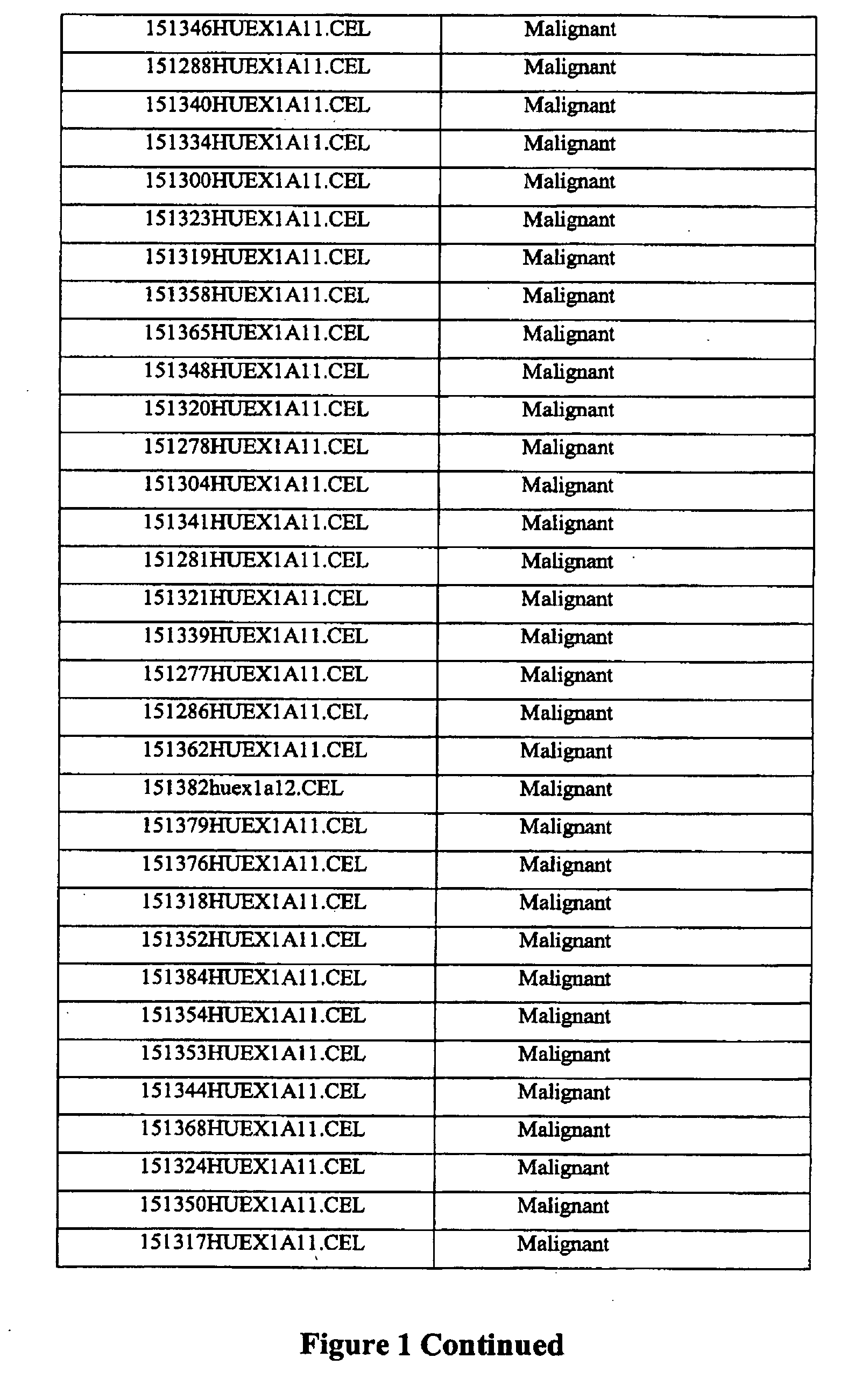
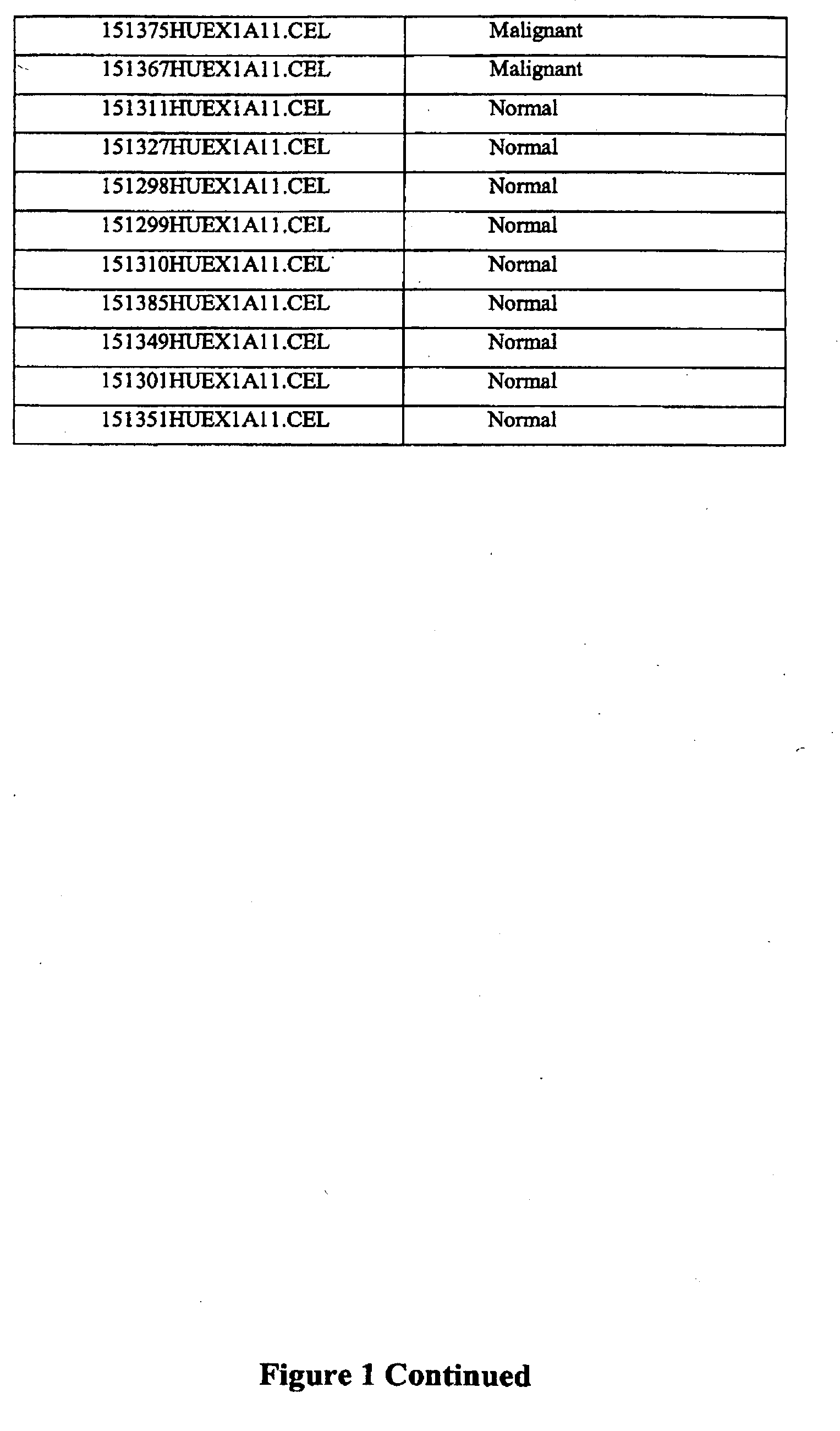
[0313]75 thyroid samples were examined for gene expression analysis using the Affymetrix Human Exon 10ST array according to manufacturer's instructions to identify genes that showed significantly differential expression and / or alternative splicing between malignant, benign, and normal samples. Three groups were compared and classified according to pathological surgical diagnosis of the tissue: benign (n=29), malignant (n=37), and normal (n=9). The samples were prepared from surgical thyroid tissue, snap frozen and then the RNA was prepared by standard methods. The names and pathological classification of the 75 samples are depicted in FIG. 1.
[0314]Microarray analysis was run with XRAY version 2.69 (Biotique Systems Inc.). Input files were normalized with full quantile normalization (Irizarry et al. Biostatistics 2003 Apr. 4 (2): 249-64). For each input array and each probe expression value, the array-ith percentile probe value was r...
example 2
Gene Expression Product Analysis of Thyroid Tissue Samples
[0320]A total of 205 thyroid tissue samples (FIG. 7) are examined with an Affymetrix HumanExon10ST array chip to identify genes that differ significantly in RNA expression levels between benign and malignant samples. Samples are classified according to post-surgical thyroid pathology: samples exhibiting follicular adenoma (FA), lymphocytic thyroiditis (LCT), or nodular hyperplasia (NHP) are classified as benign; samples exhibiting Hurthle cell carcinoma (HC), follicular carcinoma (FC), follicular variant of papillary thyroid carcinoma (FVPTC), papillary thyroid carcinoma (PTC), medullary thyroid carcinoma (MTC), or anaplastic carcinoma (ATC) are classified as malignant.
[0321]Affymetrix software is used to extract, normalize, and summarize intensity data from roughly 6.5 million probes. Approximately 280,000 core probe sets are subsequently used in feature selection and classification. The models used are LIMMA for feature sel...
example 3
Meta-Analysis of Gene Expression Product Data from Thyroid Samples
[0325]Surgical thyroid tissue samples (FIG. 7) and thyroid samples obtained via fine needle aspiration (FIG. 8) are identified as benign or malignant by pathological examination and then examined by hybridization to an Affymetrix HumanExon10ST array. A meta-analysis approach is utilized which allows the identification of genes with repeatable features in each classification. Affymetrix software is used to extract, normalize, and summarize intensity data from approximately 6.5 million probes. Roughly 280,000 probe sets are used for feature selection and classification. LIMMA is used for feature selection. Classification is performed with random forest and SVM methods. Markers that repeatedly appear in multiple iterative rounds of training, classification, and cross validation of the surgical and fine needle aspirate samples are identified and ranked. A joint set of core features are created using the top ranked feature...
PUM
| Property | Measurement | Unit |
|---|---|---|
| mass spectrometry | aaaaa | aaaaa |
| focal adhesion | aaaaa | aaaaa |
| adhesion | aaaaa | aaaaa |
Abstract
Description
Claims
Application Information
 Login to View More