
Method and apparatus for driving light emitting elements for projection of images
a technology of light emitting elements and projection methods, applied in the field of methods and apparatus for projection of images, can solve the problems of other colors in brightness and reduced overall performance, and achieve the effect of simple driving scheme of light emitting elements and stable image color quality
- Summary
- Abstract
- Description
- Claims
- Application Information
AI Technical Summary
Benefits of technology
Problems solved by technology
Method used
Image

Examples
Embodiment Construction
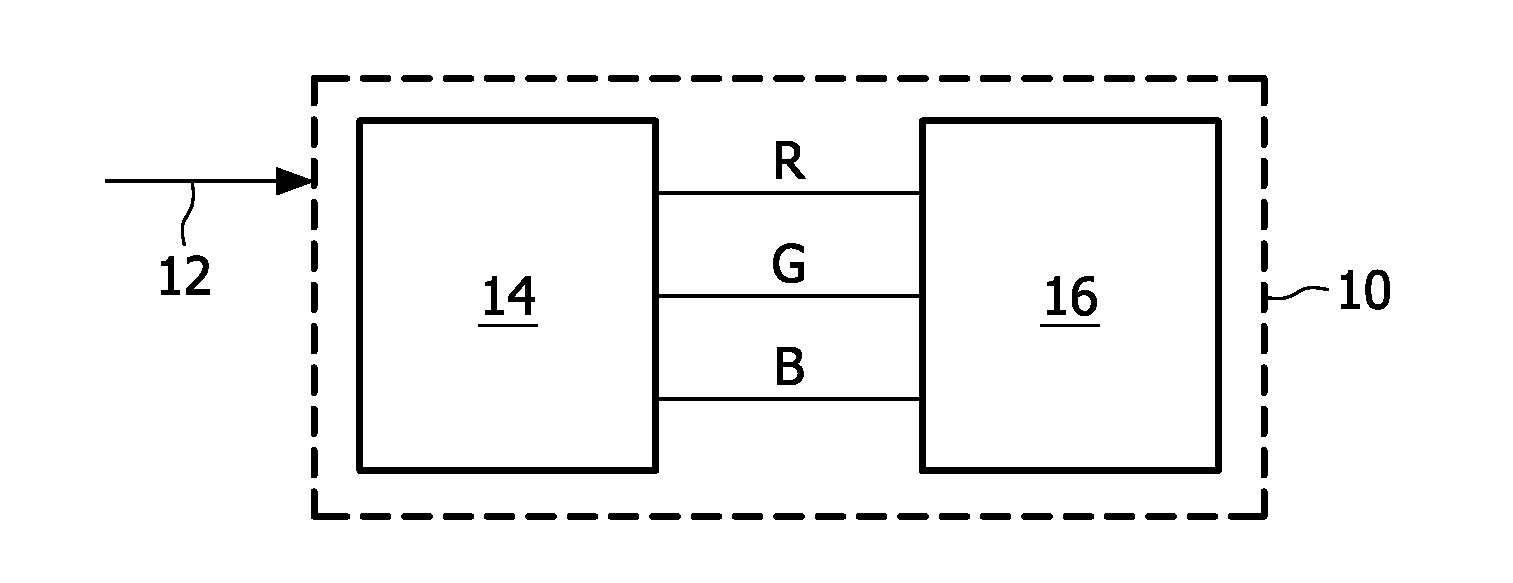
[0028]FIG. 1 schematically illustrates a projection system 10 using light emitting elements of different primary colors. An image data input 12 receives image data which are processed in the projection system by a driver circuit 14, which provides drive signals for different light emitting elements producing different primary colors such as red, green and blue colors for generating an image, or a sequence of images (video) in a projection apparatus 16 comprising the different light emitting elements and a display. The projection apparatus 16 may comprise one or more lenses, one or more mirrors, one or more digitally controlled micromirror devices (DMD), one or more liquid crystal devices (LCD) or thin film transistors (TFT), one or more liquid crystal on silicon devices (LcoS), and the like.
[0029]An example of such a projection system is the digital light processing (DLP®) technology by Texas Instruments.
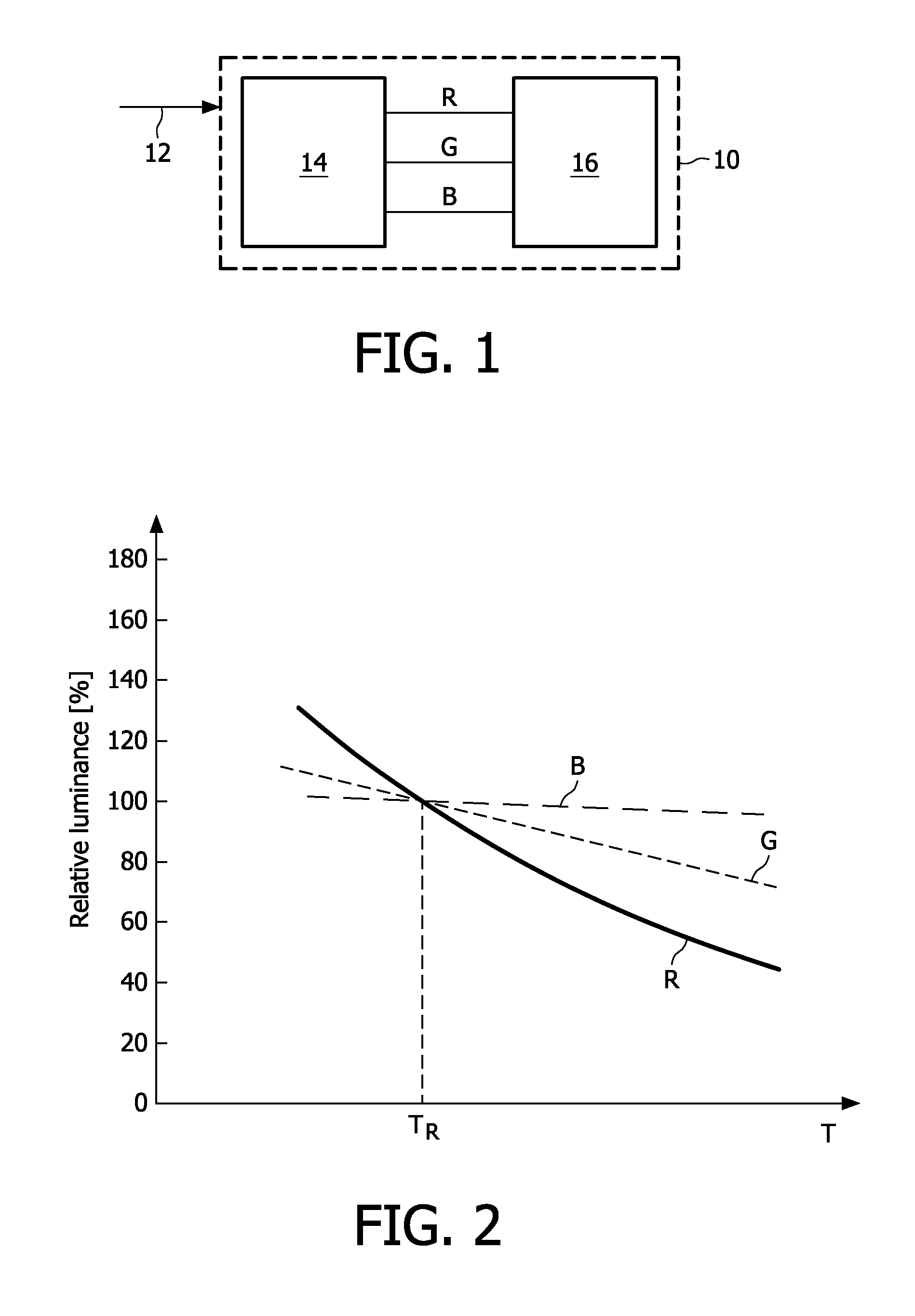
[0030]FIG. 2 illustrates relationships between the temperature (indicted by T) ...
PUM
 Login to View More
 Abstract
Description
Claims
Application Information
 Login to View More