Moving Bed Hydrocarbon Conversion Process

a hydrocarbon conversion and moving bed technology, applied in the direction of catalytic naphtha reforming, chemistry apparatus and processes, treatment with moving solid particles, etc., can solve the problems of physical damage to the particles as well as the equipment, insufficient pneumatic conveying system alone, and sporadic upsets, so as to eliminate unexpected and unpredictable upsets, the particle transfer system is more stable, and the damage to the particles and/or the equipment is small or no

a hydrocarbon conversion and moving bed technology, applied in the direction of catalytic naphtha reforming, chemistry apparatus and processes, treatment with moving solid particles, etc., can solve the problems of physical damage to the particles as well as the equipment, insufficient pneumatic conveying system alone, and sporadic upsets, so as to eliminate unexpected and unpredictable upsets, the particle transfer system is more stable, and the damage to the particles and/or the equipment is small or no

US20100187159A1Inactive Publication Date: 2010-07-29UOP LLC

Image

Smart Image Click on the blue labels to locate them in the text.
Viewing Examples
Smart Image
  • Moving Bed Hydrocarbon Conversion Process
  • Moving Bed Hydrocarbon Conversion Process
  • Moving Bed Hydrocarbon Conversion Process

Examples

Experimental program
Comparison scheme
Effect test

Embodiment Construction

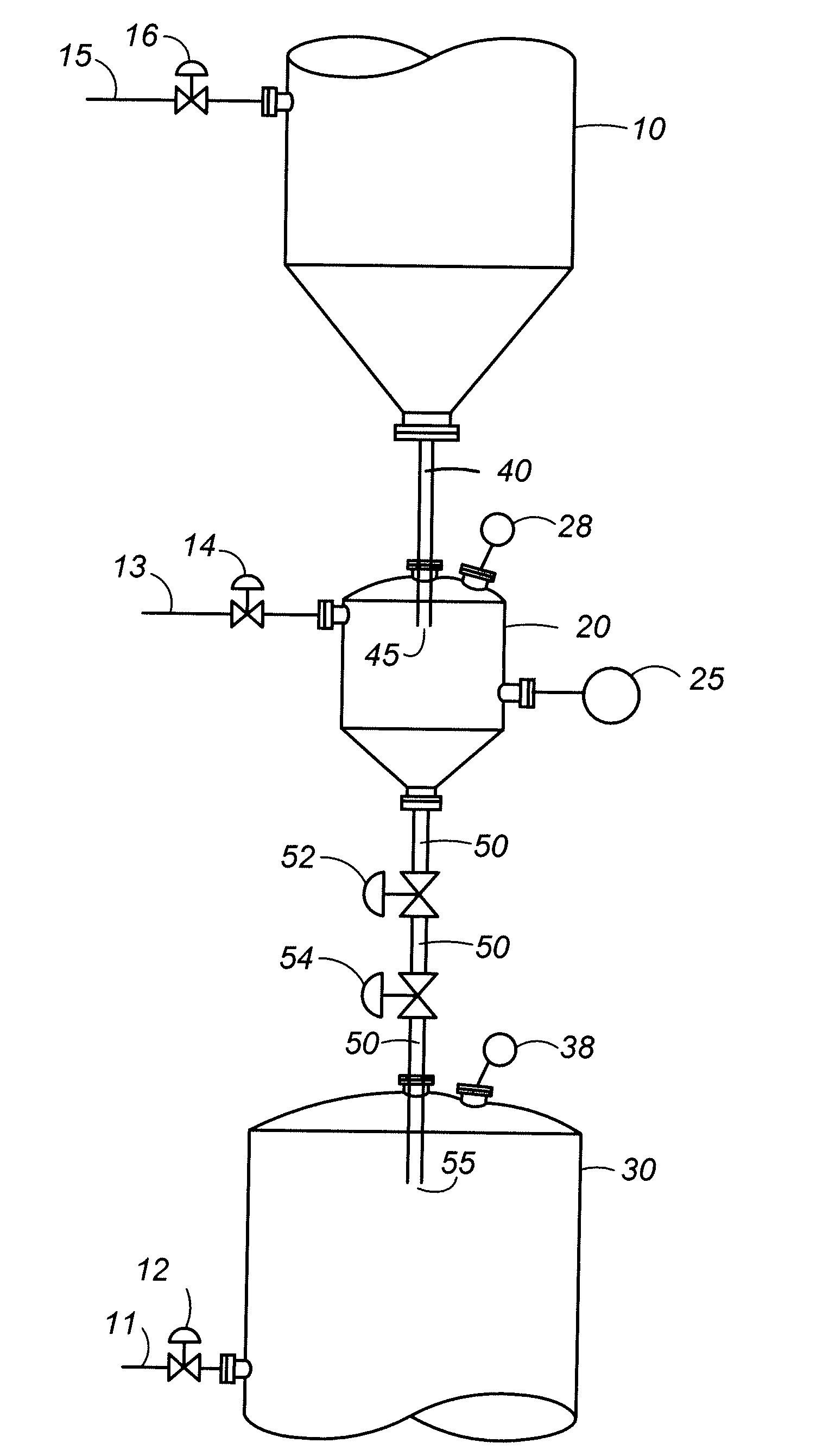
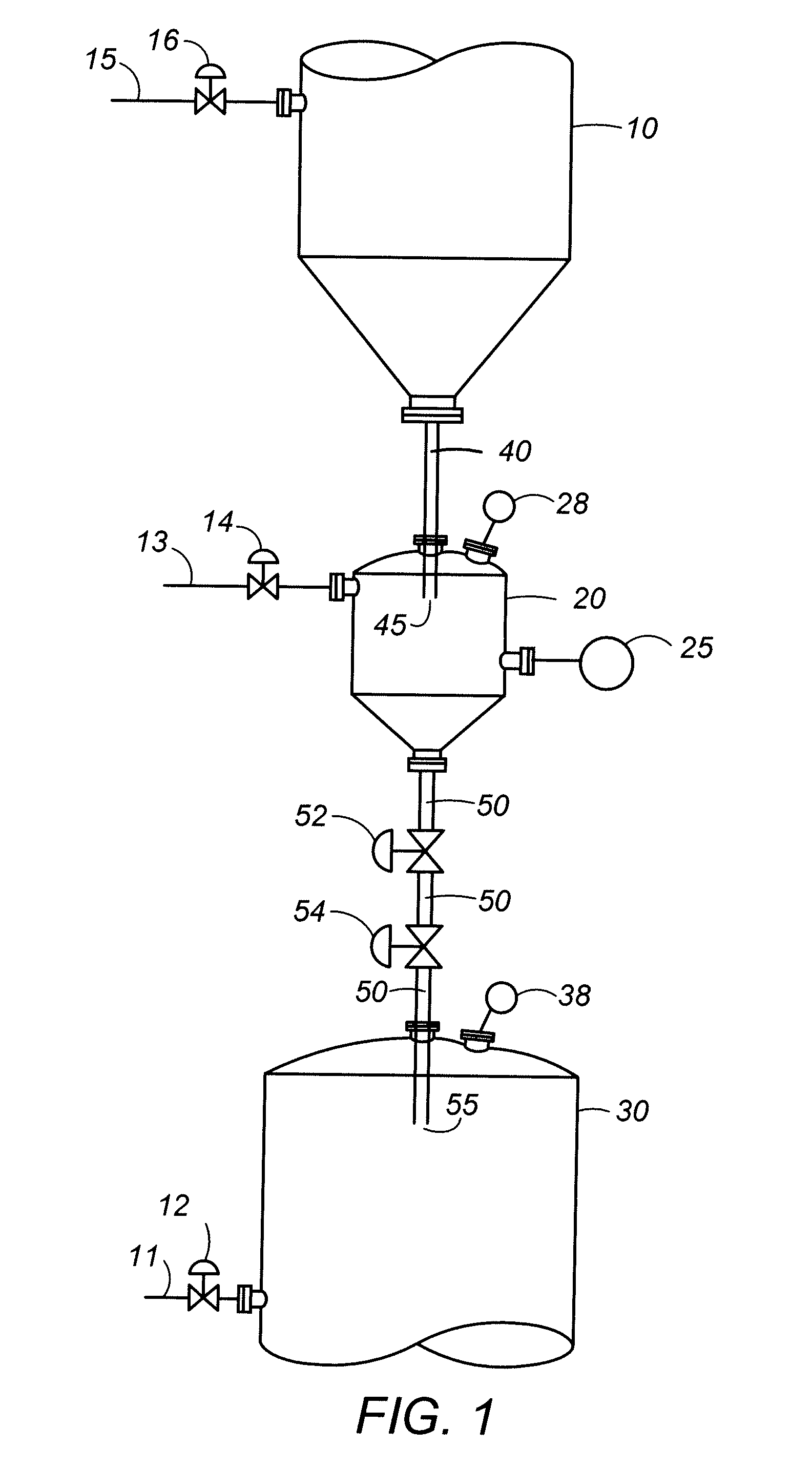
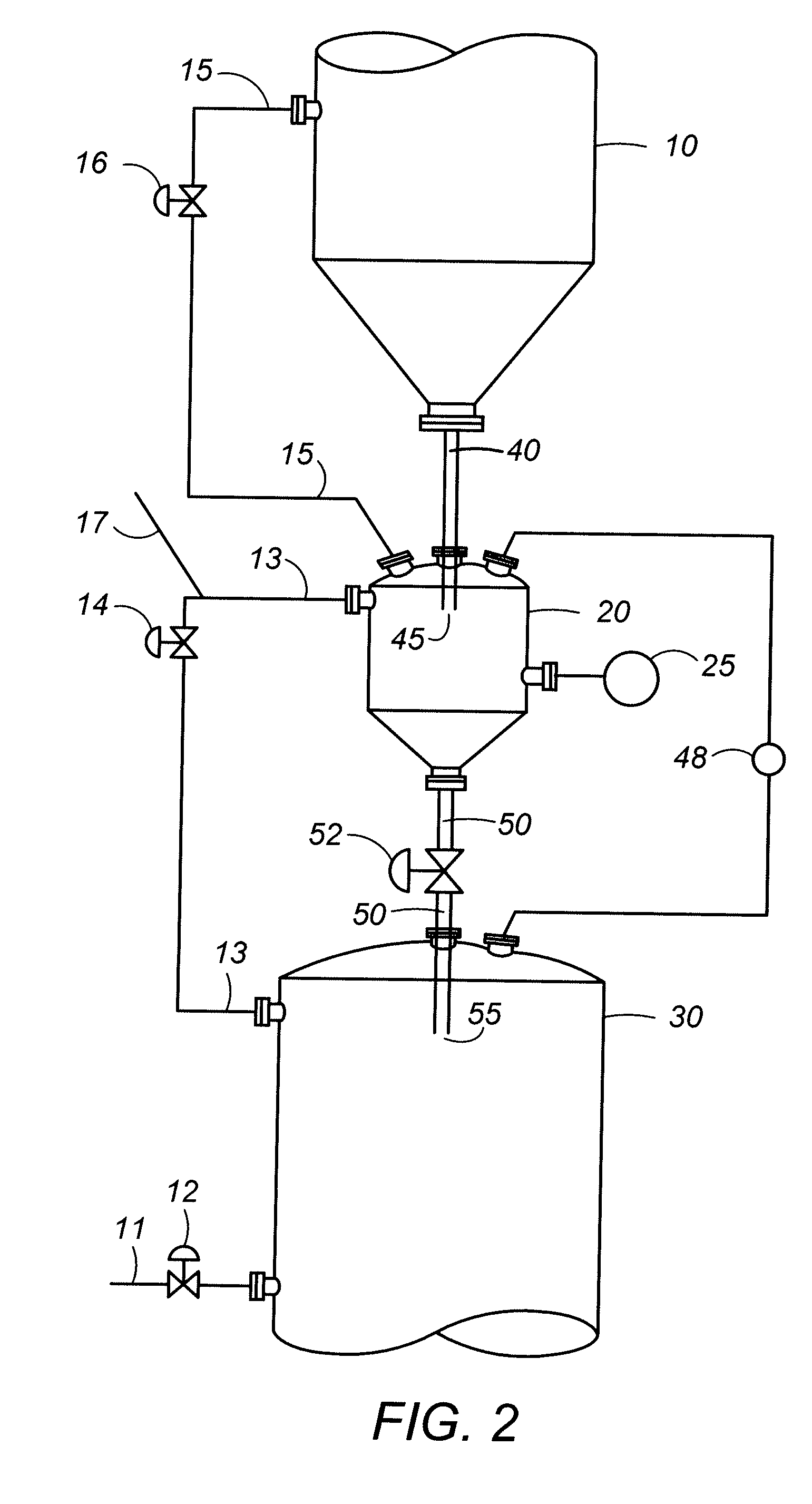
[0018]The invention may be used to transfer solid particulate matter from an upper zone, through a middle zone, to a lower zone where the lower zone pressure is greater than the upper zone pressure. Generally, particles received in an upper zone are transferred through an upper valveless standpipe or transfer conduit to a middle zone. That is, the upper transfer conduit does not include moving equipment such as valves which would block the particle flow path to the middle zone. A lower valved standpipe or transfer conduit is used to transfer the particles from the middle zone to a lower zone. That is, the lower transfer conduit comprises at least one valve. Thus, the zones and transfer conduits may be in particle communication and the transfer conduits may provide particle communication.

[0019]The invention can be used within and / or between a variety of process units to transfer particles, such as catalyst and adsorbents. The upper zone of the invention may receive particles from a s...

the structure of the environmentally friendly knitted fabric provided by the present invention; figure 2 Flow chart of the yarn wrapping machine for environmentally friendly knitted fabrics and storage devices; image 3 Is the parameter map of the yarn covering machine
Login to View More

PUM

No PUM Login to View More

Abstract

Moving bed hydrocarbon conversion processes are provided for contacting a catalyst moving downward through a reaction zone with a hydrocarbon feed, withdrawing the catalyst from the reaction zone and conveying the catalyst to a regeneration zone wherein the catalyst moves downward. The catalyst is withdrawn from the regeneration zone and passed downward to an upper zone of a particle transfer apparatus wherein the transfer of catalyst from the upper zone through a middle zone to a lower zone is regulated by varying the pressure of the middle zone, the flow rate of gas passing through an upper valveless conduit, and a valve in a lower valved conduit. The catalyst from the lower zone of the particle transfer apparatus is conveyed to the reactions zone.

Description

FIELD OF THE INVENTION[0001]This invention generally relates to the art of solid particle transport. More specifically, the invention relates to hydrocarbon conversion processes including a reaction zone, a regeneration zone, and a particle transfer zone where catalyst moves through the zones.BACKGROUND OF THE INVENTION[0002]There are many chemical processes where it is necessary to bring into contact a fluid and a solid particulate matter, such as adsorbents and catalysts. Frequently, chemical reactions as well as physical phenomena occur for a predetermined period of time in the contact zone, e.g. a reaction or adsorption zone. In many of these processes, the particles are transported between two or more particle containing vessels. The particles may be transported for a variety of reasons depending on the process. For example, particles may be transported from one contacting vessel or zone into another contacting zone in order to take advantage of different process conditions to ...

Claims

the structure of the environmentally friendly knitted fabric provided by the present invention; figure 2 Flow chart of the yarn wrapping machine for environmentally friendly knitted fabrics and storage devices; image 3 Is the parameter map of the yarn covering machine
Login to View More

Application Information

Patent Timeline
29 Jul 2010
Publication
US20100187159A1
IPC
C10G35/14
CPC
B01J8/125; C10G49/14; C10G47/28; C10G35/12
Inventors
NAUNHEIMER, CHRISTOPHER