
Electric locking and sealing device, case comprising the same, and control system therefor
a technology of sealing device and case, which is applied in the direction of instruments, unauthorized memory use protection, computation using denominational number representation, etc., can solve the problem of hard opening of the case by users, and achieve the effect of preventing power from being stolen, high safety, and preventing reverse connection
- Summary
- Abstract
- Description
- Claims
- Application Information
AI Technical Summary
Benefits of technology
Problems solved by technology
Method used
Image

Examples
first embodiment
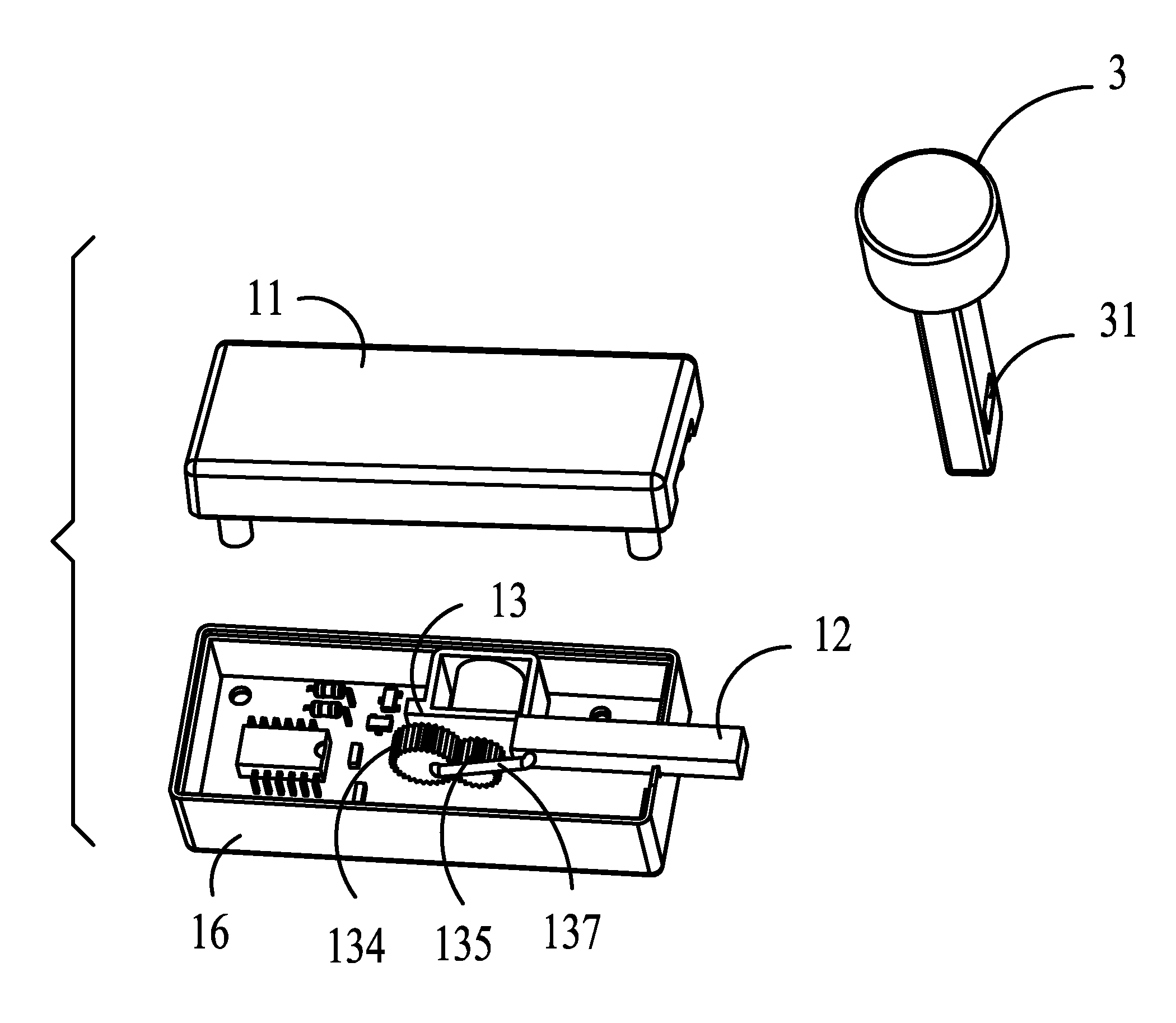
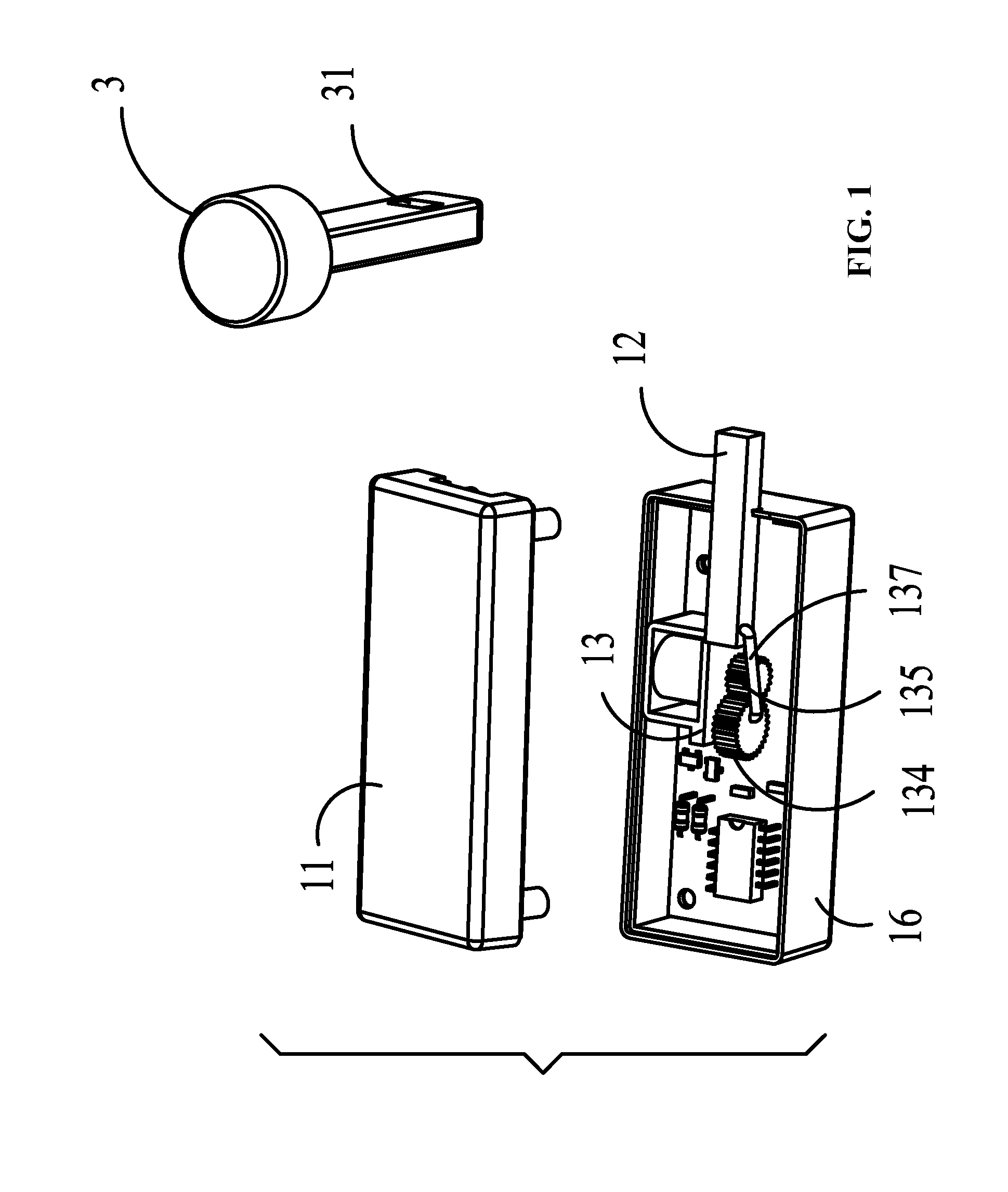
[0055]As shown in FIGS. 10 and 12, the operating unit comprises a power output mechanism having an output end being connected to the lock tongue. The power output mechanism in this embodiment can be the same as that in the first embodiment, or employs an electromagnetic type comprising an electromagnetic operating part, comprising an armature 132, an electromagnetic coil 131, and a load bearing part. One end of the armature 132 is fixedly connected to the lock tongue 12, and integrated in the load bearing part. A reset spring is fit on the armature 132.
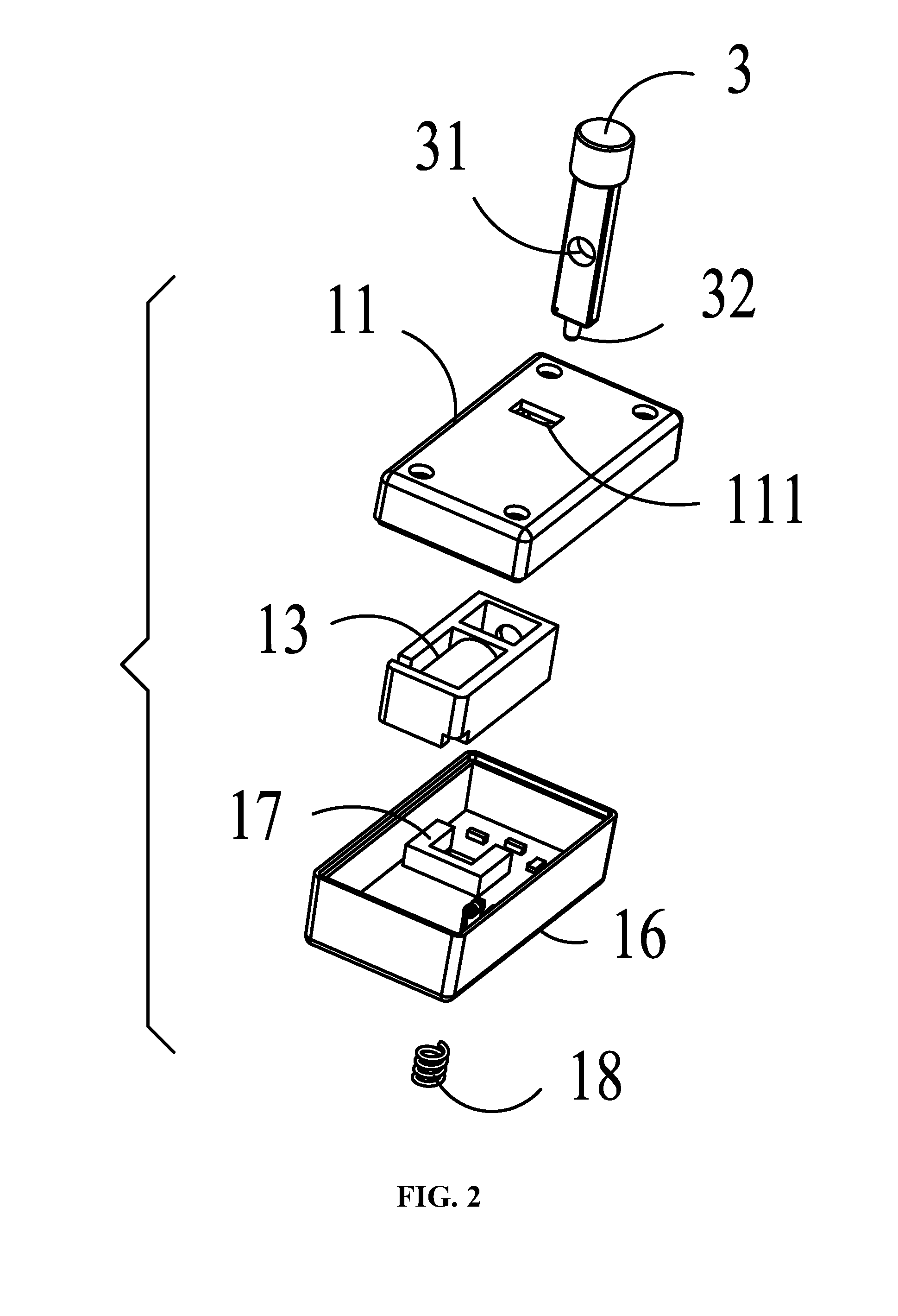
[0056]In addition, a self-test unit is added in comparison with the first embodiment. The self-test unit operates to detect whether the connecting part 3 is received in the opening 111 of the housing, and to trigger the lock tongue 12 to operate. The self-test unit comprises: a U-shaped groove 17, the U-shaped groove 17 comprises a light receiving end, and a light emitting end, a light path being formed therebetween, and a control sig...
third embodiment
[0068]As shown in FIG. 11 and FIG. 12, difference between this embodiment and the third embodiment is that, the electronic locking and sealing device comprises a cap 5 at an installation position of the bottom box 22, and a cap hole 51 is disposed on the cap 5, corresponds to a gap on the box cover 21, and covers the top of the gap of the box cover 21. The connecting part 3 extends from the cap hole 51 of the cap 5, is received in the opening 111 of the upper housing 11 in the box via the gap of the box cover 21, and enters the U-shaped groove 17 of the self-test unit, and thus obstructing a light path. At this time, the main control unit obtains a control signal, the lock tongue 12 extends and is received in the hole 31 of the connecting part. The reset spring 32 at the bottom of the lower housing 16 is compressed, the top of the connecting part 3 is fixed to the cap hole 51 of the cap, and the bottom thereof is received in the housing and blocked by the lock tongue 12, which makes...
PUM
 Login to View More
 Abstract
Description
Claims
Application Information
 Login to View More