
Methods to treat pain using an alpha-2 adrenergic agonist and an endothelin antagonist
- Summary
- Abstract
- Description
- Claims
- Application Information
AI Technical Summary
Benefits of technology
Problems solved by technology
Method used
Image

Examples
example 1
Materials and Methods
[0133]Animals: Male Swiss Webster mice weighing 25 to 30 g (Harlan, Indianapolis, IN) were used. The animals were housed five per cage in a room with controlled ambient temperature (23±1° C.), humidity (50±10%) and twelve-hour light / dark cycle (6.00 AM to 6.00 PM). Food and water were made available ad libitu Experiments were carried out after the animals had been acclimated to this environment for at least 4 days. Animal care and use for experimental procedures were approved by the Institutional Animals Care and Use. All anesthetic and surgical procedures were in compliance with the guidelines established by the Animal Care Committee.
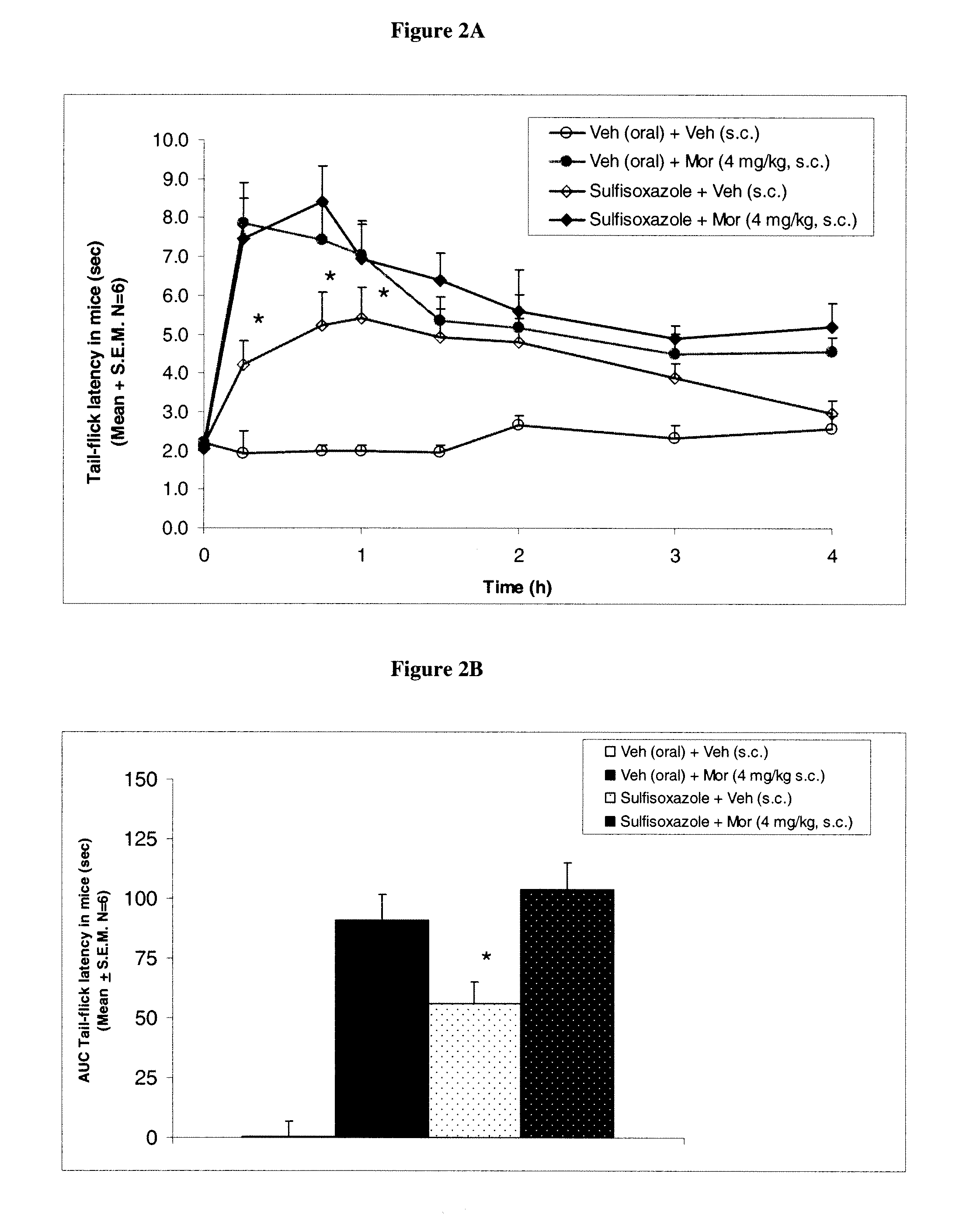
[0134]Drugs: Morphine sulfate (Mallinckrodt Chemical Co., St. Louis, Mo.) was dissolved in distilled deionized pyrogen-free water and injected subcutaneously (s.c.). Sulfisoxazole, 4-amino-N-(3,4-dimethyloxazol-5-yl)-benzenesulfonamide (Sigma Chemical Company, St. Louis, Mo.) was dissolved in carboxymethyl cellulose and administere...
example 2
Determination of Tail-Flick Latency
[0136]Antinociceptive response to morphine was determined by tail-flick latency method of D'Amour and Smith[10]. Application of theiinal stimulation (focused light) to the tail of an animal provoked withdrawal of the tail by a brief vigorous movement. The reaction time of this movement was recorded as tail-flick latency by using an analgesiometer. Tail-flick latencies to thermal stimulation (focused light) were determined before and at 30, 60, 90, 120, 180, and 240 min after injection of morphine or saline. A cutoff time of 10 sec was used to prevent damage to the tail. Tail flick latency values were subtracted from the basal latency and the differential values were used to calculate the area under the curve (AUC). Antinociceptive response in each mouse was converted to AUC0→240 min and expressed as mean±S.E.M.
example 3
Determination of Effect of Clonidine on Morphine Antinociception
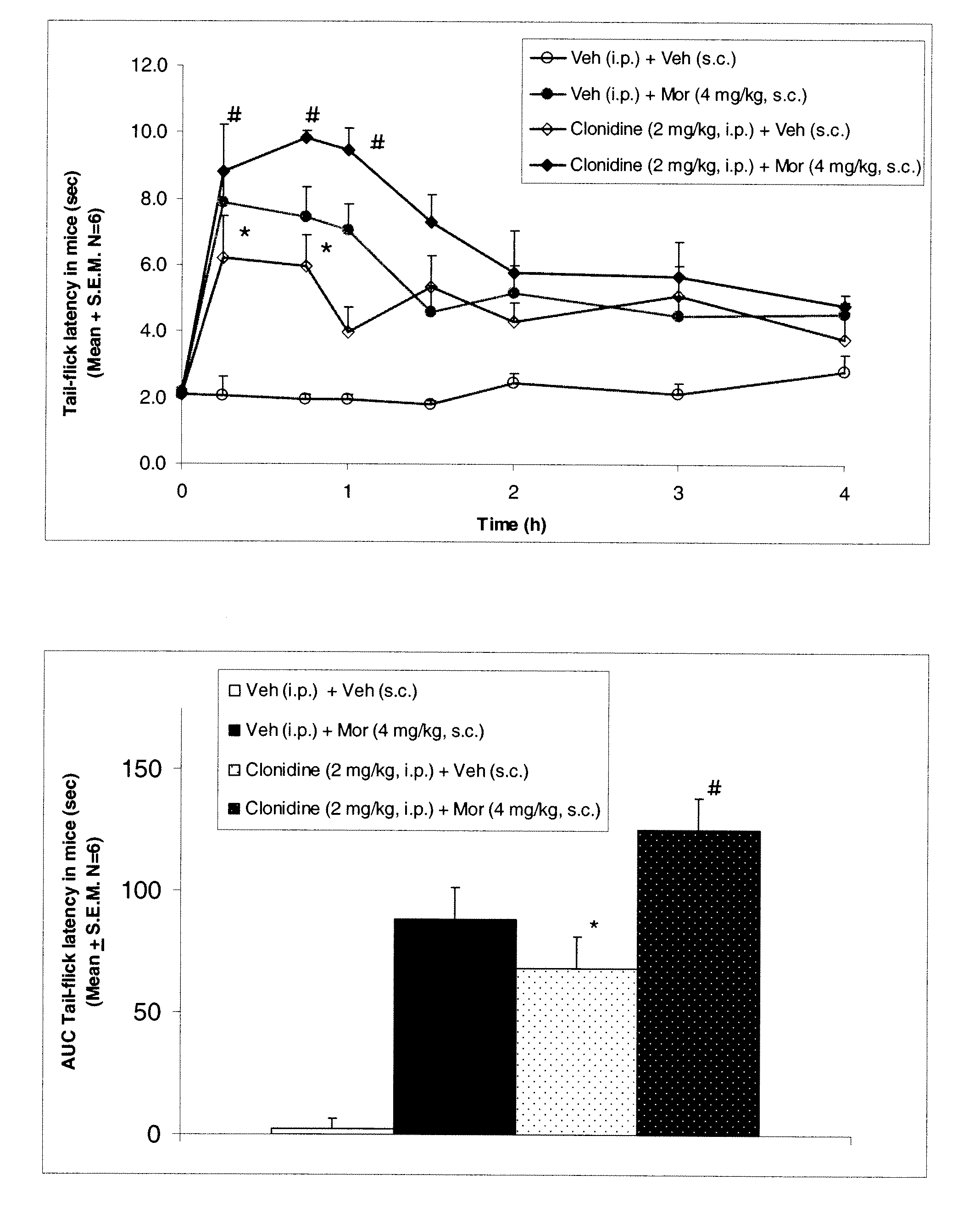
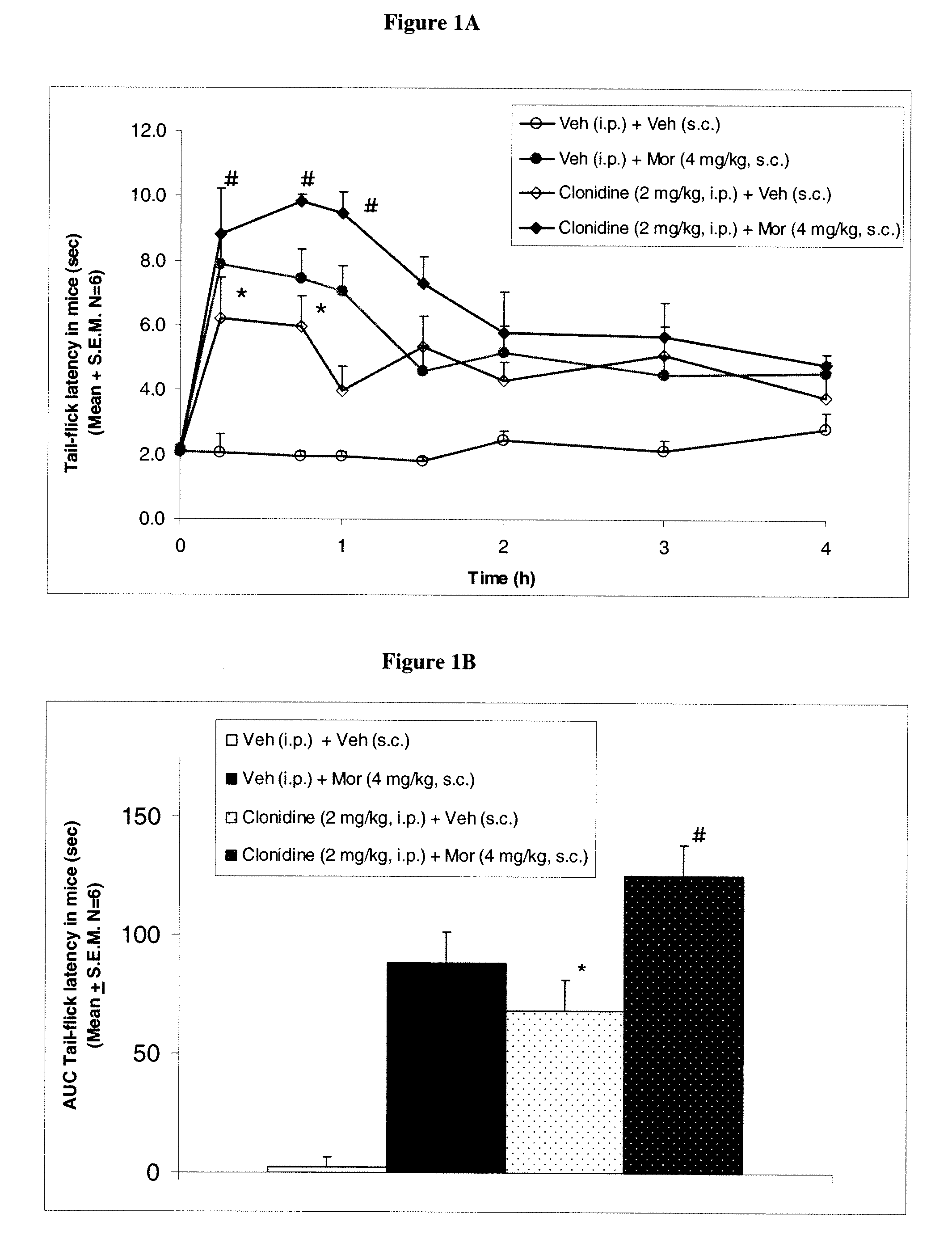
[0137]To determine the effect of clonidine on morphine induced antinociception, mice were divided into the following four groups: group 1 received vehicle (saline i.p.)+vehicle (saline s.c.); group 2 received vehicle+morphine (4 mg / kg, s.c.); group 3 received clonidine (2 mg / kg, i.p.)+vehicle (saline s.c.); and group 4 received clonidine (2 mg / kg, i.p.)+morphine (4 mg / kg, s.c.). Morphine or vehicle was administered 30 min after clonidine administration.
[0138]Baseline tail-flick latency without any drug treatment was 1.5 to 2.3 sec. In the control group (vehicle+vehicle), tail-flick latency did not change from baseline values over the duration of 4 hours. However, morphine (4 mg / kg, s.c.) produced a significant increase in tail flick latency. Clonidine (2 mg / kg, i.p.) produced an increase in tail flick latency and when morphine was administered in clonidine treated mice tail flick latency was further potentiated compared...
PUM
| Property | Measurement | Unit |
|---|---|---|
| Mass | aaaaa | aaaaa |
| Mass | aaaaa | aaaaa |
| Mass | aaaaa | aaaaa |
Abstract
Description
Claims
Application Information
 Login to View More