[0013]This embodiment relates to the discovery of a unique
rigid structure which supports, but is not limited to, three unique types of resistance devices / systems that assists in the improvement of explosive and sudden movements from a still or set position for a wide variety of athletic movements. The disclosed invention understands the need to pair an athletic movement to a resistance based exercise and allow the trainee to do so by operating the disclosed invention in the
natural environment of his or her sport while using common athletic elements which are used during competitions and practice. By applying resistance to a specific movement in the
natural environment of a sport, the trainee is able to better translate the benefits of a resistive exercise into an athletic movement because of the identical environment, features used, and technique, as well as reduced time and movement between a resistive exercise and the execution of an athletic movement.
[0015]The first device is a resistive device which applies a predetermined amount of resistance over a predetermined distance prior to releasing the trainee into an unrestrained state. The
advantage of releasing the trainee is to further build the connection between the resistive exercise and specific athletic movement by the allowing the trainee to complete a full athletic routine in the environment of the sport.
[0016]The second device, herein referenced as ‘short movement resistance
system,’ applies a predetermined amount of resistance over a predetermined distance prior to restricting the trainee from departing from the starting apparatus. The
advantage of the short movement resistance
system is that a high level of resistance can be applied to the initial ‘twitch’ of an explosive movement which relates to how quickly the trainee can engage his or her body to provide thrust. An additional
advantage of the short movement resistance
system is that the trainee can execute more initial twitch movements compared to the time it takes to do a fully executed starting motion, which involves returning to the starting location and resetting in the starting stance. The trainee will also have the advantage of performing a resistive exercise with minimal time and movement prior to a fully executed athletic routine. After the completion of the resistive exercise, the trainee simply disconnects himself or herself and is able to perform a fully and unrestrained athletic movement.
[0017]The third device is a resistive device which restricts departure from a starting apparatus until a predetermine force is generated by the trainee, in which case, the trainee can depart unrestrained. The advantage of this device is that the trainee will be required to apply large forces during the initial movements of a routine opposed to gradually increasing his or her speed. Additionally, allowing the trainee to continue his or her routine, unrestrained, further promotes the unity of a resistive exercise and a specific athletic movement from a still or set position.
[0018]A further advantage of each resistance device / system is that the trainee will naturally alter his or her
body position to attempt to overcome the excess resistance. As the trainee uses any of the aforementioned resistance devices, he or she will find the most powerful
body position and movement to which can overcome the resistance, which translates identically into the fastest and most powerful
body position and movement when the harness is no longer attached. Additionally, a
force gauge can be integrated into any of the aforementioned resistance devices / systems to discretely measure the forces generated by the trainee to more accurately determine the optimal stance and / or motion for a specific starting routine.
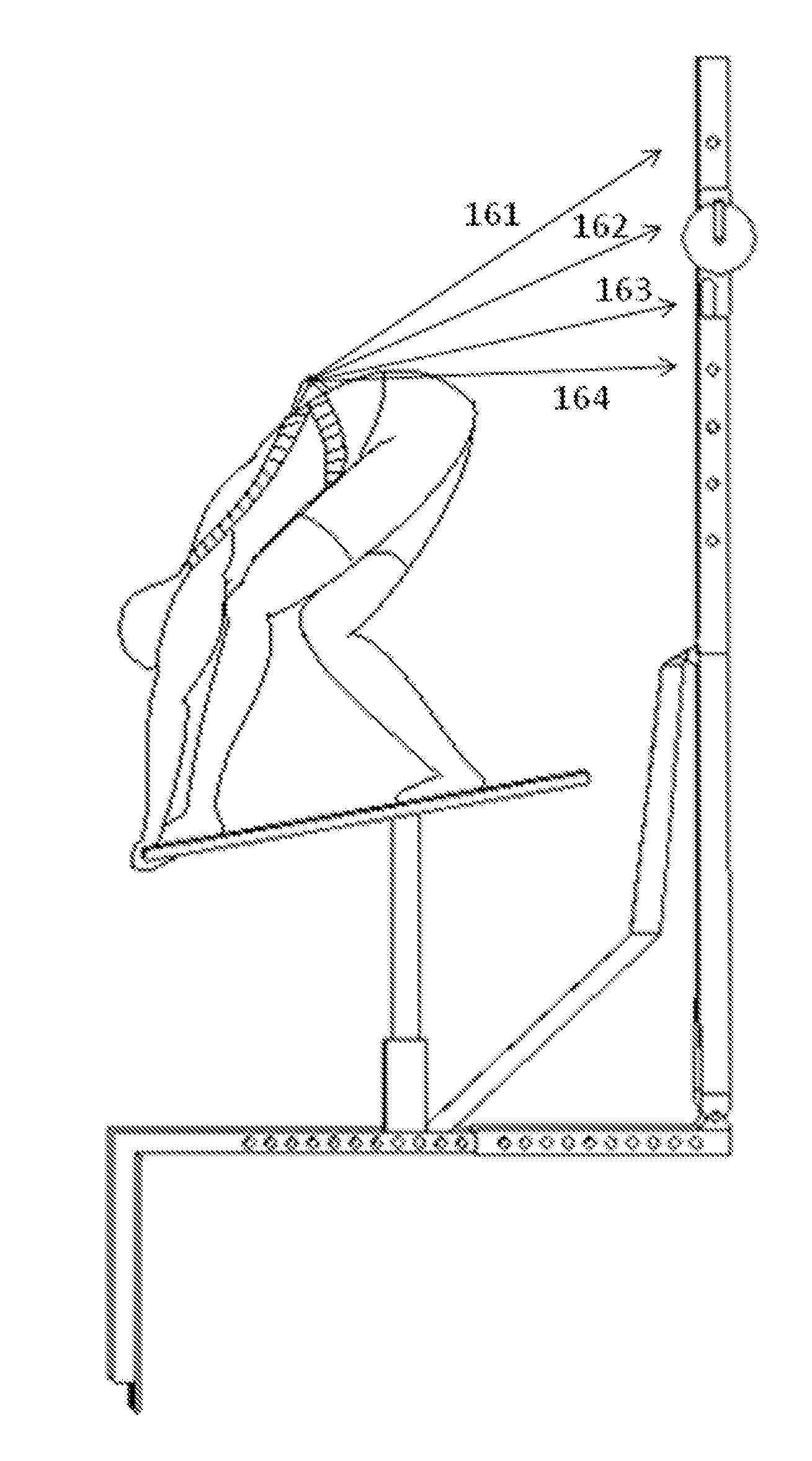
[0020]Each resistance device will be securely connected to a rigid fixture. Said rigid fixture contains various connection points for a resistive device as to allow the
vector angle of resistance to be customizable to the trainee's
body type, stance, sport, and desired direction of travel. The resistive device can be easily moved from one connection point to the next as well as interchanging from one type of resistive device to the next. The
rigid structure is designed to utilize features of the surrounding athletic environment to provide a secure base for any resistive device in a wide range of athletic venues. The
rigid structure may be specifically designed for a certain athletic environment or a versatile design may be used as long as the rigid structure acts as a secure connecting element for a resistive device.


 Login to View More
  Login to View More