Wind turbine torque-speed control

US20120027587A1Active Publication Date: 2012-02-02GENERAL ELECTRIC CO
4 Cites 10 Cited by

Patent Information

Authority / Receiving Office
US · United States
Current Assignee / Owner
Publication Date
2012-02-02

Smart Images

  • Figure 1
    Figure 1
  • Figure 2
    Figure 2
  • Figure 3
    Figure 3
Patent Text Reader

Abstract

The present subject matter relates to methods and systems for operating a wind turbine that, in some embodiments may include a gearbox. The wind turbine is provided with a blade having an adjustable pitch angle and the tip speed ratio (TSR) of the blade is monitored. In operation, the method and system is configured to increase the pitch angle of the blade concurrently with an increase in TSR to maintain turbine operation within an identified high power coefficient (Cp) operational region for the blade. TSR may be monitored by monitoring one of the velocity of the tip of the blade, wind speed, the rotational speed of the blade, or the rotational speed of a component within the gearbox.
Need to check novelty before this filing date? Find Prior Art

Description

FIELD OF THE INVENTION

[0001] The present subject matter is directed generally to wind turbines, and more particularly to a method for torque-speed control of a wind turbine.BACKGROUND OF THE INVENTION

[0002] Wind turbines have received increased attention as environmentally safe and relatively inexpensive alternative energy sources. With this growing interest, considerable efforts have been made to develop wind turbines that are reliable and efficient.

[0003] Generally, a wind turbine includes a rotor having multiple blades. The rotor is mounted to a housing or nacelle, which is positioned on top of a truss or tubular tower. Utility grade wind turbines that are designed to provide electrical power to a utility grid can have large rotors (e.g., 30 or more meters in length). In addition, wind turbines are typically mounted on towers that are at least 60 meters in height. Blades on these rotors transform wind energy into a rotational torque or force that drives one or more generators that m...

Examples

Embodiment Construction

[0021]Reference now will be made in detail to embodiments of the invention, one or more examples of which are illustrated in the drawings. Each example is provided by way of explanation of the invention, not limitation of the invention. In fact, it will be apparent to those skilled in the art that various modifications and variations can be made in the present invention without departing from the scope or spirit of the invention. For instance, features illustrated or described as part of one embodiment can be used with another embodiment to yield a still further embodiment. Thus, it is intended that the present invention covers such modifications and variations as come within the scope of the appended claims and their equivalents.

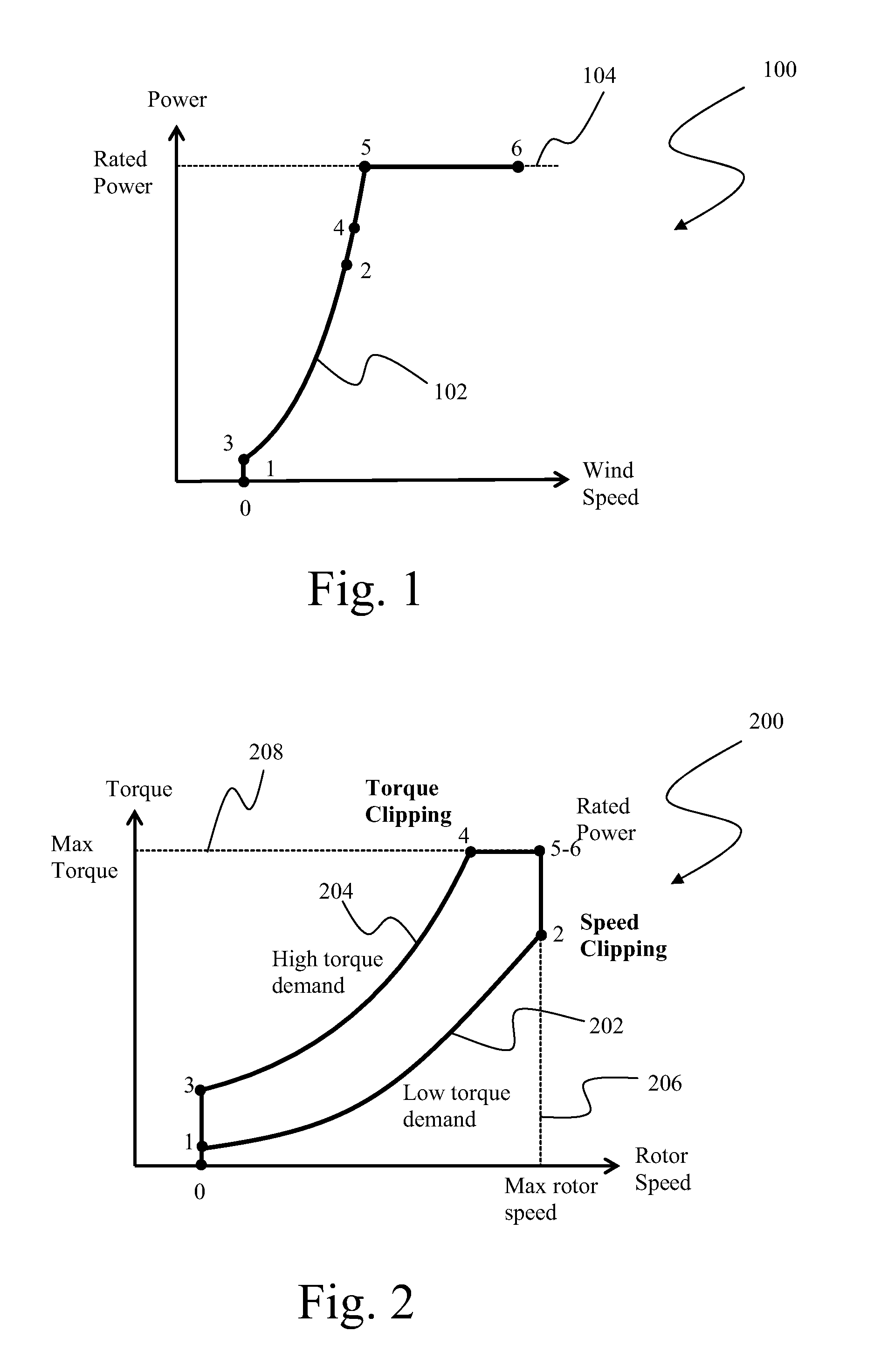
[0022]Reference will now be made in detail to the presently preferred embodiments of the subject wind turbine torque-speed control method and system. Referring now to the drawings, FIG. 1 illustrates a typical operating power curve 100 for a wind turbine. A...