Unlock instant, AI-driven research and patent intelligence for your innovation.

Synthesis of Highly Fluorescent GSH-CDTE Nanoparticles (Quantum Dots)

a synthesis method and quantum dots technology, applied in the field of synthesis of quantum dots, can solve the problems of reducing the quantum yield, affecting the stability of the gsh-cdte nanoparticle, and affecting the fluorescence and solubility of the nanoparticle,

Inactive Publication Date: 2013-10-31
UNIV DE SANTIAGO DE CHILE
View PDF0 Cites 4 Cited by
  • Summary
  • Abstract
  • Description
  • Claims
  • Application Information

AI Technical Summary

Benefits of technology

The present invention describes a method for synthesizing quantum dots (QDs) using a low-temperature, aqueous process, which is efficient, safe, and environmentally friendly. The method involves the use of a precursor mixture of tellurium oxyanions and cadmium salts, as well as the reducing agent glutathione (GSH). The resulting QDs have a size range of 3-6 nm in diameter, with a quantum yield of up to 30%. The method can be carried out at different pHs, temperatures, and concentrations of precursors. The produced QDs display good stability, high solubility, and can be used in various applications such as electronics, solar cells, and biomedicine. The method is also more cost-effective and efficient than previous methods.

Problems solved by technology

However, notwithstanding that the addition of these shells allows getting better QDs properties, it could affect some other properties due to the possibility of increasing nanoparticle size and / or agglomeration, affecting their stability, fluorescence and solubility.
On the other hand, sometimes the shell affects fluorescent properties, drastically reducing the quantum yield.
However, their application to biological systems is complex because of nanoparticle hydrophobic characteristics.
A relevant characteristic of these methods is the use of NaHTe as Te donor, a requirement to produce the Te-2 precursor, which is highly unstable and requires using special equipment.
When using H2Te, the synthesis procedure also requires many safety conditions, since this molecule is a highly toxic gas.
Nevertheless, citrate salts must be added in the process to avoid CdTeO3precipitation, and therefore the procedure is not efficient.
Finally, and as mentioned above, the use of a strong reducing agent as NaBH4, and the application of high temperatures, reflux conditions and the condensation of the synthesis mixture, are essential conditions in the method difficulting the synthesis, purity, and putative product applications
As a difference with the protocol of the present application, the authors of this document, D2, declare that an essential feature of their methods the use of a strong reducing agent such as NaBH4, as well as high temperatures, reflux conditions and condensation of the synthesis mixture, making the synthesis difficult, decreasing the purity and eventual use of the products.

Method used

the structure of the environmentally friendly knitted fabric provided by the present invention; figure 2 Flow chart of the yarn wrapping machine for environmentally friendly knitted fabrics and storage devices; image 3 Is the parameter map of the yarn covering machine
View more

Image

Smart Image Click on the blue labels to locate them in the text.
Viewing Examples
Smart Image
  • Synthesis of Highly Fluorescent GSH-CDTE Nanoparticles (Quantum Dots)
  • Synthesis of Highly Fluorescent GSH-CDTE Nanoparticles (Quantum Dots)
  • Synthesis of Highly Fluorescent GSH-CDTE Nanoparticles (Quantum Dots)

Examples

Experimental program
Comparison scheme
Effect test

Embodiment Construction

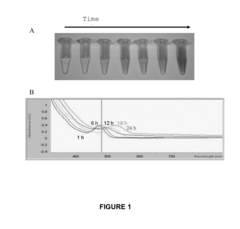
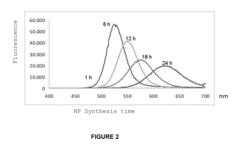
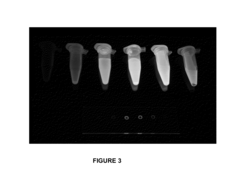
[0042]The synthesis of nanoparticles (NPs) or quantum dots (QDs) of CdTe-GSH in aqueous phase is conducted following this protocol:[0043]An aqueous CdCl2 solution is prepared (it can be any other salt of Cd+2 salt, such as cadmium sulphate, acetate or per-chlorate) up to a final concentration of 4 mM, in 50 ml 15 mM citrate buffer (it can be also Tris-HCl, phosphate, borax citrate Luria Bertani bacterial culture media or M9, among others), at pH9 (the pH may vary in the range of pH 9-13), at ambient temperature.[0044]GSH up to a final concentration of 10 mM is added, under strong stirring or agitation (avoiding the forming of a white precipitate of Cd°).[0045]After 5-10 minutes ( ) a tellurium oxyanion is added as K2TeO3 (or Na2TeO3) at a final concentration of 1 mM. The component ratio in the final synthesis mixture CdCl2: GSH: K2TeO3 is 4:10:1, (however, the synthesis also allows other ratios as 1:2:1, and 6:10:1). At this stage, the solution turns to a light green color, which is...

the structure of the environmentally friendly knitted fabric provided by the present invention; figure 2 Flow chart of the yarn wrapping machine for environmentally friendly knitted fabrics and storage devices; image 3 Is the parameter map of the yarn covering machine
Login to View More

PUM

No PUM Login to View More

Abstract

The invention relates to a method for the synthesis of glutathione-capped cadmium-telluride (GSH-CdTe) quantum dots in an aqueous medium, including the steps of: a) preparing a precursor solution of cadmium in a citrate buffer; b) adding glutathione (GSH) to the preceding mixture via strong agitation; c) adding a telluride (potassium or sodium telluride) oxyanion as a telluride donor to the preceding mixture; d) allowing the preceding mixture to react; and e) stopping the reaction by incubation at low temperature.

Description

FIELD OF APPLICATION[0001]The present invention refers to a method of synthesis of quantum dots (QDs) which comprise CdTe and a gluthatione cover (GSH). The synthesis is produced at low temperatures, in the presence of oxygen, and by using biocompatible substrates. The precursors which are used in the synthesis are inexpensive compounds as tellurium oxyanions and cadmium salts, whilst the GSH is used as a stability and reducing agent. The quantum dots (QDs) can be synthesized with different buffers at different pHs, temperatures, precursor molecules and concentrations generating different sizes and spectroscopic characteristics. Nanoparticles synthesized by the described method display sizes which vary in the 3-6 nm range in diameter, with a quantum yield up to 30%. Based on these characteristics, the QDs generated by this method are useful in electronic and optoelectronic applications, solar cells, as bioprobes and in bioimaging, among many other uses.DESCRIPTION OF THE PRIOR ART[0...

Claims

the structure of the environmentally friendly knitted fabric provided by the present invention; figure 2 Flow chart of the yarn wrapping machine for environmentally friendly knitted fabrics and storage devices; image 3 Is the parameter map of the yarn covering machine
Login to View More

Application Information

Patent Timeline
no application Login to View More
IPC IPC(8): C09K11/88
CPCC09K11/88Y10S977/896Y10S977/774Y10S977/95B82Y40/00C09K11/025C09K11/883
Inventor PEREZ DONOSO, JOSE MANUELMONRAS CHARLES, JUAN PABLOOSORIO-ROMAN, IGOR ORLANDOVASQUEZ GUZMAN, CLAUDIO CHRISITAN
Owner UNIV DE SANTIAGO DE CHILE