
Novel spin hall effect magnetic-ram
a technology of magnetic-ram and three-terminal spin, which is applied in the field of three-terminal spin hall effect magnetic-randomaccess memory (mram) elements, can solve the problems of element unrecordable, information readout errors increase, value change, etc., and achieve the effect of quick switching or revers
- Summary
- Abstract
- Description
- Claims
- Application Information
AI Technical Summary
Benefits of technology
Problems solved by technology
Method used
Image

Examples
first embodiment
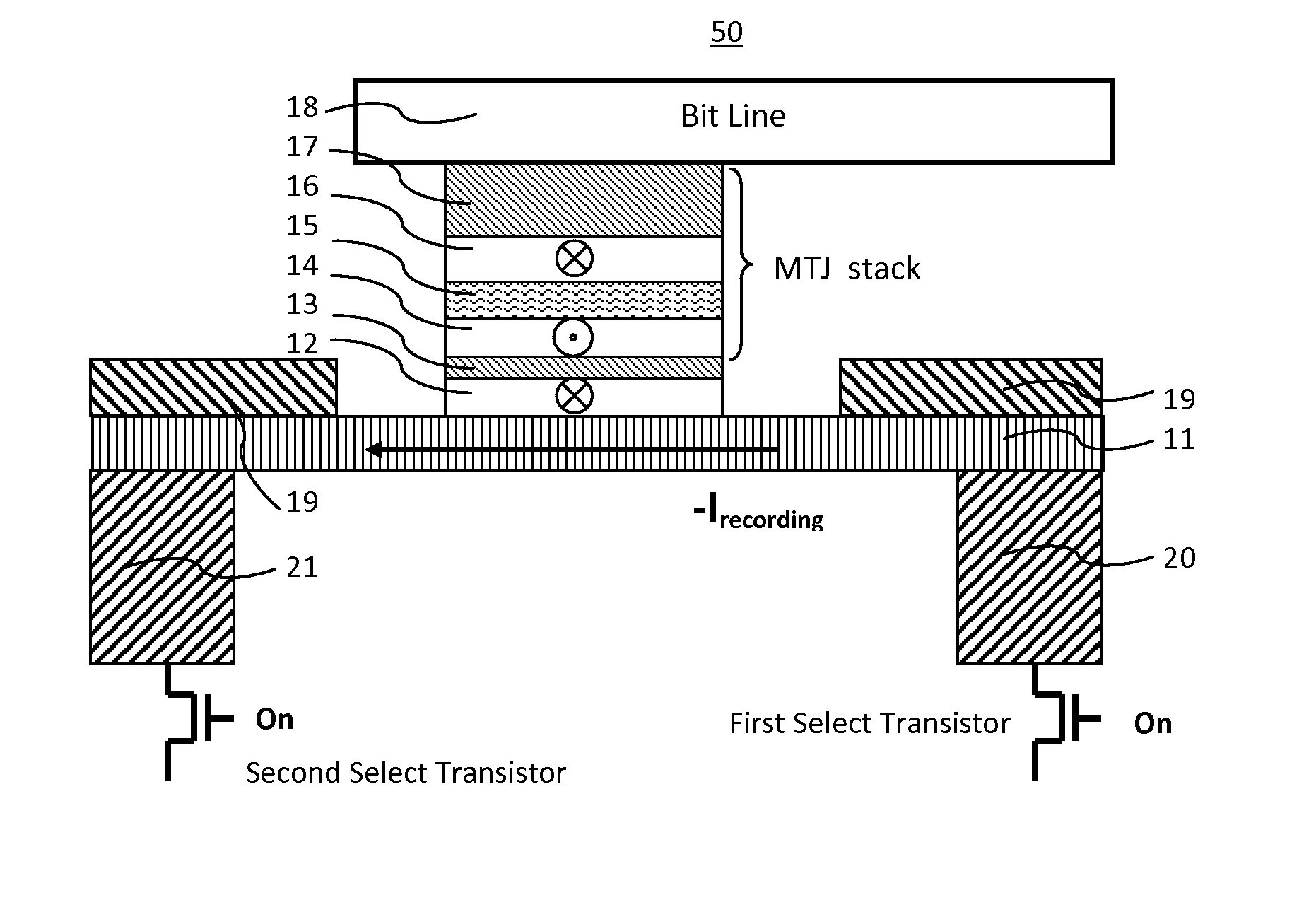
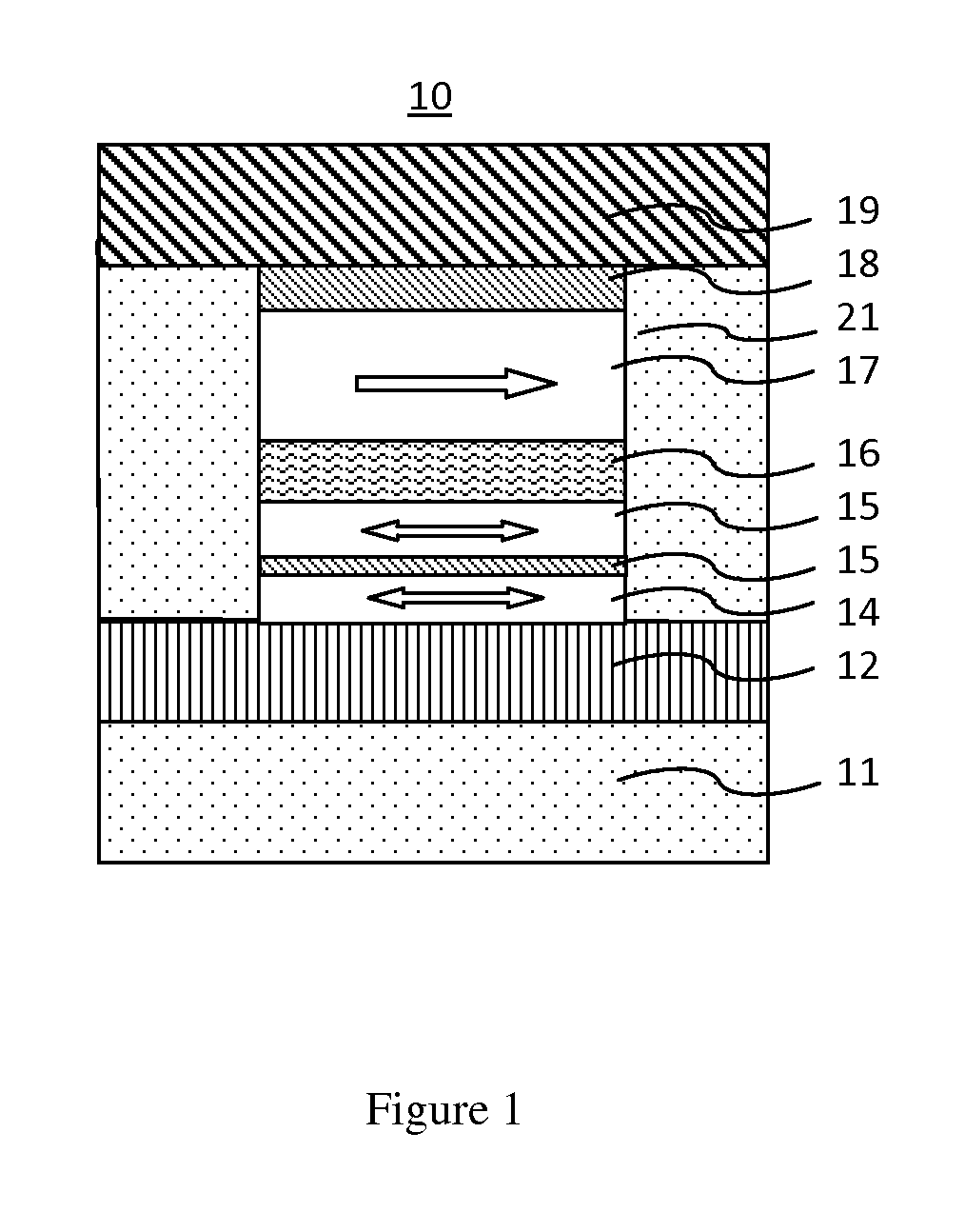
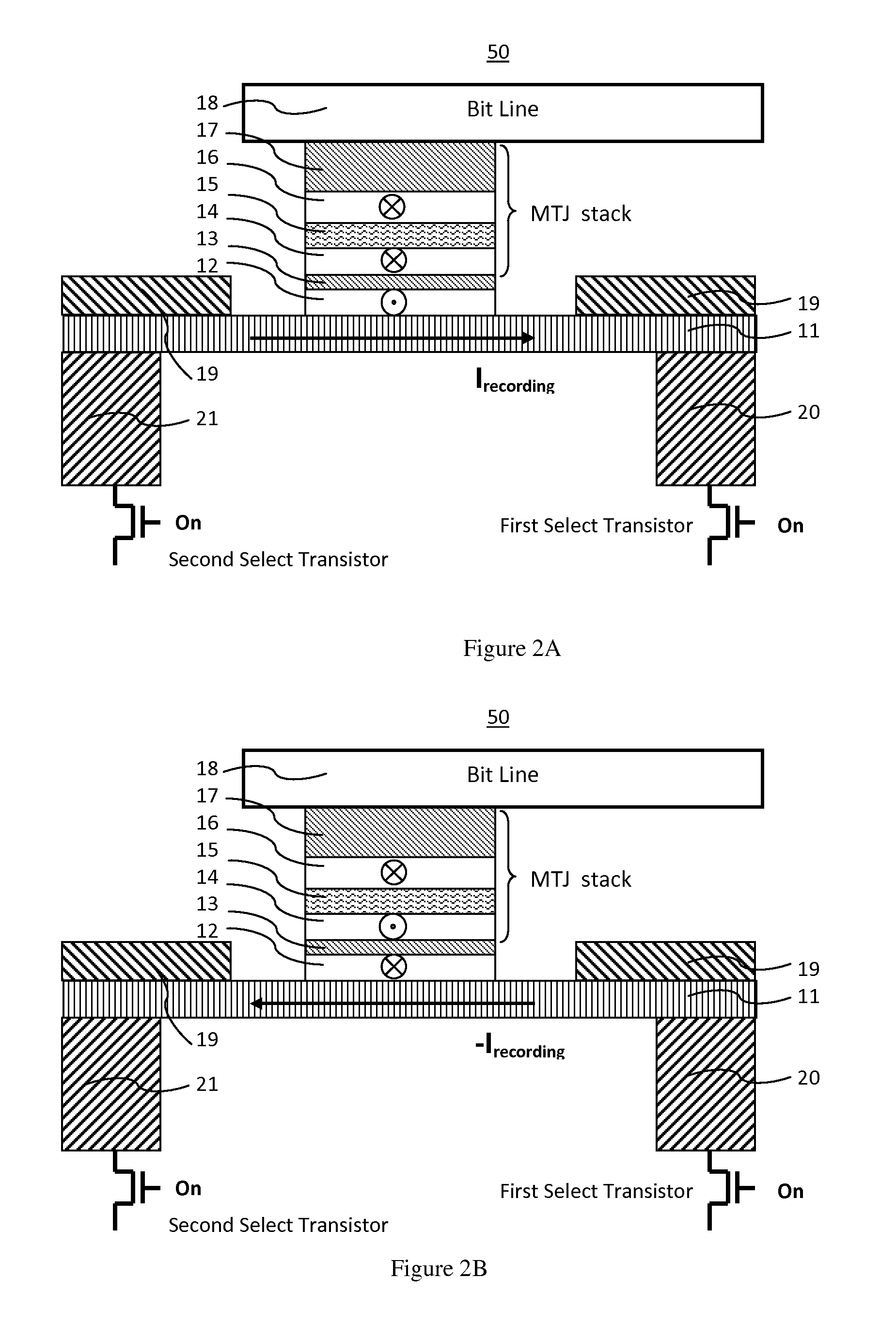
[0035]As a first embodiment, FIGS. 2A and 2B show a magnetoresistive element 50 illustrating the methods of operating a spin-transfer-torque magnetoresistive memory: a SHE spin transfer current driven recording layer magnetization to two directions in accordance with directions of a SHE current along the SHE-metal layer, respectively. A circuitry, which is not shown here, is coupled to two select transistors for providing a bi-directional current in the SHE metal layer between a first bottom electrode and a second electrode. The magnetoresistive element 50 comprises: a bit line 18, an MTJ stack comprising a cap layer 17, a reference layer 16, a tunnel barrier 15 and a recording layer 14, a non-magnetic spacing layer 13, a functional magnetic coupling layer 12, a SHE metal base layer 11, a bottom electrode conductivity enhancement layer 19, a first VIA 20 connecting a first bottom electrode and a first select transistor, a second VIA 21 connecting a second bottom electrode and a firs...
second embodiment
[0036]As a second embodiment, FIGS. 3A and 3B show magnetoresistive element 60 illustrating the methods of operating a spin-transfer-torque magnetoresistive memory: a SHE spin transfer current driven recording layer magnetization to two directions in accordance with directions of a SHE current along the SHE-metal layer, respectively. A circuitry, which is not shown here, is coupled to two select transistors for providing a bi-directional current in the SHE metal layer between a first bottom electrode and a second electrode. The magnetoresistive element 50 comprises: a bit line 18, an MTJ stack comprising a cap layer 17, a reference layer 16, a tunnel barrier 15 and a recording layer 14, a non-magnetic spacing layer 13, a functional magnetic coupling layer 12, a SHE metal base layer 11, a bottom electrode conductivity enhancement layer 19, a first VIA 20 connecting a first bottom electrode and a first select transistor, a second VIA 21 connecting a second bottom electrode and a first...
PUM
 Login to View More
 Abstract
Description
Claims
Application Information
 Login to View More