This helps you quickly interpret patents by identifying the three key elements:
Problems solved by technology
Method used
Benefits of technology
Benefits of technology
This patent text describes a technique for easily and securely sticking rubber, especially vulcanized rubber, to surfaces without needing excessive labor. Additionally, the patent describes a way to create a strong and airtight adhesion between a rubber composite and a rubber article using a coating agent. The patent also introduces a transparent coating agent that improves adhesiveness to rubber articles through photoirradiation, and a coating agent that does not use any organic solvent, which reduces environmental load. Overall, this patent offers a straightforward solution for adhesion and decoration of rubber articles.
Problems solved by technology
Heretofore, a material having a good adhesion force to a vulcanized rubber member is desired, but there is not known any material capable of realizing a sufficient adhesion force.
In addition, heretofore also desired is a coating material having good adhesiveness to a rubber article such as a tire or the like, but there is not known any material capable of realizing sufficient adhesiveness.
Method used
the structure of the environmentally friendly knitted fabric provided by the present invention; figure 2 Flow chart of the yarn wrapping machine for environmentally friendly knitted fabrics and storage devices; image 3 Is the parameter map of the yarn covering machine
View more
Image
Smart Image Click on the blue labels to locate them in the text.
Viewing Examples
Smart Image
Click on the blue label to locate the original text in one second.
Reading with bidirectional positioning of images and text.
Smart Image
Examples
Experimental program
Comparison scheme
Effect test
examples
[0184]The present invention is described in more detail with reference to Examples given below; however, the present invention is not whatsoever limited to the following Examples.
[Source Materials and Others]
[0185]As the source materials and others, the following were used.
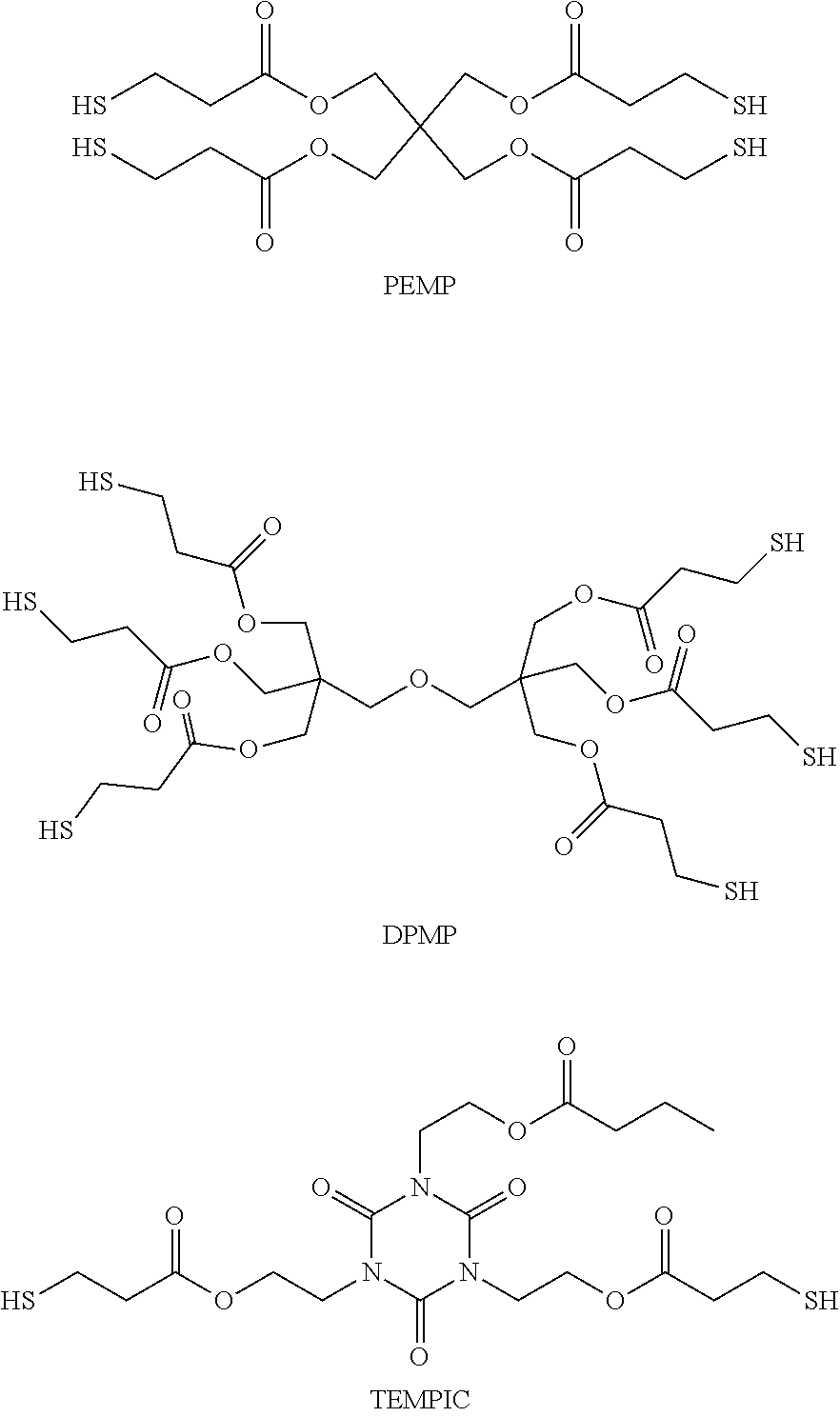
[0186]Pentaerythritol tetrakis(3-mercaptopropionate) (PEMP): manufactured by SC Organic Chemical Co., Ltd., having 4 thiol groups.
[0187]Dipentaerythritol hexakis(3-mercaptopropionate) (DPMP): manufactured by SC Organic Chemical Co., Ltd., having 6 thiol groups.
[0188]Tris-[(3-mercaptopropionyloxy)-ethyl]isocyanurate (TEMPIC); manufactured by SC Organic Chemical Co., Ltd., trade name “TEMPIC”, having 3 thiol groups.
[0189]HDI burette-modified isocyanate: manufacture by Sumitomo Bayer Urethane Co., Ltd., trade name “Desmodur N3200”, having NCO content of 23.0%.
[0190]HDI isocyanurate-modified isocyanate: manufacture by Nippon Polyurethane Industry Co., Ltd., trade name “Coronate HXLV”, having NCO content of 23.2%.
[0227]The components were formulated as shown in Table 2 below (in which the numerical value of each component means part by mass) to give a composition, and the composition was used as an adhesive.
[0228]The resultant adhesive was cured in the manner as above, and the adhesion force of the cured adhesive was measured in the manner as above. As the rubber member, used was NR / BR. The results are shown in Table 3.
[0229]In Table 2 as well as Table 4, Table 6, Table 8, Table 10 and Table 12, the thiol functional group concentration means the concentration of the thiol group (mmol / g) in the total amount of the constitutive components of the adhesive or the adhesive sheet. The NCO functional group concentration means the concentration of the isocyanate group (mmol / g) in the total amount of the constitutive components of the adhesive or the adhesive sheet. Further, the generator concentration means the concentration of the radical generator (mmol / g) in t...
[0230]As shown in Table 2, in Examples 8 to 14 and Comparative Examples 10 to 18, the same adhesives as those in Examples 1 to 7 and Comparative Examples 1 to 9, respectively, were prepared.
[0231]The adhesive was applied onto a PET-made release sheet, and kept at room temperature for 30 minutes to produce an adhesive sheet having a length of 100 mm, a width of 25 mm and a thickness of 30 μm.
[0232]The resultant adhesive sheet was cured in the manner as above, and also in the manner as above, the adhesion force of the cured adhesive sheet was measured. As the rubber member, NR / BR was used like in Example 1. The results are shown in Table 3.
the structure of the environmentally friendly knitted fabric provided by the present invention; figure 2 Flow chart of the yarn wrapping machine for environmentally friendly knitted fabrics and storage devices; image 3 Is the parameter map of the yarn covering machine
Login to View More
PUM
Property
Measurement
Unit
Ratio
aaaaa
aaaaa
Login to View More
Abstract
The present invention provides a laminate obtained by arranging a composition to be in contact with a rubber, wherein the composition is prepared by blending a polythiol compound (A), an isocyanate group-containing compound (B) and a radical generator (C), and wherein the ratio of the total molar number of the isocyanate group contained in the isocyanate-containing compound (B) to the total molar number of the thiol group contained in the polythiol compound (A) (isocyanate group / thiol group) is from 0.2 to 0.78, and provides a method for producing the laminate. The present invention thus provides a laminate, in which the rubber layer is adhered using at least one of an adhesive or an adhesive sheet capable of strongly adhering a rubber member, especially a vulcanized rubber member, and provides a laminate adhering to a rubber article using at least one of a coating agent and a coating sheet.
Description
TECHNICAL FIELD[0001]The present invention relates to a laminate and a method for producing it, and precisely relates to a laminate that comprises rubber layers adhered via an adhesive layer formed from a specific composition, or to a laminate obtained by adhering a coating agent or a coating sheet containing the composition to the surface of a rubber article.BACKGROUND ART[0002]Heretofore, a material having a good adhesion force to a vulcanized rubber member is desired, but there is not known any material capable of realizing a sufficient adhesion force. As a method of bonding a vulcanized rubber member, for example, PTL 1 discloses a technique of surface-treating a vulcanized rubber member and bonding another member to the treated surface via an adhesive therebetween.[0003]In addition, heretofore also desired is a coating material having good adhesiveness to a rubber article such as a tire or the like, but there is not known any material capable of realizing sufficient adhesivenes...
Claims
the structure of the environmentally friendly knitted fabric provided by the present invention; figure 2 Flow chart of the yarn wrapping machine for environmentally friendly knitted fabrics and storage devices; image 3 Is the parameter map of the yarn covering machine
Login to View More
Application Information
Patent Timeline
Application Date:The date an application was filed.
Publication Date:The date a patent or application was officially published.
First Publication Date:The earliest publication date of a patent with the same application number.
Issue Date:Publication date of the patent grant document.
PCT Entry Date:The Entry date of PCT National Phase.
Estimated Expiry Date:The statutory expiry date of a patent right according to the Patent Law, and it is the longest term of protection that the patent right can achieve without the termination of the patent right due to other reasons(Term extension factor has been taken into account ).
Invalid Date:Actual expiry date is based on effective date or publication date of legal transaction data of invalid patent.


 Login to View More