

Method for making customised nanoparticles, nanoparticles and uses thereof
a nanoparticle and nanoparticle technology, applied in the field of biodegradable nanoparticle production, can solve the problem of never being biodegradable, and achieve the effect of low viscosity of macromonomers and high conversion to polymers
- Summary
- Abstract
- Description
- Claims
- Application Information
AI Technical Summary
Benefits of technology
Problems solved by technology
Method used
Image

Examples
Embodiment Construction
[0039]Preferred embodiments of the invention are described in the following, wherein the description is for the purpose of illustrating the present preferred embodiments of the invention and not for the purpose of limiting the same.
Synthesis of Macromonomers:
Reactants:
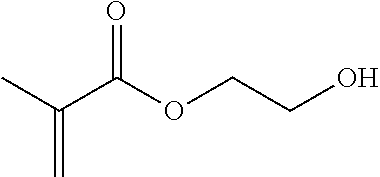
[0040]2-hydroxyethyl methacrylate (ROP initiator)[0041]Lactide (cyclic monomer)[0042]Sn(Oct)2 (FDA approved catalyst for ROP)
[0043]The bulk reaction is carried out at 130° C. At this temperature the solution is homogeneous. By varying the ratio between lactide and HEMA it is possible to produce oligomers with different lactic acid chain lengths as reported in the reaction scheme 1:
[0044]In Table A both the molecular weight (MW) of synthesized macromonomer and the relative degree of polymerization (n) determined through NMR analysis are reported. Since the aim of this invention is to produce materials suitable for bio-application, the most interesting macromonomers are those characterized by a low MW. These compounds in...
PUM
| Property | Measurement | Unit |
|---|---|---|
| particle size | aaaaa | aaaaa |
| temperature | aaaaa | aaaaa |
| temperature | aaaaa | aaaaa |
Abstract
Description
Claims
Application Information
 Login to View More