
Processes for preparing fluoroketolides
- Summary
- Abstract
- Description
- Claims
- Application Information
AI Technical Summary
Benefits of technology
Problems solved by technology
Method used
Image

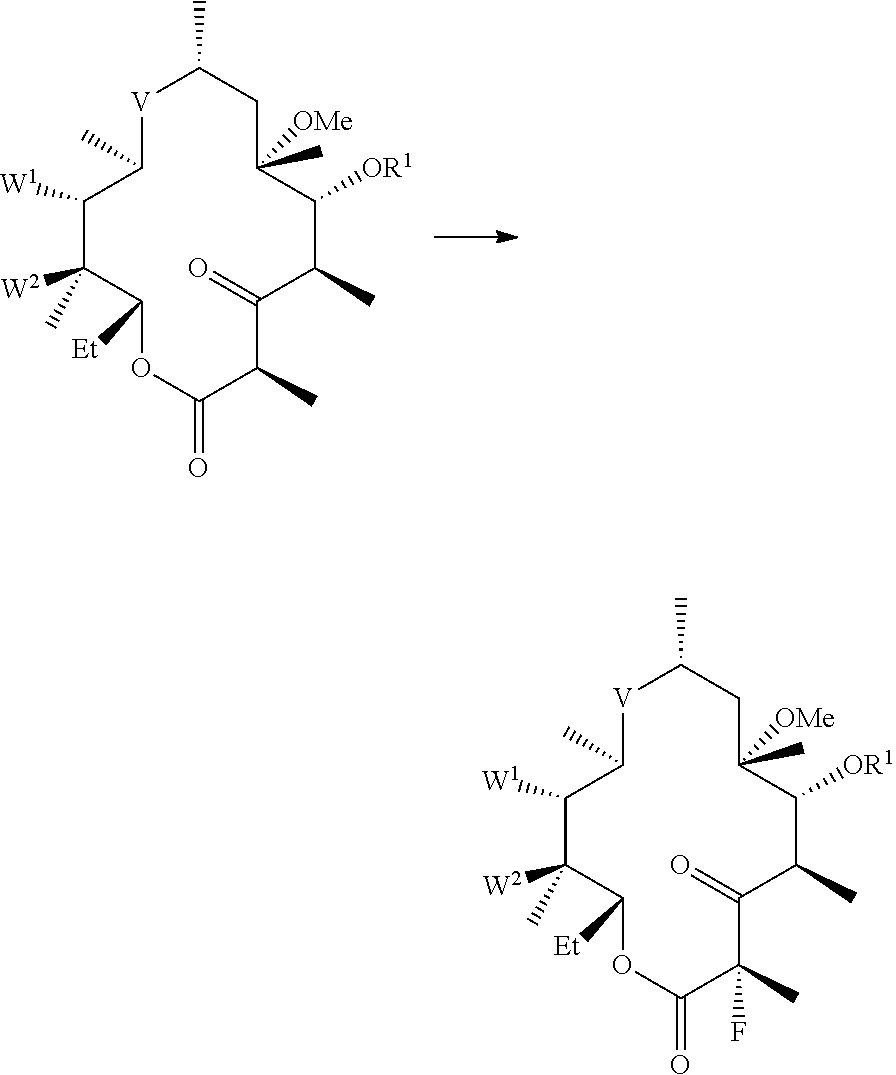
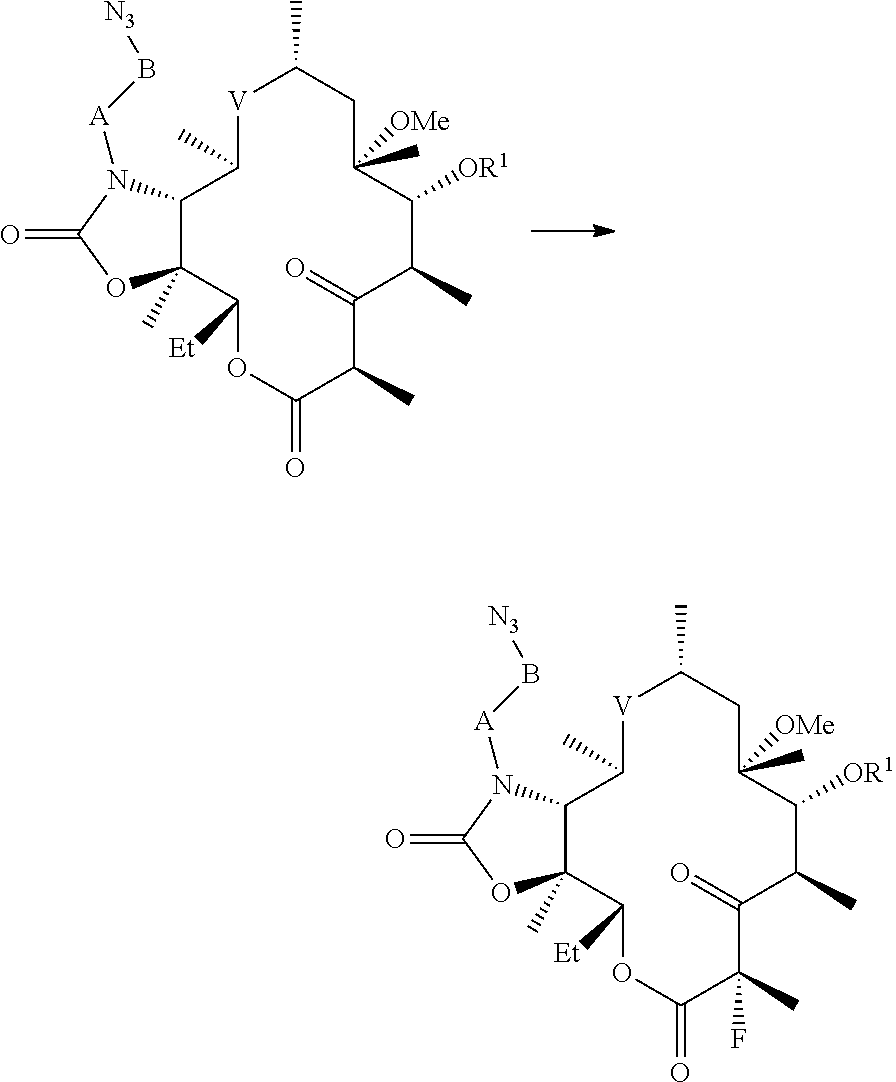
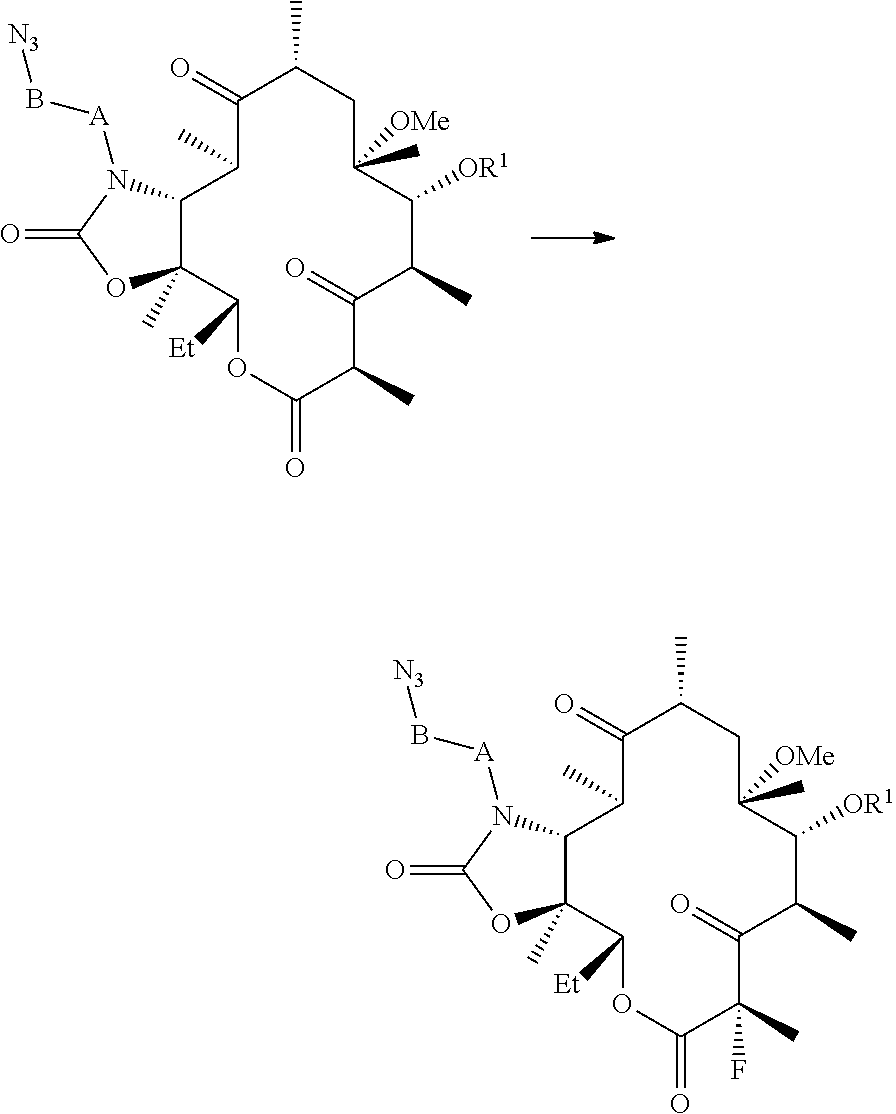
Examples
examples
[0156]
Example
[0157]General procedure for preparing fluoroketolides. A solution of starting material is cooled to a temperature in the range from about −15° C. to about −40° C. An amine base described herein (2-3 eq) is added. A fluorinating reagent (1-2 eq), or solution of a fluorinating agent is added. After acceptable or complete conversion, the reaction is quenched with water. The compound of formula (I) is isolated from the organic layer, and optionally precipitated from an alcohol / water mixture.
Example
[0158](11-N-(4-azido-butyl)-5-(2′-benzoyl-desosaminyl)-3-oxo-2-fluoro-6-O-methyl-erythronolide A, 11,12-cyclic carbamate) (CEM-276, compound (2)). CEM-275 (compound (1), 1.0 eq) is added to DMF, isopropyl acetate, or a mixture of DMF / isopropyl acetate (2-10 volumes) and stirred at ambient temperature to give a clear solution. It is to be understood that the foregoing concentrations are not critical. The solution is cooled to and maintained at −20° C. to −30° C. with stirring. DBU ...
example
[0167]The foregoing process was adapted by using NFSI and lithium tert-butoxide as the base. Conversion to (2) was incomplete with 9-11% remaining (1).
Comparative Example
[0168]The process disclosed in WO 2009 / 055557 was modified by using potassium pentoxide as the base. Conversion to (2) was very low or not observed. In addition, one or more unknown side products was formed.
Comparative Example
[0169]The process disclosed in WO 2009 / 055557 was modified by using lithium tert-butoxide as the base. Conversion to (2) was very low with 9-11% unreacted (1) remaining. In addition, unknown side products was also formed.
Comparative Example
[0170]The process disclosed in WO 2009 / 055557 was modified by using NaH as the base. Conversion to (2) was very low with significant decomposition to unknown side products.
Comparative Example
[0171]The process disclosed in WO 2009 / 055557 was modified by using Selectfluor as the fluorinating agent. Conversion to (2) was comparable with 29% unreacted (1) remaini...
PUM
| Property | Measurement | Unit |
|---|---|---|
| Electric charge | aaaaa | aaaaa |
Abstract
Description
Claims
Application Information
 Login to View More