Method and device for detecting a collision of a vehicle

US20190154530A1Inactive Publication Date: 2019-05-23ROBERT BOSCH GMBH
12 Cites 0 Cited by

Patent Information

Authority / Receiving Office
US · United States
Current Assignee / Owner
Publication Date
2019-05-23
Estimated Expiration
Not applicable · inactive patent

Smart Images

  • Figure 1
    Figure 1
  • Figure 2
    Figure 2
  • Figure 3
    Figure 3
Patent Text Reader

Abstract

A method for detecting a collision of a vehicle. In this context, at least one threshold value for determining at least one collision type of the collision, is modified, using an environmental information item, which represents an information item that is supplied by at least one surround sensor of the vehicle and is in regard to the collision, in order to obtain at least one modified threshold value. In a further step, the collision type is determined, using the modified threshold value and a non-environmental information item, which represents an information item that is in regard to the collision and is supplied by at least one acceleration and / or pressure sensor of the vehicle, in order to detect the collision.
Need to check novelty before this filing date? Find Prior Art

Description

CROSS REFERENCE

[0001] The present application claims the benefit under 35 U.S.C. § 119 of German Patent Application No. DE 102017220910.0 filed on Nov. 23, 2017, which is expressly incorporated herein by reference in its entirety.FIELD

[0002] The present invention is directed to a method and a device for detecting a collision of a vehicle. The present invention also includes a computer program.BACKGROUND INFORMATION

[0003] An air bag control unit seated on the vehicle tunnel is typically used to detect vehicle collisions. The algorithm used for detecting head-on collisions is based primarily on acceleration signals in the longitudinal direction (x-direction). Generally, the acceleration sensor is seated in the central airbag control unit on the vehicle tunnel, but may also be installed externally. In addition to this central x-sensor, further sensors are used, such as a central acceleration sensor measuring in the longitudinal direction (y-direction) or externally mounted acceleration se...

Examples

Embodiment Construction

[0037]In the description below of preferred exemplary embodiments of the present invention, the same or similar reference numerals are used for the elements that are depicted in the different figures and function similarly, in which case a repeated description of these elements is omitted.

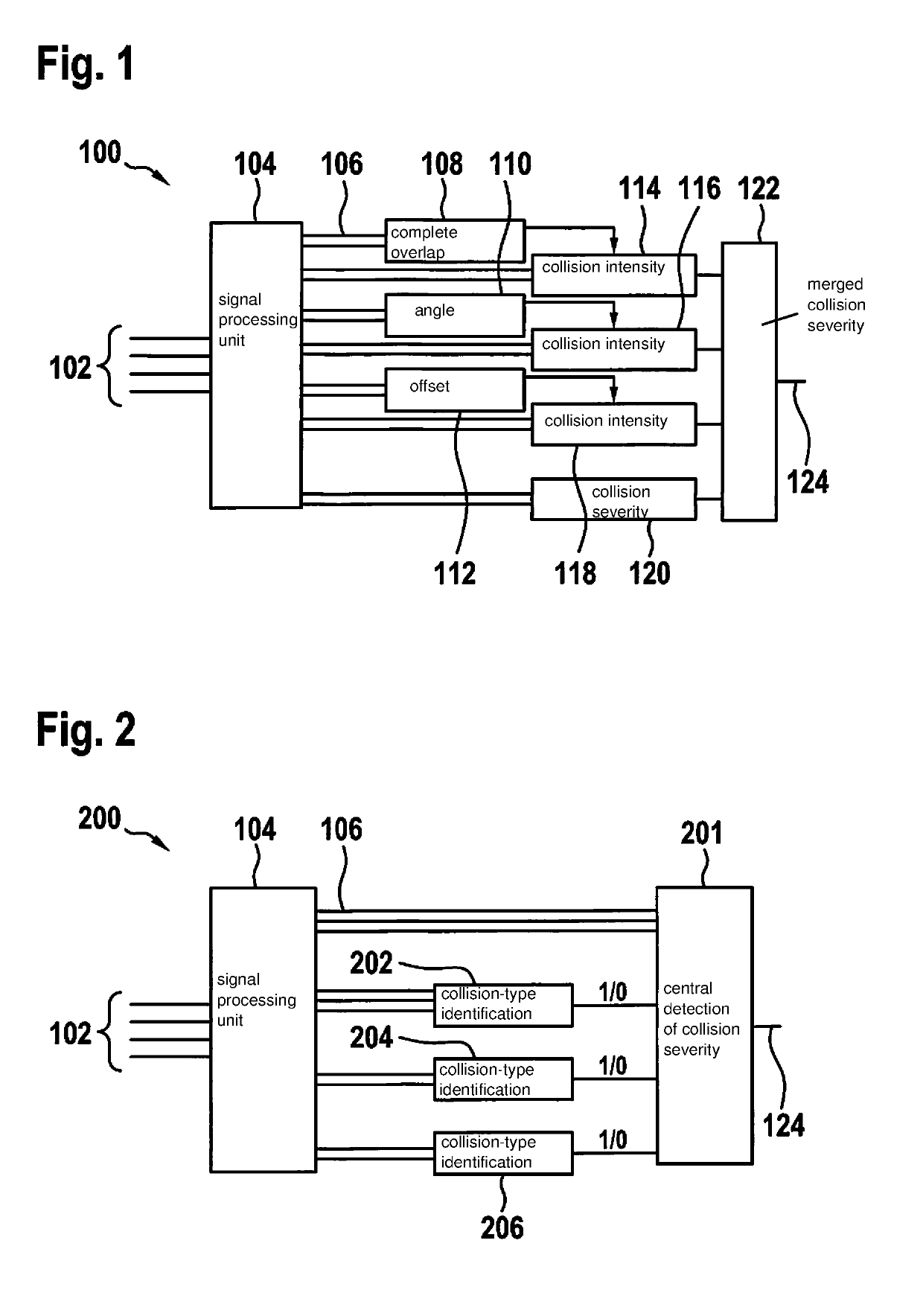
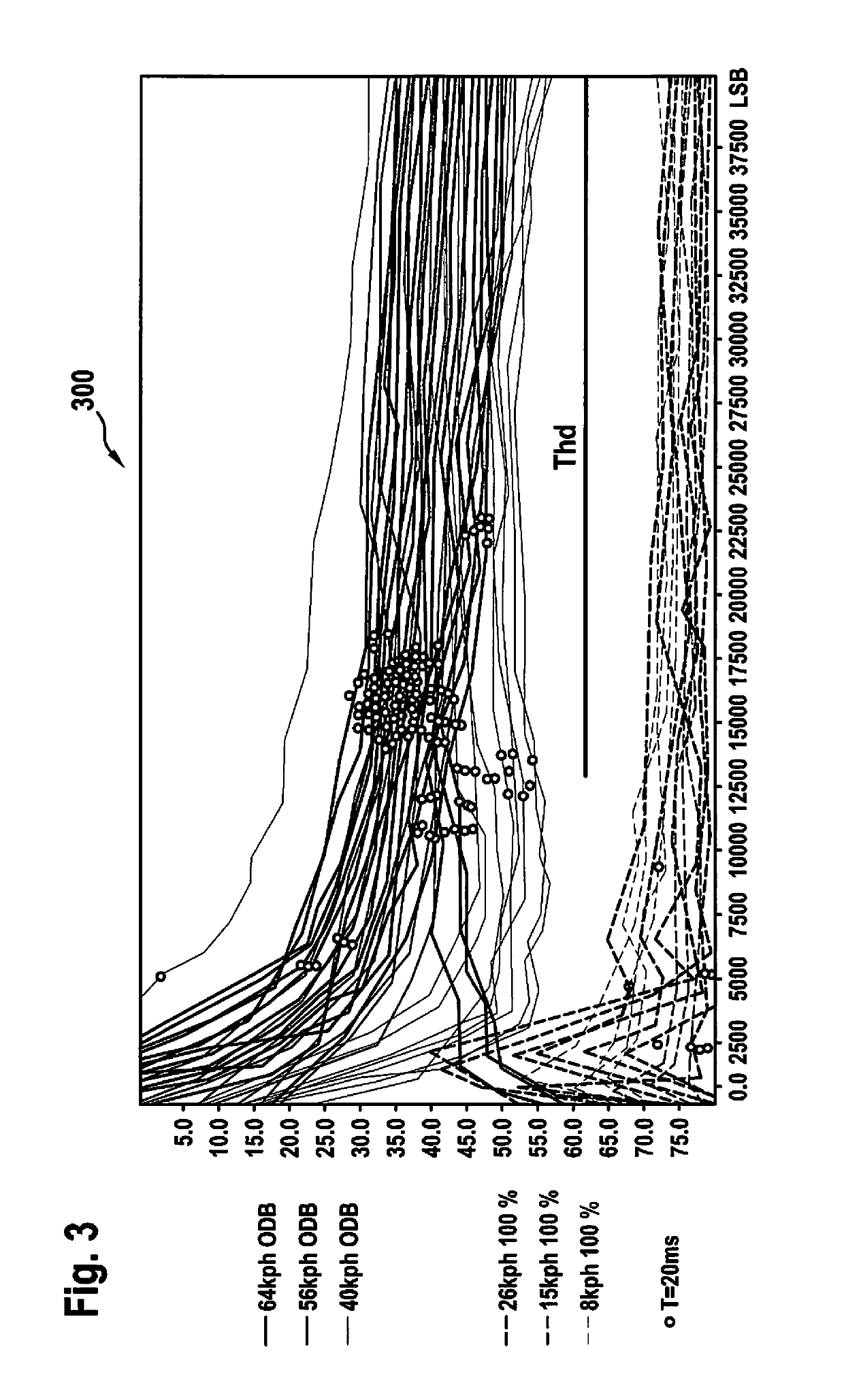
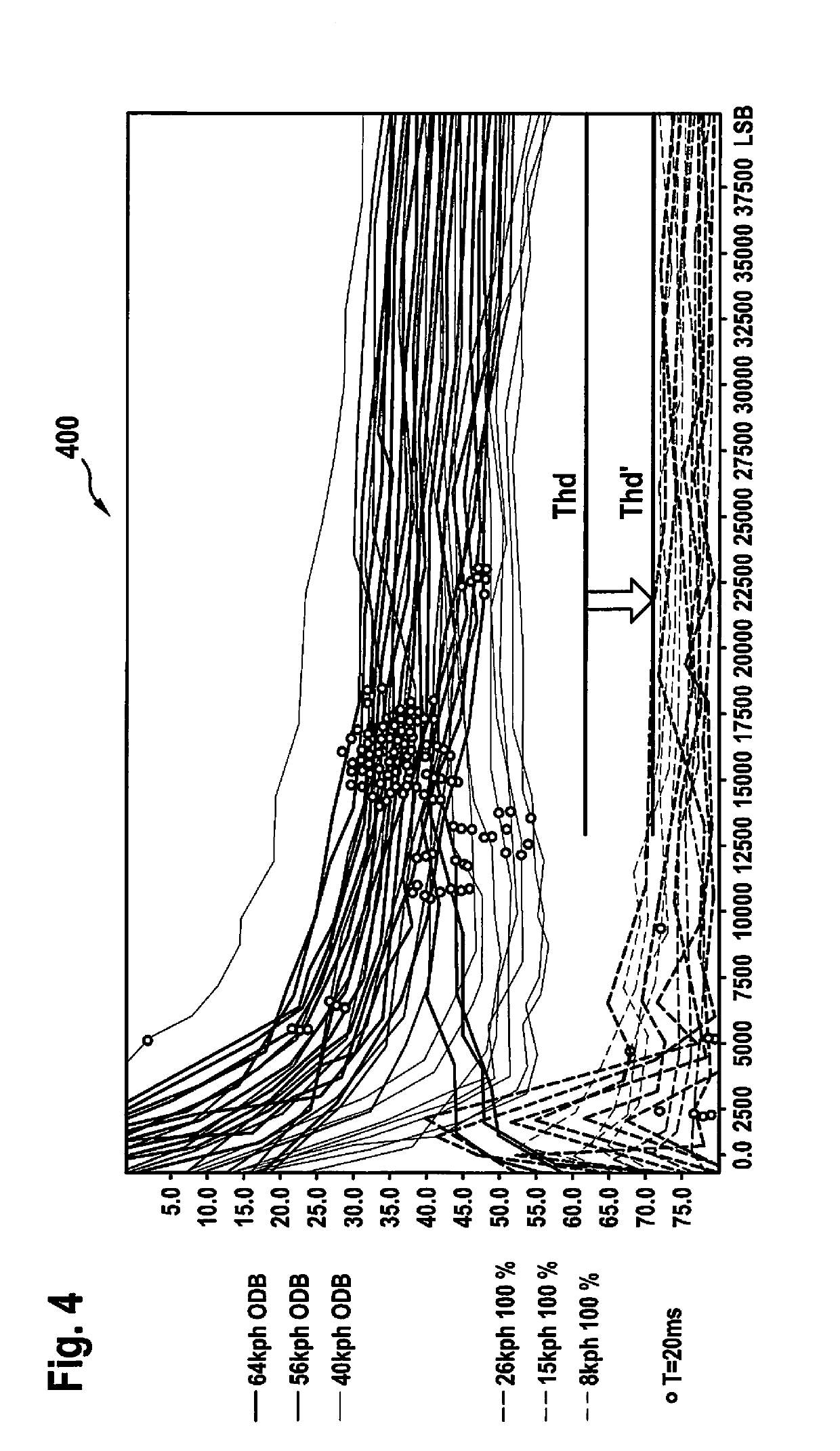
[0038]FIG. 1 shows a schematic representation of a path algorithm 100 for detecting a collision severity. As already described, existing airbag algorithms may include functions, which are for identifying the collision type, and by which the sensitivity of the evaluation of the collision severity is controlled. In principle, this may be accomplished in two ways. FIG. 1 schematically shows a so-called path algorithm. After suitable preprocessing of acceleration and pressure signals 102 by a signal processing unit 104 to form so-called signal characteristics 106, for example, by filtering or integration, then, based on a specific subset of signal characteristics, a collision-type identification is mad...