Check patentability & draft patents in minutes with Patsnap Eureka AI!

Rf-dac based phase modulator

a phase modulator and rfdac technology, applied in the direction of digital transmission, amplifier modification to reduce non-linear distortion, code conversion, etc., can solve the problem of obviating the need for a large and bulky bp

Active Publication Date: 2019-07-04
TECH UNIV DELFT
View PDF0 Cites 8 Cited by
  • Summary
  • Abstract
  • Description
  • Claims
  • Application Information

AI Technical Summary

Benefits of technology

This patent describes a new type of phase modulator for RF transmitters that has several advantages over previous designs. The RF-DAC based phase modulator has the ability to cancel out unwanted harmonics, which means it can be used without needing a large filter. It is also a more compact and easy to integrate design compared to other phase modulators. Additionally, it has a wide video bandwidth and is frequency agile, which means it can work in a variety of communication systems. Overall, this new phase modulator is well-suited for advanced communications standards and polar modulators.

Problems solved by technology

First, its harmonic rejection property in combination with its output RC LPF obviates the need for a large and bulky BPF.

Method used

the structure of the environmentally friendly knitted fabric provided by the present invention; figure 2 Flow chart of the yarn wrapping machine for environmentally friendly knitted fabrics and storage devices; image 3 Is the parameter map of the yarn covering machine
View more

Image

Smart Image Click on the blue labels to locate them in the text.
Viewing Examples
Smart Image
  • Rf-dac based phase modulator
  • Rf-dac based phase modulator
  • Rf-dac based phase modulator

Examples

Experimental program
Comparison scheme
Effect test

Embodiment Construction

[0032]Referring to FIG. 3, there is shown a radio frequency, digital-to-analog converter (RF-DAC) based phase modulator 300, according to an embodiment of the present invention. The RF-DAC based phase modulator 300 comprises a harmonic rejection RF-DAC 302, an RC low-pass filter (LPF) 304, and a limiter 306. The harmonic rejection RF-DAC 302 includes three parallel-connected in-phase / quadrature (I / Q) RF-DACs 308, 310, and 312. Each I / Q RF-DAC 308, 310, and 312 is configured to receive the same upsampled N-bit I and Q digital baseband signals IBB,UP[(N−1):0] and QBB,UP[(N−1):0], but are driven by a multi-phase set of square-wave I and Q local oscillator (LO) clocks CK0, CK45, CK90, CK135, CK180, CK225, CK270, and CK315, where each LO clock phase is shifted + / −45° with respect to its two adjacent LO clock phases. Here, “N” is a positive integer denoting the resolution of the RF-DAC based phase modulator 300. As will be explained in more detail below, the harmonic rejection RF-DAC 302 ...

the structure of the environmentally friendly knitted fabric provided by the present invention; figure 2 Flow chart of the yarn wrapping machine for environmentally friendly knitted fabrics and storage devices; image 3 Is the parameter map of the yarn covering machine
Login to View More

PUM

No PUM Login to View More

Abstract

A wideband, frequency agile, radio frequency digital-to-analog converter (RF-DAC) based phase modulator includes first, second, and third RF-DACs, each configured to upconvert an input I / Q digital baseband signal pair to a local oscillator (LO) frequency but with the first RF-DAC being driven by a first set of LO clocks, the second RF-DAC being driven by a second set of LO clocks that is forty-five degrees out of phase with respect to the first set of LO clocks, and the third RF-DAC being driven by a third set of LO clocks that is a further forty-five degrees out of phase with respect to the second set of LO clocks. First, second, and third upconverted analog signals produced by the first, second, and third RF-DACs are combined to reinforce the fundamental LO component while canceling 3rd-order and 5th-order LO harmonics.

Description

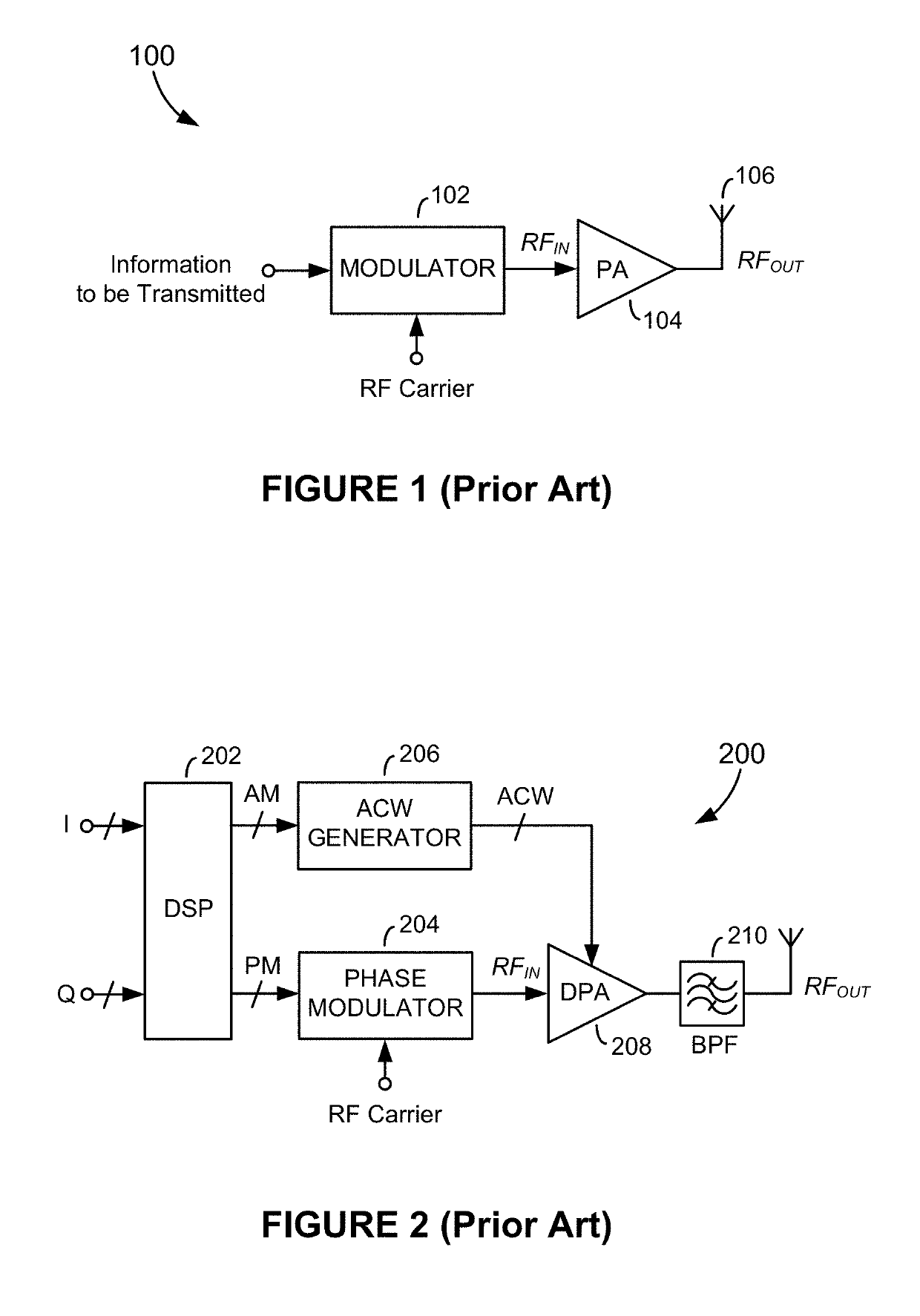
BACKGROUND OF THE INVENTION[0001]Radio frequency (RF) transmitters are used in basestations, cellular handsets, smartphones, tablets, laptops, etc. to transmit voice and / or data to RF receivers. In general, as illustrated in FIG. 1 an RF transmitter 100 is comprised of three primary components: a modulator 102, a power amplifier (PA) 104, and an antenna 106. The modulator 102 serves to modulate the voice or data to be transmitted onto an RF carrier having a frequency capable of ‘carrying’ the voice or data over the air to a remote receiver, such as a cellular base station, Wi-Fi hotspot, or Bluetooth receiver, as the case may be, and the PA 104 operates to increase the RF power of the modulated RF carrier, just prior to being radiated by the antenna 106, in order to compensate for attenuation the RF carrier experiences as it propagates to the receiver.[0002]In the interest of maximizing spectral efficiency, i.e., the data rate per given allocation of the radio frequency RF spectrum,...

Claims

the structure of the environmentally friendly knitted fabric provided by the present invention; figure 2 Flow chart of the yarn wrapping machine for environmentally friendly knitted fabrics and storage devices; image 3 Is the parameter map of the yarn covering machine
Login to View More

Application Information

Patent Timeline
no application Login to View More
Patent Type & Authority Applications(United States)
IPC IPC(8): H03F1/32H03F1/02H04B1/04H04L27/36
CPCH03F1/3241H03F1/0222H03F1/3223H04B1/0483H04L27/362H03F1/0227H03F1/0288H03F3/24H03F2200/451H03M1/662H03M1/745H03M1/747
Inventor DE VREEDE, LEONARDUS CORNELIUS NICOLAASALAVI, SEYED MORTEZAMEHRPOO, MOHAMMEDREZAPOLUSHKIN, MIKHAIL EVGENYEVICHHASHEMI, MOHSENSHEN, YIYU
Owner TECH UNIV DELFT
Features
  • R&D
  • Intellectual Property
  • Life Sciences
  • Materials
  • Tech Scout
Why Patsnap Eureka
  • Unparalleled Data Quality
  • Higher Quality Content
  • 60% Fewer Hallucinations
Social media
Patsnap Eureka Blog
Learn More